
You can feel it in your chest when the topic of retirement money comes up. Not panic, exactly—more like a quiet pressure. Bills don’t stop. Roofs still leak. Groceries still climb. And if you’re a homeowner, you’ve probably heard the phrase “reverse mortgage” whispered like it’s either a lifesaver or a trap.
But here’s the problem: clarity often comes with a cost—your phone number, your email, your name on a form that triggers a dozen follow-ups. You want numbers, not noise. You want a calm, private space to explore options. That’s where anonymous tools can change the whole experience, especially when you’re trying to understand how a reverse mortgage might fit into your life.
This guide walks you through how an anonymous calculator can help you explore estimates, questions, and next steps—without feeling like you’ve invited a sales team into your living room.
Why Privacy Changes Everything in Reverse Mortgage Research
When you’re weighing a reverse mortgage, you’re not just “shopping a product.” You’re touching something tender: your home, your independence, your future. That’s why privacy matters so much.
You might be asking yourself:
– “What if this is a bad idea, and someone talks me into it?”
– “What if I’m just curious, but now I’m on a list forever?”
– “What if I’m not ready to talk to anyone yet?”
You’re allowed to be not ready.
A reverse mortgage is complicated because it mixes emotion with math. And the moment you feel pressured, the math starts to blur. An anonymous calculator gives you breathing room—space to think clearly, privately, and at your pace.
A quick story: many people treat money research like exercise. You know you should do it, you even want to do it, but you don’t want an audience. Think about the first time you walked into a gym, unsure which machine did what. That awkwardness can be real. Now imagine the gym demanding your phone number before you can even step inside. That’s what traditional lead forms can feel like. With anonymity, you get to “warm up” without being watched.
How an Anonymous Tool Works (and What It Can—and Can’t—Tell You)
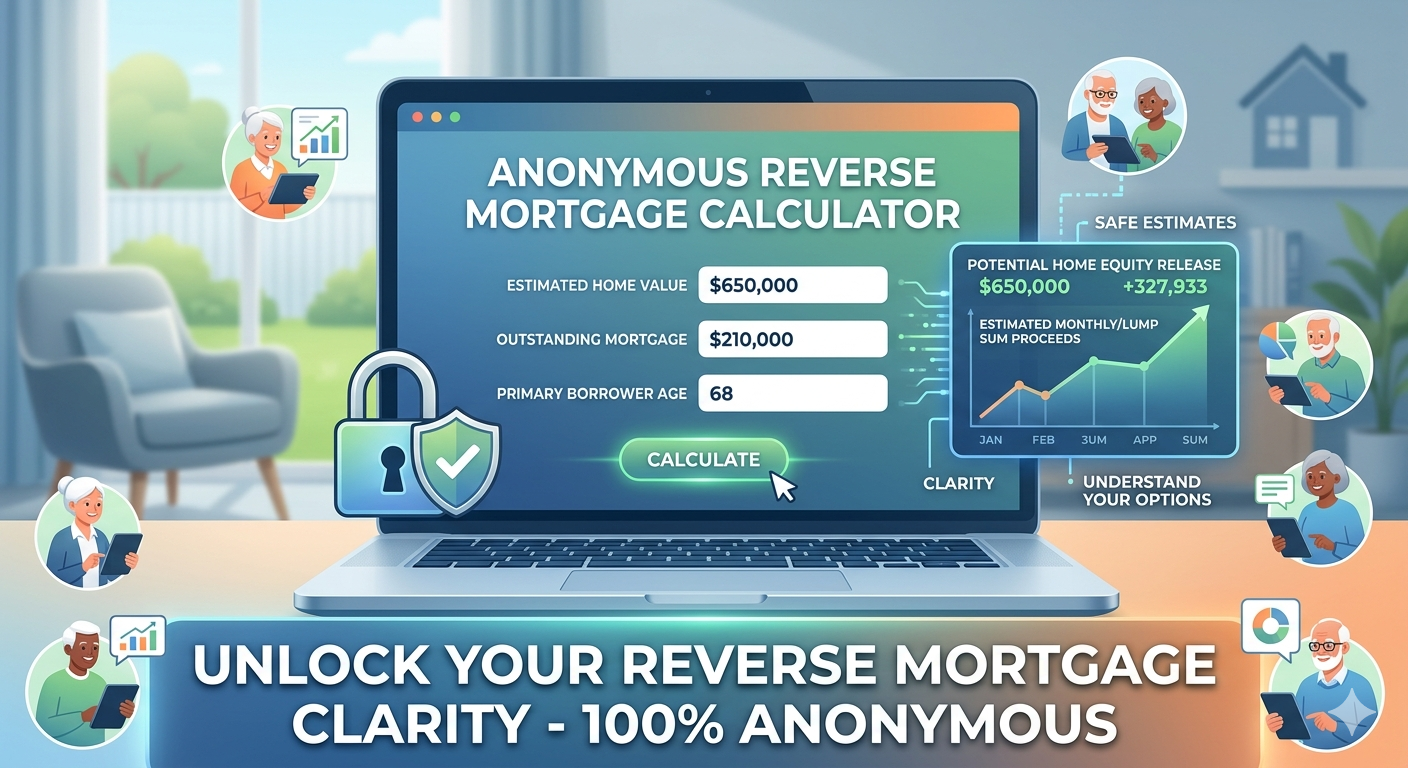
An anonymous reverse mortgage calculator typically asks for a few general inputs, such as:
– Your age (or youngest borrower’s age)
– Estimated home value
– Current mortgage balance (if any)
– ZIP code (sometimes)
– Interest rate assumptions (sometimes prefilled)
Then it generates an estimated borrowing amount or available proceeds. Not a promise. Not a contract. A starting point.
Here’s what you gain immediately:
– A rough estimate of eligibility and potential proceeds
– A way to compare “what if” scenarios (home value changes, different ages, different balances)
– Confidence to ask better questions later
Here’s what you don’t get from a calculator alone:
– A personalized loan offer
– Closing costs and lender margins nailed to the penny
– Counseling guidance (required for most reverse mortgages)
– A full plan for taxes, insurance, and long-term budgeting
This is still valuable—because the first step isn’t signing. The first step is seeing.
And yes, you can do that quietly.
Guide Step 1: Start with a reverse mortgage calculator without personal information
If you’ve ever clicked “Get Quote” and instantly regretted it, you’re not alone. You deserve a tool that doesn’t treat curiosity like consent.
When you use a reverse mortgage calculator no personal info required, you’re choosing a research-first approach. You’re gathering signals before you invite in opinions. That one boundary can completely change how safe and steady the process feels.
Look for calculators that:
– Don’t require your name, email, or phone number to display results
– Explain assumptions in plain language
– Show ranges (not just one “perfect” number)
– Let you adjust inputs easily
And as you explore, notice your own reaction. If your shoulders drop and you can finally think, that’s a sign you’re using the right kind of tool.
A small anecdote about a “century”: a homeowner once described their house as “the only thing in our family that’s lasted a century.” It had been patched, painted, and loved through generations. That’s what this decision touches—legacy, stability, memory. So of course you want to explore your options without anyone pushing you faster than your heart can handle.
Guide Step 2: Use a reverse mortgage calculator no personal info to test “what if” scenarios
Once you get that first estimate, the real magic is in the what-ifs.
Using a reverse mortgage calculator no personal info lets you experiment. You can run scenarios like:
– What if the home value is $50,000 higher than expected?
– What if you wait one more year?
– What if you pay down some of the current mortgage first?
– What if you want a lump sum vs. a line of credit?
This is where clarity gets built—one small test at a time.
Now here’s a word that fits this moment: “anonymical.” It sounds odd, almost playful—like something you’d hear in a late-night conversation where someone is trying to describe privacy but can’t quite find the right term. A reader once joked that their research was “completely anonymical—like I’m a ghost with a calculator.” And honestly? That’s the point. You get to explore as a ghost first. Then, only if you choose, you step into the room.
When you’re running scenarios, remember: calculators give estimates, not guarantees. But estimates are powerful. They turn vague anxiety into visible numbers you can respond to.
Guide Step 3: Understand the key factors behind the estimate
Even when the tool is anonymous, the logic is real. Most reverse mortgage estimates are driven by:
– Age of the youngest borrower: older often means higher potential proceeds.
– Home value: higher value can increase available funds, up to program limits.
– Interest rate environment: affects how much can be borrowed.
– Existing mortgage balance: must typically be paid off first using proceeds.
– Property type and eligibility: single-family, FHA-approved condo, etc.
Knowing these levers helps you feel less at the mercy of the results. You stop thinking, “The calculator decided.” You start thinking, “We can change the inputs and understand why.”
This is also where you can slow down and ask: what do you want the money to do?
– Cover monthly basics?
– Create a buffer for medical costs?
– Pay off debt?
– Fund home repairs so you can stay put?
The clearer your purpose, the more useful the estimate becomes.
Guide Step 4: Move from anonymous clarity to confident next steps
At some point, you may want to talk to a counselor or lender. That’s not a failure of anonymity—it’s the natural next stage.
But you’ll walk into that conversation differently if you started privately.
You’ll have:
– A realistic range in mind
– Specific questions ready
– Less fear of being steamrolled
– More ability to recognize pressure tactics