For millions of banking aspirants across India, the State Bank of India (SBI) Junior Associate exam is the gateway to a stable, prestigious career. The competition is intense, and the atmosphere at the exam centers is always a mix of high anxiety and sheer determination. If you have just stepped out of the exam hall, it is completely normal to feel a rush of adrenaline and a desperate need to know how you stacked up against the competition.
To channel that energy productively, you need facts. This comprehensive sbi clerk prelims exam analysis is designed to give you a reality check grounded in data. We have aggregated feedback from thousands of students to provide an authentic sbi clerk review, breaking down the exact questions asked, the difficulty fluctuations across shifts, and the crucial safe attempts you need to start preparing for the Mains.
Whether you are trying to predict your results or you are a future aspirant looking for a reliable roadmap, this complete sbi clerk exam analysis is your ultimate guide.
Why You Need a Reliable SBI Clerk Review
Before diving into the numbers, let us talk about why analyzing the paper is critical. The SBI Clerk exam is conducted across multiple days and multiple shifts. Because the question papers change with every single shift, the difficulty level naturally fluctuates.
Decoding Normalization: SBI uses an equi-percentile normalization method. If your shift was genuinely harder than others, your score will be scaled up. A thorough sbi clerk analysis helps you understand if you were actually in a “hard” shift or if the paper was standard.
Identifying Examiner Trends: For students in upcoming shifts, an analysis acts as a cheat sheet. It tells you exactly where the examiner is focusing—whether they are favoring Simplification in Quants or Month-based Puzzles in Reasoning.
Managing Post-Exam Anxiety: It is incredibly easy to panic if you only attempted 72 questions when your peers claim they attempted 90. A verified review grounds you in reality, showing you the actual average safe attempts rather than exaggerated claims.
Crucial Information: SBI Clerk Shift Timings
Time management begins before you even enter the exam hall. Knowing the exact schedule helps you prepare your mind and body for peak performance. The exam is typically conducted in four distinct shifts throughout the day.
Here are the standard sbi clerk shift timings you must be aware of:
| Shift Number | Reporting Time | Exam Start Time | Exam End Time |
| Shift 1 | 08:00 AM | 09:00 AM | 10:00 AM |
| Shift 2 | 10:30 AM | 11:30 AM | 12:30 PM |
| Shift 3 | 01:00 PM | 02:00 PM | 03:00 PM |
| Shift 4 | 03:30 PM | 04:30 PM | 05:30 PM |
A Candid Reminder: The gates close strictly 15 to 30 minutes before the exam starts. Latecomers are absolutely not entertained under any circumstances. Furthermore, the biometric verification process takes time, so arriving early is not just a suggestion; it is a necessity to keep your stress levels low.
The Ground Rules: Exam Pattern Refresher
To contextualize the sbi clerk exam analysis, we must look at the structure of the test. The Prelims is a test of ruthless speed and precision. You have a strict time limit, meaning question selection is just as important as conceptual knowledge.
| Section | Total Questions | Maximum Marks | Time Allotted |
| English Language | 30 | 30 | 20 Minutes |
| Numerical Ability | 35 | 35 | 20 Minutes |
| Reasoning Ability | 35 | 35 | 20 Minutes |
| Total | 100 | 100 | 60 Minutes |
Crucial Constraints to Keep in Mind:
Sectional Timing: You are locked into each section for exactly 20 minutes. You cannot jump to Quants if you finish English early.
Negative Marking Penalty: Every incorrect answer costs you 0.25 marks. Blind guessing will destroy your normalized score.
No Sectional Cut-Off: SBI only looks at your overall aggregate score. If you are weak in English but a genius in Reasoning, you can absolutely still clear the exam.
Overall SBI Clerk Exam Analysis: The Big Picture
Across all days and shifts, the overall difficulty level of the SBI Clerk Prelims exam generally hovered between Easy to Moderate.
The State Bank of India designs this preliminary phase purely as a screening mechanism. They are not testing complex, multi-layered problem-solving here—that is reserved for the Mains. They want to see your reflexes, your basic calculation speed, and your ability to remain calm under a ticking clock.
The Speed Breakers: In almost every sbi clerk review, candidates pointed out that certain Data Interpretation (DI) tables or specific flat-and-floor puzzles acted as deliberate speed breakers. The secret to a high score was the discipline to skip these time-traps immediately.
The High-Yield Zones: Simplification, Syllogism, Alphanumeric Series, and Error Spotting remained the absolute highest-scoring, lowest-effort areas across all shifts.
In-Depth Section-Wise SBI Clerk Prelims Exam Analysis
Let us break down the paper section by section to give you a granular view of the weightage, the specific topics asked, and where the major challenges were hidden.
1. Reasoning Ability: The Puzzle Heavyweight
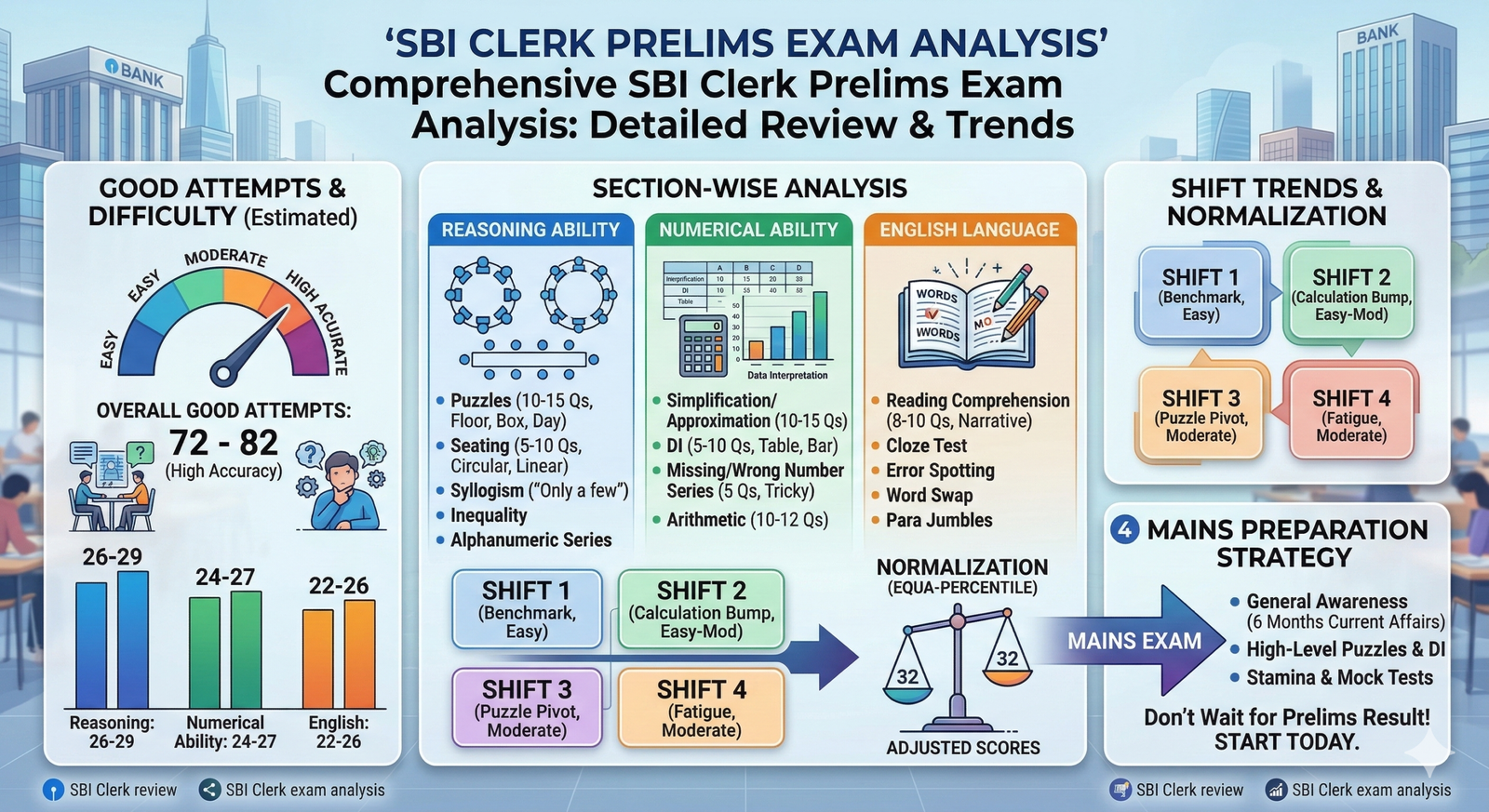
The Reasoning section tests your logical framing and deduction skills. Based on our comprehensive sbi clerk analysis, this section was consistently rated as Easy to Moderate, but it was undeniably lengthy. Puzzles and Seating Arrangements made up a massive 50% to 60% of the entire section.
Topic-Wise Breakdown:
| Topic | Number of Questions | Difficulty Level |
| Puzzles (Box, Floor, Day/Month-based) | 10 – 15 | Moderate (Time-consuming) |
| Seating Arrangement (Linear, Circular) | 5 – 10 | Easy to Moderate |
| Syllogism (Focus on “Only a few”) | 3 – 5 | Easy |
| Inequalities | 3 – 4 | Easy |
| Alphanumeric / Numeric Series | 5 | Easy (High Scoring) |
| Blood Relations | 2 – 3 | Moderate |
| Direction & Distance | 3 | Easy |
| Miscellaneous (Meaningful word, etc.) | 2 – 3 | Easy to Moderate |
Expert Insight & Strategy: The “Only a few” concept in Syllogism is now a permanent, non-negotiable fixture. Furthermore, the most successful candidates tackled the 20 minutes strategically: they hunted down Inequalities, Series, and Syllogism first (securing 10-15 marks in 5 minutes) before touching the 8-person Box Puzzles.
2. Numerical Ability: The Calculation Gauntlet
For many test-takers, Numerical Ability (Quants) triggers the most anxiety. However, the sbi clerk review reveals that the mathematics tested is strictly fundamental. The difficulty was solidly Easy to Moderate.
The defining characteristic of this section was the sheer volume of speed math.
Topic-Wise Breakdown:
| Topic | Number of Questions | Difficulty Level |
| Simplification / Approximation | 10 – 15 | Easy (Calculation intensive) |
| Data Interpretation (Table, Bar, Line Graph) | 5 – 10 | Easy to Moderate |
| Number Series (Missing / Wrong) | 5 | Moderate (Tricky patterns) |
| Quadratic Equations | 0 – 5 | Easy |
| Arithmetic Word Problems | 10 – 12 | Moderate |
Expert Insight & Strategy: Arithmetic covered standard topics: Ages, Profit & Loss, Simple/Compound Interest, Time & Work, Partnerships, and Boats & Streams. Candidates who had memorized fractional percentages (like 1/8 = 12.5%), squares up to 40, and cubes up to 20 breezed through the 15 Simplification questions in under 6 minutes. This bought them the luxury of time to solve the heavily calculative Data Interpretation sets.
3. English Language: Context over Complex Grammar
The English section is often the great equalizer. While some find it deeply intuitive, others struggle with archaic grammar rules. According to our sbi clerk exam analysis, the section was largely Easy.
SBI has shifted away from testing obscure vocabulary and is heavily leaning towards contextual understanding. If you can read a sentence and understand its tone, you can score well.
Topic-Wise Breakdown:
| Topic | Number of Questions | Difficulty Level |
| Reading Comprehension (Story/Article-based) | 8 – 10 | Easy to Moderate |
| Cloze Test | 5 – 6 | Easy |
| Error Spotting / Sentence Correction | 4 – 5 | Easy |
| Word Swap / Phrase Replacement | 4 – 5 | Easy |
| Para Jumbles / Sentence Rearrangement | 5 | Moderate |
| Fillers (Single / Double) | 3 – 4 | Easy |
Expert Insight & Strategy: The Reading Comprehensions (RCs) were mostly narrative or based on current socio-economic trends (e.g., climate change, banking digitization, or behavioral psychology). The RC usually included 2-3 direct vocabulary questions (Synonyms/Antonyms) that could be solved just by reading the surrounding sentence. The golden rule here was avoiding negative marks; skipping a confusing Para Jumble was a much smarter move than risking the 0.25 penalty.
Deep Dive: Shift-Wise SBI Clerk Analysis
Examinations are organic; they change and evolve as the day progresses. While the core syllabus remains static, the flavor and intensity of the questions shift. Here is a realistic look at how the different sbi clerk shift timings impacted the paper’s difficulty:
Shift 1: The Traditional Benchmark
The 9:00 AM morning shift is always the trendsetter. Candidates in Shift 1 consistently delivered an sbi clerk review labeling the paper as Easy. Because there is no prior analysis available for the day, examiners keep the question types highly traditional. Simplification dominates Quants, standard linear arrangements appear in Reasoning, and the English RC is usually a straightforward story.
Shift 2: The Calculation Bump
By the 11:30 AM shift, there is usually a slight bump in calculation intensity. The concepts remain foundational, but the Data Interpretation sets in Quants might feature larger numbers or require decimal calculations. Overall difficulty edges towards Easy to Moderate.
Shift 3: The Reasoning Pivot
Historically, the 2:00 PM afternoon shift begins to test a candidate’s mental stamina. Shift 3 usually features trickier, more time-consuming Reasoning sections. You are highly likely to encounter an “Uncertain Number of People” linear seating arrangement or a double-variable puzzle (e.g., 7 people + 7 different colors) that takes 4-5 minutes to decode. Overall difficulty: Moderate.
Shift 4: The Fatigue and Normalization Factor
The final 4:30 PM shift is heavily scrutinized. While the raw difficulty might mirror Shift 3, candidate fatigue is a real factor. Wrong Number Series (which takes longer to crack than Missing Number Series) tends to appear here. Candidates in this shift usually see a positive bump in their scores during the normalization process to account for the tricky variations.
Good Attempts & The Path to the Mains
“Did I attempt enough?” is the only question that matters post-exam. A “Good Attempt” is not the cut-off; rather, it is a data-backed estimate of how many questions a well-prepared candidate could solve accurately within the time limit.
Based on the complete sbi clerk prelims exam analysis, here is the safe zone (assuming a high accuracy rate of 90% or above):
| Section | Good Attempts (Estimated) | Accuracy Target |
| Reasoning Ability | 26 – 29 | > 95% |
| Numerical Ability | 24 – 27 | > 90% |
| English Language | 22 – 26 | > 85% |
| Overall Good Attempts | 72 – 82 | Excellent |
A Reality Check on Attempts: If your attempts fall within the 72–82 range, and you entirely avoided blind guessing, you are in a dominant position. However, if you attempted 65–70 questions but your accuracy is a flawless 100%, do not write yourself off. The normalization algorithm highly rewards precision, and your raw score of 68 could easily be normalized to a 74.
Understanding State-Wise Cut-Off Trends
SBI Clerk cut-offs are heavily dependent on state-wise vacancies.
High-Competition States (78+ marks): States like Uttar Pradesh, Delhi, Haryana, and Rajasthan historically see massive applicant volumes against limited vacancies, driving the cut-off sky-high.
Moderate States (70 – 77 marks): Maharashtra, Gujarat, and West Bengal generally fall in the median competitive range.
Lower-Competition States (60 – 68 marks): Certain North-Eastern and Southern states with strict local language proficiency test (LPT) requirements often see lower cut-offs.
The Next Step: Transitioning to the Mains Exam
One of the most fatal mistakes a banking aspirant makes is pausing their preparation to wait for the Prelims results. By the time SBI declares the result, you will likely have fewer than 20 days until the Mains exam. That is absolutely not enough time to memorize six months of General Awareness.
Based on our sbi clerk analysis, here is how you must pivot your strategy today:
Acknowledge the Paradigm Shift: The Mains exam is a completely different beast. It is no longer about speed; it is about deep, grueling conceptual understanding. Expect puzzles with 3 to 4 variables, and expect Data Interpretation sets based purely on Arithmetic (like Probability or Time & Distance caselets).
Conquer General Awareness: The General/Financial Awareness section carries 50 marks. It is the section that dictates who gets the job and who goes home. Dedicate a minimum of 2 hours daily to reading banking awareness, RBI circulars, and current affairs from the past 6 months.
Build Mental Stamina: The stamina required to sprint for 60 minutes in Prelims is vastly different from enduring a 2 hour and 40-minute marathon in Mains. You must start taking full-length, sectional Mains mock tests every single weekend to condition your brain.
The Battlefield: SBI Clerk Mains Exam Pattern
Before executing the plan, you must know how your time will be divided in the actual exam:
| Section | Total Questions | Maximum Marks | Time Allotted |
| General/Financial Awareness | 50 | 50 | 35 Minutes |
| General English | 40 | 40 | 35 Minutes |
| Quantitative Aptitude | 50 | 50 | 45 Minutes |
| Reasoning & Computer Aptitude | 50 | 60 | 45 Minutes |
| Total | 190 | 200 | 2 Hours 40 Minutes |
Note: Reasoning carries the highest weightage per question. General Awareness offers the highest return on time invested.
Your 30-Day Intensive Mains Masterplan
This schedule assumes you can dedicate 6 to 8 hours a day to focused study.
Week 1: Building the Mains Foundation & Historic GA
Goal: Transition from Prelims-level speed to Mains-level depth. Cover the oldest months of Current Affairs.
Financial/General Awareness (2.5 Hours):
Current Affairs: Read the monthly capsules for Month 6 and Month 5 (the oldest months from your target date).
Banking Static: Master core concepts: History of Indian Banking, Functions of RBI, Monetary Policy, and Types of Bank Accounts.
Reasoning & Puzzles (2 Hours):
Puzzles: Solve 4-5 sets of 2-Variable Seating Arrangements (e.g., 8 people in a circle + their professions).
Misc: Practice Mains-level Syllogism (Reverse Syllogism, Coded Syllogism) and Coded Inequalities.
Quantitative Aptitude (1.5 Hours):
Focus on Arithmetic-based Data Interpretation (e.g., Time & Work DI, Profit & Loss Pie Charts).
General English (1 Hour):
Read one financial editorial daily (e.g., from LiveMint or The Economic Times). Solve 2 Mains-level Reading Comprehensions.
Week 2: Increasing Variables & Mid-Term GA
Goal: Tackle highly complex data structures and cover the middle months of Current Affairs.
Financial/General Awareness (2.5 Hours):
Current Affairs: Read the monthly capsules for Month 4 and Month 3.
Banking Static: Cover Negotiable Instruments (Cheques, DDs), Basel Norms, NPA (Non-Performing Assets), and SARFAESI Act.
Revision: Take weekly quizzes on Month 6 & 5 to ensure retention.
Reasoning & Puzzles (2 Hours):
Puzzles: Shift to Floor & Flat Puzzles with an added variable (e.g., 4 floors, 2 flats, different car brands) and Box Puzzles (10+ boxes).
Misc: Practice Coded Blood Relations and Coded Direction Sense.
Quantitative Aptitude (1.5 Hours):
Master Probability and Permutation/Combination Caselets and Missing Data Tables. Practice Data Sufficiency (3 statements).
General English (1 Hour):
Focus on complex Para Jumbles (where the first/last sentence is fixed) and advanced Cloze Tests.
Week 3: Peak Complexity & Recent GA
Goal: Master the trickiest questions examiners can throw at you and secure the most recent news (which carries the highest weightage).
Financial/General Awareness (2.5 Hours):
Current Affairs: Read the monthly capsules for Month 2 and Month 1 (the most recent months).
Special Focus: Union Budget highlights, Economic Survey key points, recent RBI circulars, and major government schemes launched in the last 6 months.
Reasoning & Puzzles (2 Hours):
Puzzles: Tackle the hardest types: Day/Month/Year Puzzles with base year calculations, and Uncertain Linear Seating with variables.
Critical Reasoning: Spend 45 minutes daily on Statement & Assumption, Course of Action, and Cause & Effect. (Many candidates skip this; mastering it gives you a huge edge).
Quantitative Aptitude (1.5 Hours):
Practice High-level Number Series (where one series logic applies to a second series) and complex Quantity 1 vs. Quantity 2 questions.
General English (1 Hour):
Practice Word Swap/Usage in complex sentences, Error Spotting in paragraphs, and inference-based RC questions.
Week 4: The Execution Phase (Mock Tests & Revision)
Goal: Build mental stamina, identify skip-worthy questions, and consolidate memory.
Daily Task 1 (2 Hours 40 Mins): Take One Full-Length Mains Mock Test. Sit in a quiet room and do not pause the timer. Treat it exactly like the real exam.
Daily Task 2 (1.5 Hours): Mock Analysis. This is more important than the mock itself.
Where did you get stuck? * Did you choose the wrong puzzle? * Review every single GA question you got wrong.
Daily Task 3 (2 Hours): GA Mega-Revision. Put away new material. Rapidly revise all 6 months of MCQs, focusing heavily on banking terminologies, GDP forecasts, and RBI penalty news.
Daily Task 4 (1 Hour): Solve 2 High-Level puzzles and 1 Arithmetic DI just to keep your calculation reflexes sharp.
3 Iron-Clad Rules for Success
The “Write-it-Down” Puzzle Strategy: In Mains, never read a puzzle line-by-line and try to place variables immediately. Read the entire puzzle once, extract all the positive and negative conditions in short-hand notation on your rough sheet, and then start connecting the dots. This prevents you from re-reading a confusing paragraph five times.
GA is About Layers, Not Just Reading: Reading a 100-page PDF once will result in a zero score. You must read it, highlight it, and then take at least 3-4 different online quizzes on that specific month to actually lock the data into your memory.
The Art of Skipping: You are not supposed to attempt all 190 questions. If a blood-relation mixed seating arrangement looks like a nightmare, skip it. Finding the “Easy-to-Moderate” questions hiding among the brutally tough ones is the true test of a Mains candidate.
Stick to this regimen, and you will walk into the Mains examination hall with genuine confidence, not just blind hope.
Frequently Asked Questions (FAQs)
Q1: How accurate is the standard sbi clerk exam analysis for predicting cut-offs?
Answer: While an analysis provides a highly accurate picture of the paper’s difficulty and standard good attempts, exact cut-offs are unpredictable because they rely heavily on state-specific vacancy fluctuations and the normalization algorithm.
Q2: What happens if I attempt 88 questions but get 18 wrong?
Answer: Accuracy is everything. If you attempt 88 and get 18 wrong, your positive score is 70. However, the negative marking (18 x 0.25 = 4.5) reduces your final raw score to 65.5. Furthermore, poor accuracy can negatively impact your normalized score, pulling you further down.
Q3: Are the sbi clerk shift timings strictly followed?
Answer: Yes, absolutely. SBI is notorious for its strict adherence to timings. If the reporting time is 8:00 AM, the gates will close well before the 9:00 AM exam start time. Always aim to reach the center 30 minutes before the official reporting time.
Q4: Which section was the toughest according to the overall sbi clerk review?
Answer: Most candidates did not find any section particularly “tough,” but rather “lengthy.” Reasoning, specifically the multi-variable floor puzzles, was cited as the biggest time-consumer. In Quants, the Arithmetic word problems required deeper calculation than usual.
The prelims phase is officially behind you. Do not waste precious time overthinking your attempts or stressing about the exact decimal points of the cut-off. The real test of your endurance, logic, and comprehensive banking knowledge is the Mains examination.