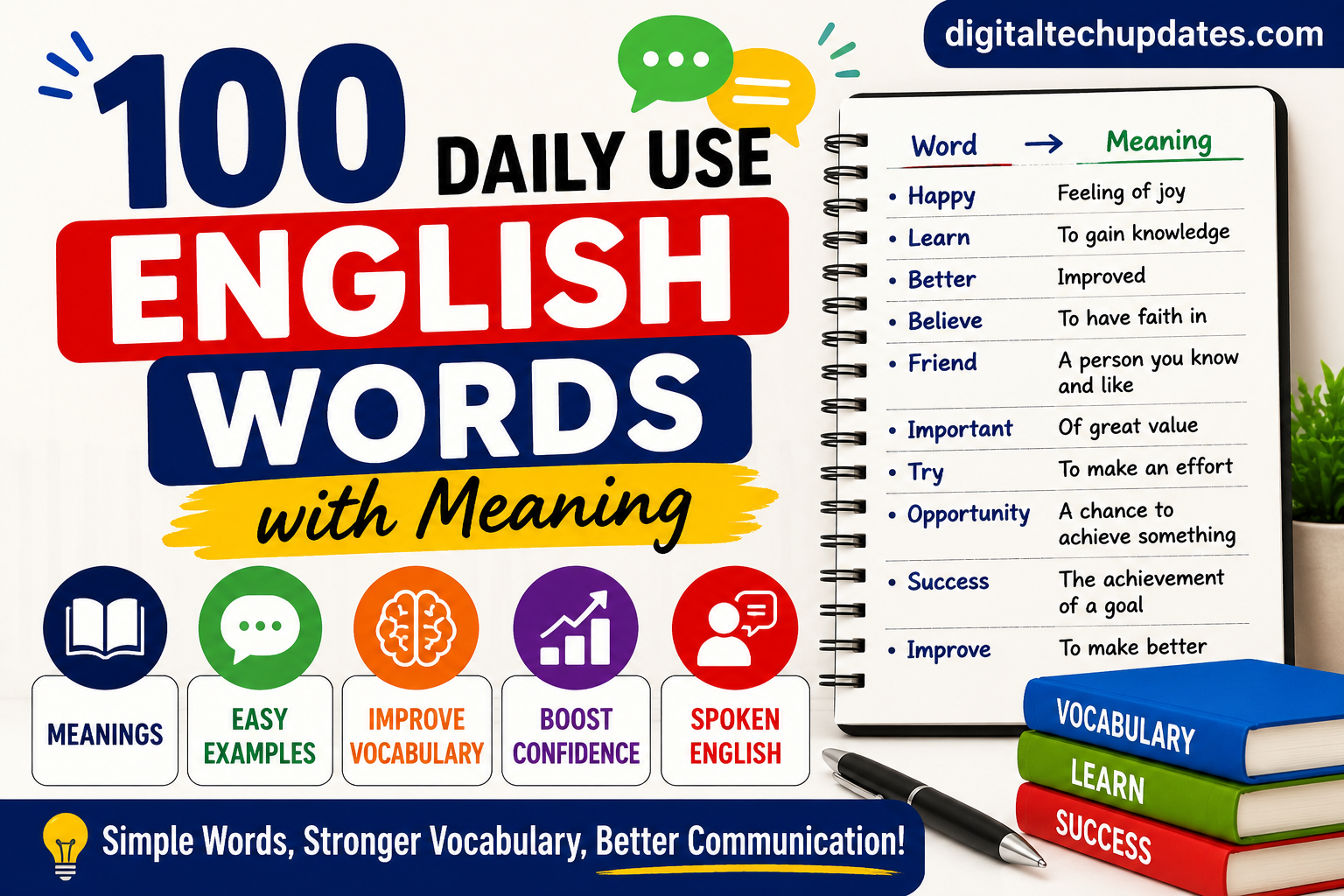
100 Daily Use English Words With Meaning: The Only List You’ll Ever Need

Have you ever frozen mid-sentence in an interview, a meeting, or even a simple conversation — searching for the right English word, but it just… wouldn’t come?
You’re not alone. Millions of people, no matter how many grammar books they’ve read, struggle with the same problem: they know English, but they don’t feel confident speaking it.
Here’s the secret nobody tells you: You don’t need 5,000 words to speak fluent English. You need the right 100.
The words we use every single day — in offices, interviews, WhatsApp chats, and casual conversations — are surprisingly limited. Master these, and you’ll notice something magical: sentences start forming on their own, confidence builds naturally, and English stops feeling like a “subject” and starts feeling like a tool you actually own.
This list is built exactly for that purpose — simple, practical, and usable from today itself. 💪
Why Learning “Daily Use” Words Works Better Than Memorizing a Dictionary
Before we jump into the list, let’s understand why this method works so well:
- ✅ High repetition — these words appear again and again in real conversations, so you remember them naturally
- ✅ Immediate usability — you can start using them today, not “someday”
- ✅ Confidence booster — using correct words in the right context builds real speaking confidence
- ✅ Interview and workplace ready — these are the exact words used in interviews, offices, and daily communication
- ✅ Great for Government job aspirants, students, and professionals preparing for English-medium interviews or exams
Now, let’s get into the words.
100 Daily Use English Words With Meaning and Example Sentences
We’ve organized these into easy-to-scan groups so your brain absorbs them faster.
Group 1: Words for Daily Conversations (1–20)
| # | Word | Meaning | Example Sentence |
|---|---|---|---|
| 1 | Achieve | To successfully complete something | She worked hard to achieve her goals. |
| 2 | Available | Free or ready to use | Is the manager available right now? |
| 3 | Believe | To accept something as true | I believe you can do it. |
| 4 | Confident | Feeling sure of yourself | He spoke confidently in the meeting. |
| 5 | Decide | To make a choice | We need to decide today. |
| 6 | Encourage | To give support or confidence | Her teacher encouraged her to try again. |
| 7 | Familiar | Well known to you | This place looks familiar. |
| 8 | Gather | To collect or bring together | Please gather your documents. |
| 9 | Handle | To manage or deal with | Can you handle this task alone? |
| 10 | Improve | To make better | I want to improve my English. |
| 11 | Journey | A trip from one place to another | Life is a beautiful journey. |
| 12 | Kind | Friendly and generous | She is very kind to everyone. |
| 13 | Manage | To control or organize | He manages a large team. |
| 14 | Notice | To observe something | Did you notice the changes? |
| 15 | Opportunity | A chance to do something | This job is a great opportunity. |
| 16 | Prepare | To get ready | I need to prepare for the exam. |
| 17 | Quality | The standard of something | This product has great quality. |
| 18 | Reliable | Trustworthy and dependable | He is a reliable friend. |
| 19 | Suggest | To recommend an idea | Can you suggest a good book? |
| 20 | Trust | To believe in someone | I trust your judgment. |
Group 2: Words for Work and Interviews (21–40)
| # | Word | Meaning | Example Sentence |
|---|---|---|---|
| 21 | Achievement | A successful result | Getting this job is a big achievement. |
| 22 | Analyze | To examine something carefully | We need to analyze the data. |
| 23 | Approach | A way of doing something | Let’s try a different approach. |
| 24 | Assist | To help someone | Can you assist me with this? |
| 25 | Candidate | A person applying for something | She is a strong candidate for the role. |
| 26 | Collaborate | To work together | Our teams collaborate on projects. |
| 27 | Deadline | The last date to finish something | The deadline is next Friday. |
| 28 | Efficient | Working well without waste | He is very efficient at his job. |
| 29 | Feedback | Opinion about performance | The manager gave positive feedback. |
| 30 | Goal | Something you want to achieve | My goal is to get promoted. |
| 31 | Initiative | The ability to act independently | She showed great initiative at work. |
| 32 | Interview | A formal meeting to assess someone | I have an interview tomorrow. |
| 33 | Motivate | To inspire action | Good leaders motivate their team. |
| 34 | Objective | A goal or aim | Our objective is to increase sales. |
| 35 | Performance | How well something is done | His performance improved this month. |
| 36 | Priority | Something treated as most important | Safety is our top priority. |
| 37 | Professional | Relating to a job, done properly | She handled it in a professional way. |
| 38 | Responsibility | A duty you are expected to handle | Honesty is my responsibility. |
| 39 | Strategy | A plan to achieve something | We need a new marketing strategy. |
| 40 | Teamwork | Working together effectively | Teamwork made the project successful. |
Group 3: Words for Emotions and Reactions (41–60)
| # | Word | Meaning | Example Sentence |
|---|---|---|---|
| 41 | Anxious | Worried or nervous | She felt anxious before the exam. |
| 42 | Ashamed | Feeling guilty or embarrassed | He felt ashamed of his mistake. |
| 43 | Brave | Showing courage | It was brave of you to speak up. |
| 44 | Curious | Eager to know something | I’m curious about your plan. |
| 45 | Delighted | Very pleased | We are delighted to meet you. |
| 46 | Disappointed | Sad because expectations weren’t met | She was disappointed with the result. |
| 47 | Eager | Very keen to do something | He is eager to learn new skills. |
| 48 | Frustrated | Annoyed because of difficulty | I feel frustrated with slow internet. |
| 49 | Grateful | Thankful | I’m grateful for your help. |
| 50 | Hopeful | Feeling positive about the future | We are hopeful about the results. |
| 51 | Jealous | Envious of someone | Don’t be jealous of others’ success. |
| 52 | Nervous | Worried or uneasy | I felt nervous before the interview. |
| 53 | Proud | Feeling satisfaction from achievement | I’m proud of your progress. |
| 54 | Relieved | Free from worry | She felt relieved after the exam. |
| 55 | Satisfied | Content with something | I’m satisfied with the service. |
| 56 | Surprised | Feeling unexpected astonishment | I was surprised by the news. |
| 57 | Sympathetic | Showing understanding for others | He was sympathetic to my situation. |
| 58 | Tense | Feeling stressed or worried | The atmosphere was tense before the meeting. |
| 59 | Thrilled | Extremely excited | I’m thrilled about the new opportunity. |
| 60 | Worried | Feeling anxious about something | She was worried about the exam result. |
Group 4: Words for Describing People and Things (61–80)
| # | Word | Meaning | Example Sentence |
|---|---|---|---|
| 61 | Ambitious | Having a strong desire to succeed | He is ambitious about his career. |
| 62 | Brilliant | Extremely intelligent or excellent | That was a brilliant idea. |
| 63 | Calm | Peaceful and quiet | She stayed calm during the crisis. |
| 64 | Creative | Having original ideas | He is a creative writer. |
| 65 | Diligent | Hardworking and careful | She is diligent in her studies. |
| 66 | Elegant | Graceful and stylish | The dress looked elegant. |
| 67 | Flexible | Able to adapt easily | Our timing is flexible. |
| 68 | Genuine | Real and sincere | He gave a genuine apology. |
| 69 | Honest | Truthful and sincere | Always be honest with yourself. |
| 70 | Intelligent | Having good understanding ability | She is highly intelligent. |
| 71 | Loyal | Faithful and devoted | He is loyal to his friends. |
| 72 | Modern | Relating to the present time | This is a modern design. |
| 73 | Optimistic | Hopeful about the future | Stay optimistic despite challenges. |
| 74 | Patient | Able to wait calmly | You need to be patient with kids. |
| 75 | Practical | Sensible and realistic | That’s a practical solution. |
| 76 | Punctual | Arriving on time | He is always punctual for meetings. |
| 77 | Sincere | Genuine and honest | She gave a sincere apology. |
| 78 | Talented | Having natural skill | She is a talented singer. |
| 79 | Unique | One of a kind | Your idea is truly unique. |
| 80 | Wise | Having good judgment | Listen to your grandfather’s wise advice. |
Group 5: Words for Everyday Situations (81–100)
| # | Word | Meaning | Example Sentence |
|---|---|---|---|
| 81 | Absolutely | Completely, totally | I absolutely agree with you. |
| 82 | Actually | In fact, really | Actually, I didn’t know that. |
| 83 | Basically | In simple terms | Basically, we need more time. |
| 84 | Certainly | Definitely, for sure | I will certainly help you. |
| 85 | Currently | At the present time | I’m currently working from home. |
| 86 | Definitely | Without any doubt | I will definitely come to the party. |
| 87 | Especially | More than usual | I love mangoes, especially in summer. |
| 88 | Eventually | In the end, finally | She eventually got the job. |
| 89 | Frequently | Happening often | He frequently travels for work. |
| 90 | Immediately | Without delay | Please reply immediately. |
| 91 | Obviously | Clearly, evidently | Obviously, we need to try harder. |
| 92 | Occasionally | From time to time | I occasionally eat outside food. |
| 93 | Personally | From one’s own perspective | Personally, I prefer tea over coffee. |
| 94 | Probably | Most likely | It will probably rain today. |
| 95 | Recently | A short time ago | I recently changed my job. |
| 96 | Regularly | On a consistent basis | Exercise regularly for good health. |
| 97 | Slightly | To a small degree | I’m slightly confused about this. |
| 98 | Specifically | In a particular way | I specifically asked for this design. |
| 99 | Suddenly | Happening quickly and unexpectedly | Suddenly, the power went off. |
| 100 | Ultimately | In the end, finally | Ultimately, it’s your decision. |
Quick Practice Checklist: Make These Words Stick
Learning is easy. Remembering is the hard part. Use this checklist daily:
- Pick 10 words a day and write one sentence for each
- Speak 5 sentences out loud using today’s words
- Use at least 2 new words in your WhatsApp or office chats
- Revise yesterday’s 10 words before learning new ones
- Record yourself speaking a 1-minute topic using these words
- Teach one word to a friend or family member (teaching = remembering)
Following this simple checklist for 10 days will cover this entire list — and you’ll notice a real difference in how naturally English flows in your conversations.
Bonus Tip: How to Use These Words in Real Conversations
Knowing meanings isn’t enough — using them naturally is the real goal. Here’s a simple trick:
Instead of saying: “I am happy.” Try: “I’m absolutely delighted with the results.”
Instead of saying: “I will do it.” Try: “I will definitely handle this responsibility.”
Small upgrades like this instantly make your English sound more fluent and professional — perfect for interviews, presentations, and daily conversations.
Frequently Asked Questions (FAQs)
Q1. What are the most common English words used in daily life?
The most common daily-use English words include simple verbs, adjectives, and connector words like achieve, believe, confident, decide, definitely, and obviously — words used repeatedly across conversations, interviews, and workplace communication.
Q2. How can I improve my English vocabulary quickly?
The fastest way to improve vocabulary is to focus on high-frequency daily-use words rather than rare ones, practice them in real sentences, and use at least 2–3 new words in conversation every day.
Q3. How many English words are needed for daily conversation?
Research shows that just 800 to 1,000 core English words cover nearly 90% of everyday conversations, which is why mastering focused lists like this one is far more effective than memorizing a dictionary.
Q4. Are these words useful for interviews and government job exams?
Yes, this list specifically includes workplace and interview-focused vocabulary that is commonly used in professional communication, interviews, and English-medium competitive exams.
Q5. What is the best way to remember new English words permanently?
The best method is active use — writing sentences, speaking out loud, and repeating the word in real conversations within 24 hours of learning it, which strengthens memory retention significantly.
Q6. Can beginners use this word list to start learning English?
Absolutely. This list is designed specifically for beginners, using simple meanings and everyday example sentences so learners can start using the words immediately without needing prior vocabulary knowledge.
Final Thoughts: Your English Journey Starts With Just One Word Today
You don’t need to feel overwhelmed by English anymore. You don’t need a thick dictionary, expensive coaching, or years of study to speak confidently.
You just need consistency — one word, one sentence, one conversation at a time.
Today, you’ve already taken the first step by learning 100 powerful, practical words that professionals, students, and job-seekers use every single day.
👉 Your task now: Pick 5 words from this list and use them in a conversation today — even if it’s just talking to yourself in the mirror.
Loved this list? Save it on Pinterest so you never lose it, share it with someone preparing for interviews, and comment below telling us which word you’ll use first!

Thalla Lokesh
Thalla Lokesh is a Digital Marketing Strategist and SEO Specialist with over 12 years of experience in helping businesses grow their online presence. Since beginning his career in 2013, he has successfully worked across industries including healthcare, education, technology, and e-commerce. He specializes in search engine optimization (SEO), content marketing, keyword strategy, and link building, with a strong focus on delivering measurable results. Lokesh has helped brands achieve top rankings on Google through data-driven strategies, high-quality content, and ethical SEO practices aligned with search engine guidelines. As the founder of Honey Web Solutions , a Tirupati-based digital marketing company, he actively works with clients to improve organic traffic, lead generation, and online visibility. He also contributes expert insights on digital marketing trends, AI SEO, and content strategies through blogs and industry platforms.