Cost of Debt: Formula, How to Calculate It, Examples & WACC

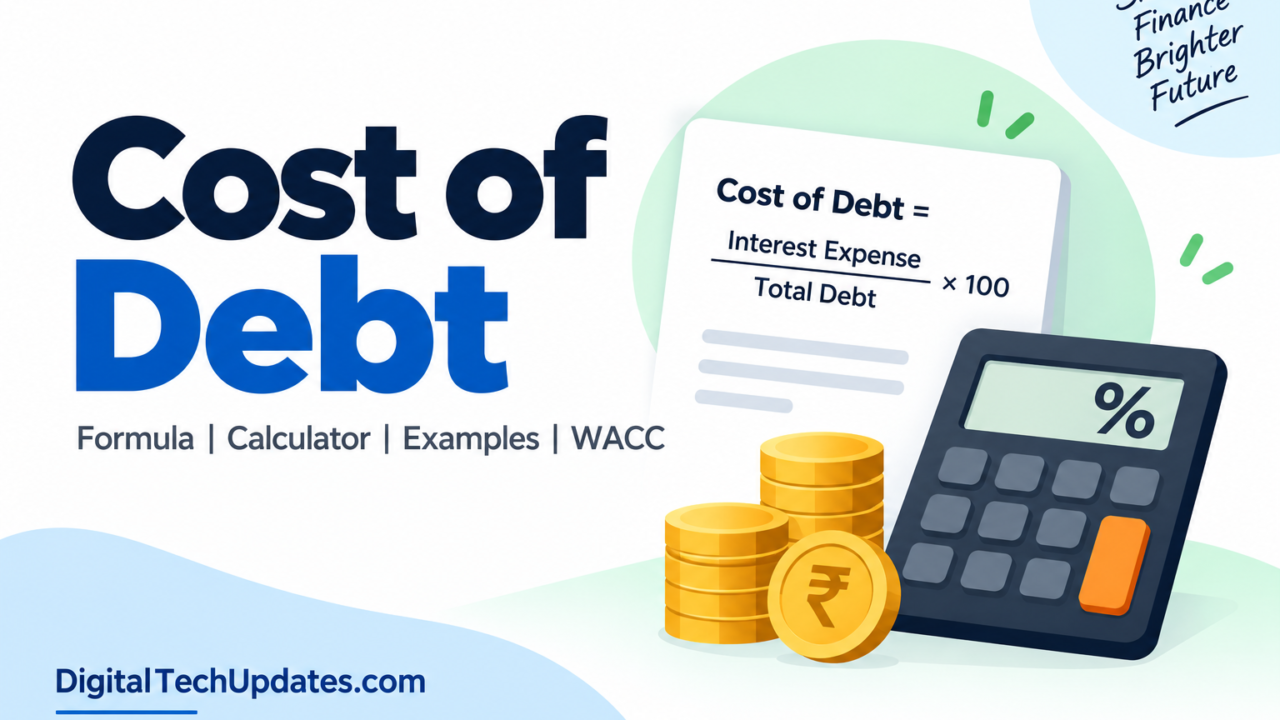
Cost of debt is the effective rate a company pays to borrow money through loans, bonds, notes, or other forms of debt. It is one of the most important concepts in corporate finance because it helps businesses evaluate financing decisions, calculate WACC (Weighted Average Cost of Capital), and determine whether an investment or project is likely to create value.
The basic cost of debt formula is:
Pre-Tax Cost of Debt = Interest Expense ÷ Total Debt × 100
When taxes are taken into account:
After-Tax Cost of Debt = Pre-Tax Cost of Debt × (1 − Tax Rate)
For example, if a company has a cost of debt of 8% and a corporate tax rate of 25%, its after-tax cost of debt is:
8% × (1 − 25%) = 6%
That 6% is generally the figure used for the debt component of WACC when the interest expense provides a tax benefit.
What Is Cost of Debt?
The cost of debt is the rate a company effectively pays to obtain borrowed capital.
Businesses can raise money through several forms of debt, including:
- Bank loans
- Business loans
- Corporate bonds
- Debentures
- Notes payable
- Lines of credit
- Other interest-bearing borrowings
From the company’s perspective, interest paid to lenders represents a financing cost. From the lender’s perspective, that interest represents the return earned for providing capital.
A company with strong creditworthiness will generally be able to borrow at a lower rate than a company with greater default risk. Credit risk, prevailing interest rates, maturity, debt structure, and market conditions can therefore influence a company’s cost of debt.
For valuation purposes, analysts often use the current yield on existing debt or a current borrowing rate that reflects what the company would pay in today’s market rather than simply relying on an old coupon rate.
Cost of Debt Formula
There are several ways to calculate or estimate cost of debt depending on the information available.
1. Simple Cost of Debt Formula
The basic formula is:
Cost of Debt = Annual Interest Expense ÷ Total Debt × 100
Example
Suppose a company has:
- Total debt = $2,000,000
- Annual interest expense = $160,000
Then:
Cost of Debt = $160,000 ÷ $2,000,000 × 100
Cost of Debt = 8%
The company’s pre-tax cost of debt is therefore 8%.
This method is simple and useful when analyzing a company’s historical borrowing cost. However, it may not represent the rate the company would have to pay if it borrowed money today.
After-Tax Cost of Debt
The after-tax cost of debt accounts for the tax benefit associated with deductible interest expense.
The formula is:
After-Tax Cost of Debt = Pre-Tax Cost of Debt × (1 − Tax Rate)
Example
Assume:
- Pre-tax cost of debt = 8%
- Corporate tax rate = 25%
Calculation:
After-Tax Cost of Debt = 8% × (1 − 0.25)
= 8% × 0.75
= 6%
Therefore, the company’s:
Pre-tax cost of debt = 8%
After-tax cost of debt = 6%
The difference reflects the value of the interest tax shield, assuming the interest is deductible and the company can use the deduction.
Why Is After-Tax Cost of Debt Lower?
Interest expense can reduce taxable income when it is deductible under the applicable tax rules.
For example, imagine a company earns $1 million before interest and has $100,000 of deductible interest expense.
Without considering the interest deduction, taxable income would be higher. The interest deduction can reduce the company’s tax liability.
This creates an interest tax shield.
The simplified relationship is:
Tax Shield = Interest Expense × Tax Rate
If interest expense is $100,000 and the tax rate is 25%:
Tax Shield = $100,000 × 25% = $25,000
In simplified terms, the company saves $25,000 in taxes.
However, actual tax treatment depends on the jurisdiction and the company’s circumstances, so the simple formula should not be treated as universal tax advice.
Pre-Tax Cost of Debt vs After-Tax Cost of Debt
These two measures are related but serve different purposes.
| Measure | Formula | Typical Use |
|---|---|---|
| Pre-tax cost of debt | Interest rate or borrowing cost | Measuring the stated/required borrowing cost |
| After-tax cost of debt | Rd × (1 − Tax Rate) | WACC and valuation |
| Historical cost of debt | Interest expense ÷ debt | Analyzing past borrowing costs |
| Market cost of debt | Current market yield/borrowing rate | Valuation and current financing analysis |
The important point is that pre-tax cost of debt is not always the same as the coupon rate on a company’s bonds.
Cost of Debt Using Yield to Maturity
For a company with publicly traded bonds, analysts may use the bond’s yield to maturity (YTM) as an estimate of the current cost of debt.
Why?
Because the coupon rate tells you the contractual interest payment based on the bond’s face value, while YTM reflects the return investors require based on the bond’s current market price and remaining cash flows.
For example, consider a bond with:
- Face value = $1,000
- Annual coupon = $60
- Current market price = $950
- Years to maturity = 10
An approximate YTM can be calculated as:
Approximate YTM = [C + (F − P) ÷ n] ÷ [(F + P) ÷ 2]
Where:
- C = annual coupon payment
- F = face value
- P = current bond price
- n = years to maturity
Using the figures above:
YTM ≈ [60 + (1,000 − 950) ÷ 10] ÷ [(1,000 + 950) ÷ 2]
YTM ≈ 6.67%
If the company’s tax rate is 25%:
After-Tax Cost of Debt ≈ 6.67% × (1 − 25%)
≈ 5.00%
YTM is particularly useful when market prices for a company’s outstanding debt are available.
Cost of Debt Example
Let’s work through a complete example.
Suppose ABC Ltd. has:
- Total debt: ₹10 crore
- Annual interest expense: ₹80 lakh
- Corporate tax rate: 25%
Step 1: Calculate pre-tax cost of debt
Cost of Debt = Interest Expense ÷ Total Debt
= ₹0.80 crore ÷ ₹10 crore
= 8%
Step 2: Calculate after-tax cost of debt
After-Tax Cost of Debt = 8% × (1 − 25%)
= 8% × 0.75
= 6%
Final answer
ABC Ltd.’s:
Pre-tax cost of debt = 8%
After-tax cost of debt = 6%
The 6% figure can then be used as the debt cost in a WACC calculation, assuming the relevant interest expense is tax-deductible.
Cost of Debt Calculator
You can calculate the after-tax cost of debt using the following inputs:
Pre-Tax Cost of Debt:
Enter the company’s borrowing rate.
Tax Rate:
Enter the applicable corporate tax rate.
Formula:
After-Tax Cost of Debt = Cost of Debt × (1 − Tax Rate)
Quick examples
| Pre-Tax Cost of Debt | Tax Rate | After-Tax Cost of Debt |
|---|---|---|
| 5% | 20% | 4.00% |
| 6% | 25% | 4.50% |
| 7% | 25% | 5.25% |
| 8% | 25% | 6.00% |
| 9% | 25% | 6.75% |
| 10% | 30% | 7.00% |
| 12% | 25% | 9.00% |
Tip: If your website already has a financial calculator, linking this article to a dedicated Cost of Debt Calculator can improve the usefulness of the page and create a natural internal link.
Cost of Debt and WACC
One of the most important applications of cost of debt is calculating WACC, or Weighted Average Cost of Capital.
WACC measures the weighted average cost of the company’s different sources of financing.
For a company financed with debt and equity:
WACC = (E/V × Re) + (D/V × Rd × (1 − T))
Where:
- E = Market value of equity
- D = Market value of debt
- V = Total capital (E + D)
- Re = Cost of equity
- Rd = Pre-tax cost of debt
- T = Corporate tax rate
The debt component is adjusted for taxes because interest expense can provide a tax benefit.
Cost of Debt Example in WACC
Suppose a company has:
- Market value of equity = ₹60 crore
- Market value of debt = ₹40 crore
- Cost of equity = 12%
- Pre-tax cost of debt = 8%
- Tax rate = 25%
Total capital:
₹60 crore + ₹40 crore = ₹100 crore
Equity weight
E/V = 60/100 = 60%
Debt weight
D/V = 40/100 = 40%
After-tax cost of debt
8% × (1 − 25%) = 6%
WACC
WACC = (60% × 12%) + (40% × 6%)
WACC = 7.20% + 2.40%
WACC = 9.60%
Therefore, the company’s estimated WACC is 9.60%.
WACC is commonly used as a discount rate in valuation and capital-budgeting analysis when the project has risk comparable to the company’s existing operations.
Why Cost of Debt Matters
Cost of debt matters because borrowing is not free.
A company must generate sufficient returns from the money it borrows to justify the financing cost.
A higher cost of debt can:
- Increase financing expenses
- Reduce profitability
- Increase WACC
- Make projects less attractive
- Increase financial risk
- Reduce the value of future cash flows in a DCF valuation
A lower cost of debt can make borrowing relatively more attractive, particularly when the company has stable cash flows and manageable leverage.
However, the lowest interest rate is not automatically the best financing option. Maturity, covenants, refinancing risk, fees, currency exposure, and other terms also matter.
Factors That Affect Cost of Debt
Several factors influence how much a company pays to borrow.
1. Credit Risk
Companies with stronger financial positions generally have easier access to lower-cost financing.
A company with weak cash flows or high leverage may have to offer lenders a higher return.
2. Interest Rate Environment
Market interest rates influence borrowing costs.
When benchmark rates rise, newly issued debt can become more expensive.
3. Credit Rating
Credit ratings can influence the interest rate demanded by lenders and bond investors.
Higher perceived credit risk generally results in a higher required yield.
4. Debt Maturity
Longer-term debt can carry different pricing from short-term debt because lenders face different interest-rate and credit risks.
5. Collateral
Secured debt may have a different borrowing cost from unsecured debt because the lender has a claim on specified assets.
6. Company Leverage
As debt increases relative to the company’s earnings and assets, lenders may perceive greater financial risk.
That can increase the required return on additional borrowing.
7. Business and Industry Risk
Companies operating in volatile industries may face higher borrowing costs because their future cash flows can be less predictable.
Cost of Debt vs Cost of Equity
Cost of debt and cost of equity are two major components of a company’s cost of capital.
| Feature | Cost of Debt | Cost of Equity |
|---|---|---|
| Capital provider | Lenders | Shareholders |
| Typical payment | Interest | Dividends/capital appreciation |
| Contractual obligation | Generally yes | No fixed required payment |
| Tax treatment | Interest may be deductible | Dividends generally aren't deductible |
| Risk to provider | Usually lower than equity | Generally higher |
| Used in WACC | Yes | Yes |
One major difference is that interest expense can be tax-deductible, while dividends paid to shareholders generally are not.
This is one reason debt can have a lower effective cost than equity.
However, excessive debt can increase financial risk and may eventually raise the company’s borrowing costs.
Cost of Debt vs Interest Rate
These terms are related but are not always interchangeable.
The interest rate is the rate charged on a specific borrowing arrangement.
The cost of debt can represent the broader effective cost of a company’s debt financing.
For a simple loan, the stated interest rate may be a reasonable approximation of the pre-tax cost of debt.
For a company with multiple loans and bonds, analysts may calculate a weighted cost based on the different borrowing instruments.
For publicly traded bonds, current yield or YTM may provide a better market-based estimate than an old coupon rate.
Weighted Average Cost of Debt
A company may have several debt instruments with different interest rates.
For example:
- Bank loan: ₹20 crore at 7%
- Bond: ₹30 crore at 9%
- Term loan: ₹10 crore at 8%
The company does not have one single debt rate simply because the individual loans have different rates.
A weighted average approach can be used.
Weighted Average Cost of Debt = Σ (Debt Weight × Individual Cost of Debt)
In this example:
Total debt = ₹60 crore
Bank loan weight:
20/60 = 33.33%
Bond weight:
30/60 = 50%
Term loan weight:
10/60 = 16.67%
Weighted cost:
(33.33% × 7%) + (50% × 9%) + (16.67% × 8%)
≈ 8.00%
So the company’s approximate pre-tax weighted cost of debt is 8%.
How to Calculate Cost of Debt From Financial Statements
Investors sometimes estimate historical cost of debt using information from a company’s financial statements.
The simplified formula is:
Cost of Debt = Interest Expense ÷ Average Debt × 100
Using average debt can be preferable to using only year-end debt when debt balances changed significantly during the year.
Example
Suppose:
- Beginning debt = ₹50 crore
- Ending debt = ₹70 crore
- Interest expense = ₹4.8 crore
Average debt:
(₹50 crore + ₹70 crore) ÷ 2 = ₹60 crore
Cost of debt:
₹4.8 crore ÷ ₹60 crore × 100 = 8%
This produces an approximate historical borrowing cost of 8%.
Remember that this is a backward-looking measure. It may not equal the rate the company would pay to issue new debt today.
Market Cost of Debt vs Book Cost of Debt
This distinction is important for valuation.
Book cost of debt
Book cost generally uses accounting information such as interest expense and reported debt balances.
It is useful for analyzing what the company has historically paid.
Market cost of debt
Market cost of debt attempts to estimate the return currently required by lenders.
For traded bonds, YTM can be used as an important market-based indicator.
For new borrowing, current rates on debt with similar risk and maturity may be used.
When calculating WACC for valuation, market-based inputs are generally more relevant when reliable market information is available.
What Happens When Cost of Debt Increases?
An increase in cost of debt can affect a business in several ways.
Higher interest expense
New borrowing becomes more expensive.
Lower profitability
Higher financing costs can reduce earnings if revenue and operating costs remain unchanged.
Higher WACC
A higher after-tax cost of debt can increase WACC, assuming other inputs remain unchanged.
Lower project value
In a discounted cash flow analysis, a higher discount rate can reduce the present value of future cash flows.
Greater financial pressure
Companies with large amounts of variable-rate debt may be particularly sensitive to higher borrowing rates.
Is a Lower Cost of Debt Always Better?
Not necessarily.
A company may be able to borrow cheaply but still take on too much debt.
Debt creates fixed financial obligations. If business conditions deteriorate, the company still has to meet interest and principal obligations.
Therefore, businesses must consider both:
Cost of debt
and
Amount of debt
A sensible capital structure balances financing cost with financial risk.
Common Mistakes When Calculating Cost of Debt
Mistake 1: Using the coupon rate as the market cost of debt
The coupon rate may not reflect the current market yield.
For traded bonds, YTM can be a more relevant market-based measure.
Mistake 2: Forgetting the tax adjustment
When calculating the debt component of WACC, analysts generally need to account for the tax effect on deductible interest.
After-tax cost = Pre-tax cost × (1 − tax rate)
Mistake 3: Using the wrong tax rate
The appropriate tax rate depends on the purpose and jurisdiction of the analysis.
Mistake 4: Using book values automatically
For WACC, market-value weights are commonly preferred when they are available and appropriate.
Mistake 5: Treating historical cost as today’s borrowing cost
A company’s historical interest expense may not represent what it would pay for new debt today.
Frequently Asked Questions About Cost of Debt
What is the cost of debt?
Cost of debt is the effective rate a company pays for borrowed money. It is commonly measured before tax and after tax.
What is the formula for cost of debt?
The simple formula is:
Cost of Debt = Interest Expense ÷ Total Debt × 100
For WACC, the after-tax formula is:
After-Tax Cost of Debt = Cost of Debt × (1 − Tax Rate)
What is the after-tax cost of debt?
After-tax cost of debt is the borrowing cost after considering the tax benefit associated with deductible interest.
Why is cost of debt used in WACC?
Debt is one source of capital used to finance a business. WACC combines the costs of debt and equity according to their respective weights.
Is cost of debt the same as interest rate?
Not always. For a simple loan, the interest rate may approximate the pre-tax cost of debt. For companies with multiple debt instruments, analysts may use a weighted borrowing cost or market-based yield.
Is cost of debt higher than cost of equity?
Not necessarily. Debt often has a lower required return because lenders generally have contractual claims and higher priority than shareholders. However, actual costs vary by company and market conditions.
How do you calculate after-tax cost of debt?
Multiply the pre-tax cost of debt by one minus the tax rate.
For example:
8% × (1 − 25%) = 6%
What is the difference between cost of debt and WACC?
Cost of debt measures the cost of borrowing. WACC measures the weighted average cost of the company’s different sources of capital, such as debt and equity.
What happens to WACC when cost of debt increases?
All else equal, an increase in after-tax cost of debt increases the debt component of WACC. The total effect depends on the company’s capital structure.
What is the cost of debt formula in WACC?
The debt component is:
D/V × Rd × (1 − T)
where D/V represents the debt weight, Rd is the pre-tax cost of debt, and T is the applicable tax rate.
Key Takeaways
The most important points to remember about cost of debt are:
- Cost of debt measures the cost a company incurs when borrowing money.
- The basic formula is Interest Expense ÷ Total Debt.
- The pre-tax cost of debt represents the borrowing cost before tax.
- The after-tax cost of debt accounts for the tax benefit of deductible interest.
- The after-tax formula is Rd × (1 − T).
- YTM can be useful for estimating the current market cost of publicly traded debt.
- Historical interest expense can provide a backward-looking estimate.
- Cost of debt is an important input in WACC.
- A lower borrowing rate does not automatically mean a better capital structure.
- Investors should consider both financing costs and the amount of financial leverage.
Final Thought
Understanding the cost of debt is essential for anyone analyzing companies, valuing businesses, comparing financing options, or studying corporate finance.
The calculation itself is relatively simple. The harder part is choosing the right cost of debt for the question being asked.
For a historical analysis, interest expense and average debt may be useful. For valuation, a current market-based borrowing cost or YTM may be more appropriate. And when calculating WACC, the after-tax cost of debt is generally the key figure because of the tax treatment of interest.
Once you understand cost of debt, the next step is to understand how it interacts with cost of equity, capital structure, and WACC to determine the overall cost of financing a business.

Thalla Lokesh
Thalla Lokesh is a Digital Marketing Strategist and SEO Specialist with over 12 years of experience in helping businesses grow their online presence. Since beginning his career in 2013, he has successfully worked across industries including healthcare, education, technology, and e-commerce. He specializes in search engine optimization (SEO), content marketing, keyword strategy, and link building, with a strong focus on delivering measurable results. Lokesh has helped brands achieve top rankings on Google through data-driven strategies, high-quality content, and ethical SEO practices aligned with search engine guidelines. As the founder of Honey Web Solutions , a Tirupati-based digital marketing company, he actively works with clients to improve organic traffic, lead generation, and online visibility. He also contributes expert insights on digital marketing trends, AI SEO, and content strategies through blogs and industry platforms.