Best Stock Screener India 2026: 10 Tools, Free Options & Stock Screening Strategies

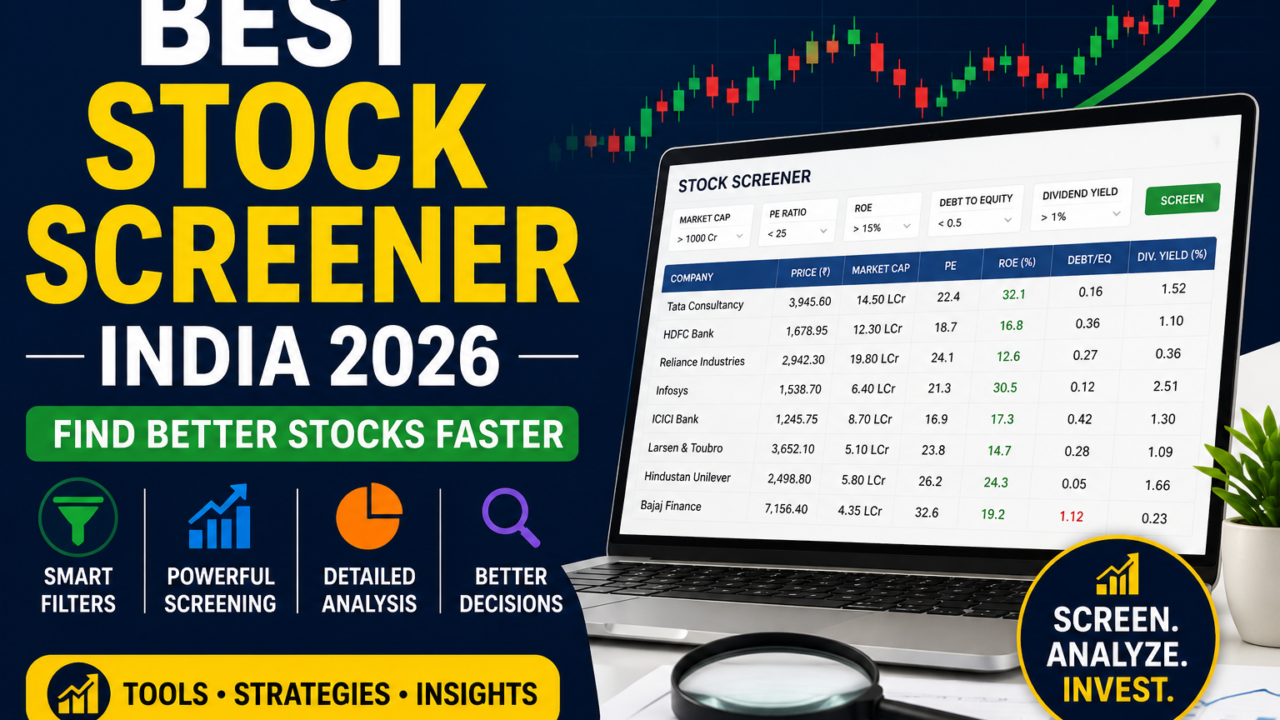
If you are searching for the best stock screener in India, you are probably trying to solve one simple problem: how do you find promising stocks without manually checking thousands of companies?
A good stock screener can make that process much easier.
Instead of opening the financial statements of hundreds of companies one by one, you can filter stocks based on criteria such as market capitalization, P/E ratio, ROE, ROCE, revenue growth, profit growth, debt-to-equity, dividend yield, price performance and trading volume.
But there is no single stock screener that is best for everyone.
A long-term investor looking for financially strong businesses will have different requirements from a trader looking for breakouts or momentum stocks.
This guide compares the best stock screeners in India in 2026, including free options, fundamental screeners, technical scanners and tools suitable for beginners and advanced investors.
Best Stock Screeners in India 2026
Here is a quick comparison:
| Stock Screener | Best For | Fundamental Screening | Technical Screening | Ease of Use |
|---|---|---|---|---|
| Screener.in | Fundamental analysis | Excellent | Limited | Easy |
| TradingView | Technical + fundamental | Excellent | Excellent | Easy |
| Tickertape | Beginners | Excellent | Good | Very Easy |
| Trendlyne | Advanced research | Excellent | Excellent | Moderate |
| Chartink | Technical scans | Limited | Excellent | Moderate |
| StockEdge | Stock research | Good | Excellent | Easy |
| Investing.com | Global markets | Good | Good | Easy |
| MarketsMojo | Stock analysis | Good | Good | Easy |
| Tijori Finance | Fundamental research | Excellent | Limited | Moderate |
| Moneycontrol | Basic stock research | Good | Basic | Easy |
The best choice depends on what you want to screen for.
1. Screener.in – Best for Fundamental Stock Screening
Screener.in is one of the most popular choices among Indian investors who focus on company fundamentals.
Its biggest advantage is the ability to create custom financial queries.
You can screen companies using conditions such as:
- Market capitalization
- P/E ratio
- ROE
- ROCE
- Debt-to-equity
- Sales growth
- Profit growth
- Operating margin
- Dividend yield
- Promoter holding
- Earnings-related metrics
Screener.in also provides long-term financial information and allows users to create custom queries using historical data. Its official feature information says its screening can use 10–15 years of financial data.
Best for
Long-term investors, value investors and fundamental analysts.
Example Screener.in query
A simple quality-stock screen could look for:
ROE > 15%
ROCE > 18%
Debt to equity < 0.5
Sales growth > 10%
Profit growth > 10%
The result is not a buy list. It is simply a shortlist for further research.
2. TradingView – Best for Technical and Fundamental Screening
TradingView is particularly useful when you want to combine stock screening with charts and technical analysis.
Its stock screener supports both fundamental and technical filters and allows users to customize screening criteria.
You can screen for conditions involving:
- Price
- Volume
- Moving averages
- RSI
- Performance
- Market capitalization
- P/E
- Earnings
- Dividends
- Technical indicators
This makes TradingView especially useful for traders who want to move directly from a screening result to a chart.
Best for
Swing traders, technical traders and investors who use both fundamentals and charts.
3. Tickertape – Best for Beginners
Tickertape is designed to make stock research and filtering relatively straightforward.
Its stock screener currently offers 200+ filters, covering areas such as valuation, growth, profitability, returns and market data.
This makes it useful if you don’t want to learn complicated screening formulas.
You can start with a simple requirement such as:
Find large-cap companies with strong profitability and reasonable valuation.
Then gradually add additional filters.
Best for
Beginners and investors who prefer a simple screening interface.
4. Trendlyne – Best for Advanced Stock Research
Trendlyne is aimed more toward investors and traders who want deeper analysis and a large selection of screening parameters.
Its platform offers extensive screening capabilities, technical indicators, financial metrics, alerts and other research features. Trendlyne currently advertises 1,000+ screening parameters across different categories.
The advantage is flexibility.
The disadvantage is that beginners may find the amount of information overwhelming at first.
Best for
Advanced investors, analysts and active traders.
5. Chartink – Best for Technical Stock Scans
Chartink is particularly useful if your main focus is technical stock screening.
Technical traders can create scans based on conditions such as:
- Moving averages
- RSI
- MACD
- Volume
- Price breakouts
- Candlestick patterns
- Previous highs and lows
- Multiple technical conditions
For example, a trader could search for stocks trading above a particular moving average while experiencing unusually high volume.
Best for
Technical traders and swing traders.
6. StockEdge – Best for Ready-Made Stock Scans
StockEdge combines stock screening with market research and analysis tools.
One of its attractions is the availability of ready-made scans and market ideas, which can save time for investors who don’t want to build every screen from scratch.
It can be useful for discovering:
- Momentum stocks
- Breakout stocks
- Volume-based opportunities
- Fundamental stocks
- Sector trends
Best for
Investors who prefer ready-made screens and research ideas.
7. Investing.com – Best for Global Stock Screening
Investing.com is useful if you follow stocks outside India as well.
Its platform covers multiple markets, so investors can research Indian companies alongside international stocks.
For someone who only wants NSE and BSE stocks, a dedicated Indian platform may be easier.
But for investors with global watchlists, the wider market coverage is an advantage.
Best for
Investors who follow Indian and international markets.
8. MarketsMojo – Best for Stock Analysis
MarketsMojo combines stock screening with broader stock-analysis features.
Rather than focusing only on one ratio, investors can use multiple areas of information when evaluating companies.
This type of platform can be useful when you want to move from:
screening → comparison → deeper stock research
instead of using separate websites for every stage.
Best for
Investors who want screening combined with broader stock analysis.
9. Tijori Finance – Best for Fundamental and Industry Research
Tijori Finance can be useful for investors who want to understand not only an individual company but also its industry and competitive environment.
Industry-level information can be particularly valuable because financial ratios mean more when compared with similar businesses.
For example, a company’s margin or valuation shouldn’t always be judged in isolation.
Best for
Fundamental investors who want industry-level context.
10. Moneycontrol – Best for Basic Stock Research
Moneycontrol is widely used by Indian investors for market information, company financials, news and stock-related research.
It may not be the first choice for advanced custom screening, but it can be useful as part of a broader research process.
Best for
Beginners who want basic company and market information in one place.
Best Stock Screener in India: Which One Should You Choose?
Rather than asking which screener is universally the best, choose one according to your strategy.
Best for fundamental analysis
Screener.in
It is particularly useful when your research starts with financial statements and ratios.
Best for technical analysis
TradingView or Chartink
Both are useful when price action and technical indicators are central to your strategy.
Best for beginners
Tickertape
Its guided filtering approach makes it relatively easy to start screening stocks.
Best for advanced investors
Trendlyne
Its extensive screening parameters make it useful for more sophisticated research.
Best for ready-made scans
StockEdge
Useful if you want to discover stocks using existing market screens.
Best Free Stock Screener India
If you’re specifically looking for a free stock screener in India, don’t assume that the platform with the most features is automatically the best.
The free version should be judged by whether it can answer your particular research question.
For example, if your objective is fundamental research, you may want to start with a platform that lets you screen:
- ROE
- ROCE
- P/E
- Debt
- Sales growth
- Profit growth
- Market capitalization
If your objective is trading, you may care more about:
- Price
- Volume
- RSI
- Moving averages
- Breakouts
- Momentum
A free screener that supports the filters you actually need may be more useful than a paid platform filled with features you never use.
How to Screen Stocks in India
Using a stock screener is relatively simple.
Step 1: Decide what type of stock you want
Don’t start by randomly selecting filters.
First decide whether you’re looking for:
- Value stocks
- Growth stocks
- Dividend stocks
- Quality companies
- Small-cap stocks
- Mid-cap stocks
- Large-cap stocks
- Breakout stocks
- Momentum stocks
- Low-debt companies
Your objective determines your filters.
10 Useful Stock Screening Strategies
1. Quality Stock Screen
A simple starting point:
- ROE > 15%
- ROCE > 18%
- Debt-to-equity < 0.5
- Profit growth > 10%
This can help identify companies with profitability and relatively conservative leverage.
2. High-Growth Stock Screen
You could start with:
- Sales growth > 15%
- Profit growth > 15%
- ROE > 15%
- Market capitalization > ₹5,000 crore
Growth should still be examined alongside valuation.
A company growing quickly can still be overpriced.
3. Low-Debt Stock Screen
For investors who prefer companies with lower financial leverage:
- Debt-to-equity < 0.3
- ROCE > 15%
- Positive profit growth
- Positive operating cash flow
The appropriate debt level varies considerably by industry, so this screen should not be applied blindly to banks and other financial companies.
4. Value Stock Screen
A basic value-oriented screen might include:
- P/E below the sector average
- P/B below a selected threshold
- Positive earnings growth
- ROE above a minimum level
- Manageable debt
A low P/E alone doesn’t make a company undervalued.
Sometimes a cheap stock is cheap for a reason.
5. Dividend Stock Screen
You could search for companies with:
- Dividend yield above a chosen level
- Positive earnings
- Sustainable payout
- Consistent dividend history
- Manageable debt
Don’t select a dividend stock based solely on the highest yield.
An unusually high yield can sometimes be caused by a falling share price.
6. High-ROE Stock Screen
One simple approach is:
- ROE > 20%
- ROCE > 20%
- Positive profit growth
- Debt-to-equity < 0.5
Then compare the resulting companies with their peers.
7. Large-Cap Stock Screen
If you want to focus on established companies, you can set a minimum market-capitalization threshold.
For example:
Market capitalization > ₹50,000 crore
You can then add profitability or growth conditions depending on your objective.
8. Breakout Stock Screen
Technical traders may look for:
- Price above 50-day moving average
- Price above 200-day moving average
- Increasing volume
- New 52-week high
- Positive momentum
This type of screen is designed for trading setups rather than long-term fundamental investing.
9. High-Volume Stock Screen
A simple volume-based strategy could look for:
- Current volume above average volume
- Positive price movement
- Price above a selected moving average
High volume can indicate increased market activity, but it does not automatically mean the stock will continue rising.
10. Nifty 50 Stock Screen
If you want to restrict your research to India’s benchmark index, start with the Nifty 50 universe and then apply additional filters.
For example:
Nifty 50 companies + ROE > 15% + profit growth > 10%
This can reduce the universe to companies that meet your chosen criteria.
A Stock Screener Is Not a Stock Recommendation
This is perhaps the most important point in this entire guide.
A stock screener works with data.
It can tell you:
“These companies meet your conditions.”
It cannot tell you with certainty:
“This stock will go up.”
A company may have excellent ROE, strong profit growth and low debt but still experience a significant decline in its share price.
Why?
Because stock prices depend on much more than historical financial ratios.
Market expectations, valuation, earnings surprises, economic conditions, interest rates, competition and investor sentiment can all influence prices.
Use screening tools to create a research shortlist, not an automatic buy list.
What to Check After Finding a Stock
Once your screener produces a shortlist, investigate each company individually.
Check the financial statements
Look at revenue, operating profit, net profit, margins and cash flow.
Check debt
Understand whether the company’s debt is appropriate for its business model.
Check valuation
Compare P/E, P/B and other valuation measures with historical levels and competitors.
Check recent results
A company’s latest quarterly results can change the investment picture considerably.
Check competitors
A stock may look attractive until you compare it with a stronger competitor trading at a similar valuation.
Check management and governance
Numbers are important, but they don’t tell the entire story.
Check the industry
A good company operating in a declining industry can face very different challenges from a good company operating in a growing market.
Common Stock Screening Mistakes
Mistake 1: Using too many filters
Adding dozens of conditions doesn’t necessarily produce a better list.
You may accidentally eliminate good companies.
Mistake 2: Looking only at P/E
A low P/E ratio isn’t enough to establish that a company is cheap.
Mistake 3: Ignoring sector differences
Financial companies, technology companies and manufacturing companies naturally have different financial structures.
Mistake 4: Buying every stock that passes the screen
A screening result is only a starting point.
Mistake 5: Ignoring valuation
A high-quality business can still be a poor investment if you pay too much.
Mistake 6: Using old data
Financial metrics change as companies report new results.
Always check when the data was last updated.
Best Stock Screener for Different Investors
| Investor | Best Starting Choice |
|---|---|
| Long-term investor | Screener.in |
| Value investor | Screener.in |
| Beginner | Tickertape |
| Technical trader | Chartink |
| Swing trader | TradingView |
| Advanced investor | Trendlyne |
| Ready-made screens | StockEdge |
| Global investor | Investing.com |
| Industry research | Tijori Finance |
These are practical starting points rather than absolute rankings. Your preferred strategy should ultimately determine which platform you use.
Frequently Asked Questions
What is the best stock screener in India?
There is no single best stock screener for every investor. Screener.in is a strong option for fundamental analysis, TradingView and Chartink are useful for technical screening, Tickertape is beginner-friendly, and Trendlyne provides extensive screening capabilities.
Which is the best free stock screener in India?
The best free option depends on the type of screening you need. For fundamental investors, a platform offering financial-ratio screening may be most useful, while technical traders may prefer a platform with price and indicator-based scans.
Is Screener.in free?
Screener.in offers free access to core stock-screening and company-analysis features, with additional capabilities available through paid plans.
Which stock screener is best for fundamental analysis?
Screener.in is a strong choice for fundamental analysis because it allows investors to build custom financial queries and examine long-term company data.
Which stock screener is best for technical analysis?
TradingView and Chartink are popular choices for technical screening because they allow traders to screen using price, volume and technical indicators.
Can stock screeners find undervalued stocks?
They can help identify companies that meet selected valuation criteria, but a low valuation ratio does not automatically mean that a stock is undervalued.
Can stock screeners predict stock prices?
No. Screeners filter stocks based on predefined conditions. They cannot reliably predict future prices.
Can beginners use stock screeners?
Yes. Beginners can start with a small number of simple filters and learn what each financial or technical metric means before adding more conditions.
Is a stock screener enough to buy a stock?
No. A screener should be one part of the research process. Investors should also examine the company’s financial statements, valuation, industry, management, recent results and risks.
Final Verdict
The best stock screener in India depends on what you’re trying to find.
For fundamental investors, Screener.in is an excellent starting point.
For technical traders, TradingView and Chartink are strong options.
For beginners, Tickertape provides a simpler way to explore stocks.
For advanced investors, Trendlyne offers a much deeper set of screening parameters.
But the platform itself isn’t the most important part.
The real advantage comes from knowing what you are looking for and why you are using each filter.
Use a stock screener to reduce thousands of companies to a manageable shortlist. Then do the work that matters: understand the business, examine the financials, compare the valuation and assess the risks.
A stock screener can save you time. It cannot replace investment research.
Disclaimer: This article is for educational and informational purposes only and should not be considered investment advice. Stock market investments are subject to market risks. Always conduct your own research or consult a qualified financial professional before making investment decisions.

Thalla Lokesh
Thalla Lokesh is a Digital Marketing Strategist and SEO Specialist with over 12 years of experience in helping businesses grow their online presence. Since beginning his career in 2013, he has successfully worked across industries including healthcare, education, technology, and e-commerce. He specializes in search engine optimization (SEO), content marketing, keyword strategy, and link building, with a strong focus on delivering measurable results. Lokesh has helped brands achieve top rankings on Google through data-driven strategies, high-quality content, and ethical SEO practices aligned with search engine guidelines. As the founder of Honey Web Solutions , a Tirupati-based digital marketing company, he actively works with clients to improve organic traffic, lead generation, and online visibility. He also contributes expert insights on digital marketing trends, AI SEO, and content strategies through blogs and industry platforms.