Fixed Charge Coverage Ratio: Formula, Calculator & Examples

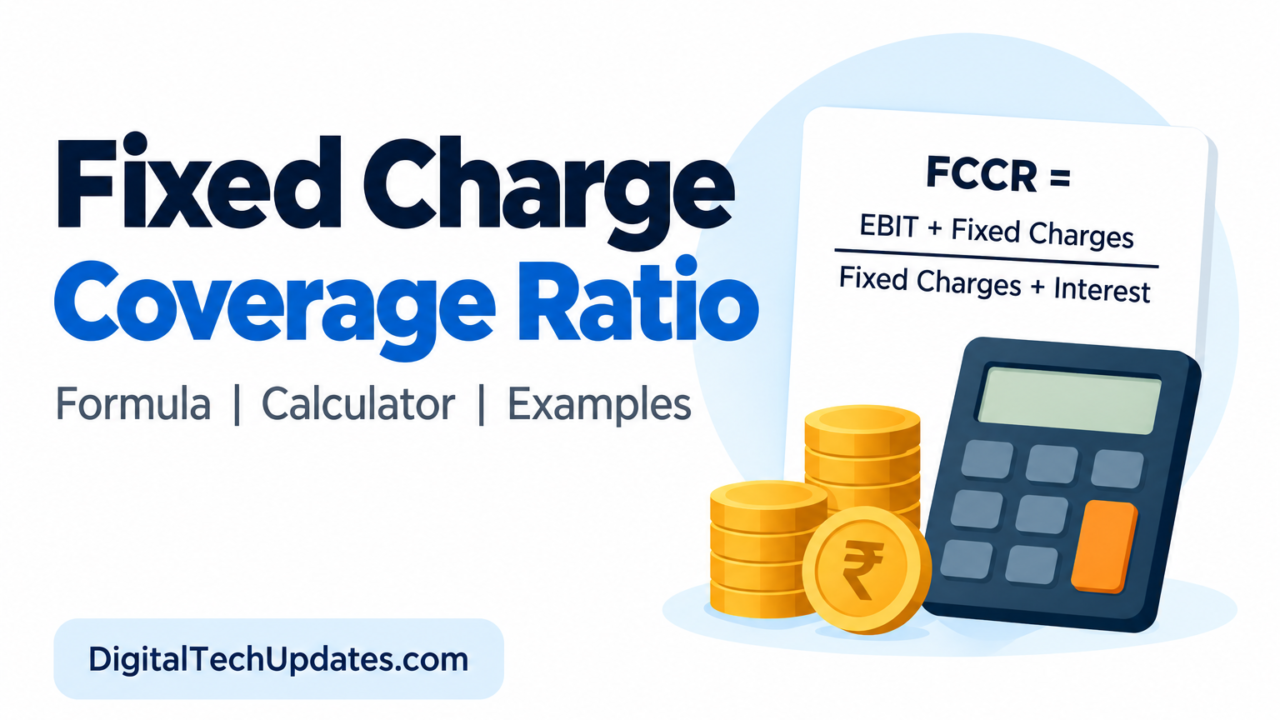
The Fixed Charge Coverage Ratio (FCCR) is a financial ratio used to measure a company’s ability to cover its fixed financial obligations from its operating earnings.
It is especially useful when a business has significant debt, lease payments, rental expenses, or other recurring fixed charges.
A commonly used formula is:
Fixed Charge Coverage Ratio = (EBIT + Fixed Charges) ÷ (Fixed Charges + Interest Expense)
For example, if a company has:
- EBIT = ₹20 lakh
- Fixed charges = ₹5 lakh
- Interest expense = ₹5 lakh
Then:
FCCR = (₹20 lakh + ₹5 lakh) ÷ (₹5 lakh + ₹5 lakh)
FCCR = ₹25 lakh ÷ ₹10 lakh = 2.5x
The company’s fixed charge coverage ratio is therefore 2.5x.
In simple terms, the calculation indicates that the earnings measure used in the formula covers the specified fixed charges and interest 2.5 times.
Important: There is no single universal FCCR formula. Banks, lenders, credit analysts, and loan agreements can define “fixed charges” differently. Always use the exact definition specified in the relevant financial agreement.
What Is Fixed Charge Coverage Ratio?
The Fixed Charge Coverage Ratio, often called FCCR, measures how well a company can meet its recurring fixed financial commitments.
Businesses have expenses that must be paid regardless of whether sales are strong or weak. Depending on the calculation, fixed charges may include:
- Interest expense
- Lease payments
- Rental payments
- Certain contractual fixed obligations
- Preferred dividend obligations in some formulations
FCCR is primarily used to evaluate financial strength and debt-servicing capacity.
A higher FCCR generally indicates that a company has a larger cushion to meet its fixed obligations.
A lower FCCR suggests that the company may have less flexibility if operating earnings decline.
Fixed Charge Coverage Ratio Formula
A commonly used FCCR formula is:
FCCR = (EBIT + Fixed Charges) ÷ (Fixed Charges + Interest Expense)
Where:
- EBIT = Earnings Before Interest and Taxes
- Fixed Charges = qualifying fixed charges included in the calculation
- Interest Expense = interest payable on debt
Example
Suppose a company reports:
- EBIT = ₹30 lakh
- Fixed charges = ₹6 lakh
- Interest expense = ₹9 lakh
The calculation is:
FCCR = (₹30 lakh + ₹6 lakh) ÷ (₹6 lakh + ₹9 lakh)
FCCR = ₹36 lakh ÷ ₹15 lakh
FCCR = 2.4x
Therefore, the company’s FCCR is 2.4x under this definition.
Why Is the Fixed Charge Coverage Ratio Important?
FCCR is important because profitability alone does not tell the complete story about a company’s ability to meet financial commitments.
Consider a company that reports a profit but also has:
- Large debt repayments
- High interest costs
- Significant lease commitments
- Long-term rental contracts
If operating earnings decline, these fixed obligations may still need to be paid.
FCCR helps answer an important question:
Does the company’s operating performance provide enough coverage for its recurring fixed financial obligations?
This makes FCCR particularly useful for:
- Banks
- Lenders
- Credit analysts
- Investors
- Financial analysts
- Business owners
- Corporate finance professionals
Fixed Charge Coverage Ratio Calculator
A Fixed Charge Coverage Ratio Calculator can make the calculation much easier.
Enter:
EBIT
The company’s earnings before interest and taxes.
Fixed Charges
Qualifying fixed charges included in your chosen FCCR definition.
Interest Expense
The company’s interest expense for the relevant period.
FCCR Formula
FCCR = (EBIT + Fixed Charges) ÷ (Fixed Charges + Interest Expense)
Quick Example
If:
- EBIT = ₹15,00,000
- Fixed charges = ₹3,00,000
- Interest expense = ₹2,00,000
Then:
FCCR = (₹15,00,000 + ₹3,00,000) ÷ (₹3,00,000 + ₹2,00,000)
FCCR = ₹18,00,000 ÷ ₹5,00,000
FCCR = 3.6x
Result
Fixed Charge Coverage Ratio = 3.6x
For a financial website, an interactive FCCR calculator should ideally appear near the top of the page, before the longer explanation. This lets users calculate the ratio immediately and then read the article to understand what their result means.
How to Calculate Fixed Charge Coverage Ratio
Calculating FCCR generally involves four steps.
Step 1: Determine EBIT
EBIT stands for Earnings Before Interest and Taxes.
It represents operating earnings before interest and tax expenses.
Step 2: Identify Fixed Charges
Determine which expenses qualify as fixed charges under the definition you are using.
These may include lease or rental payments and other contractual fixed obligations.
Step 3: Determine Interest Expense
Find the interest expense for the same reporting period.
Step 4: Apply the Formula
Use:
FCCR = (EBIT + Fixed Charges) ÷ (Fixed Charges + Interest Expense)
The result is expressed as a multiple such as 1.5x, 2.0x, or 3.0x.
Fixed Charge Coverage Ratio Example
Let’s look at a complete example.
ABC Ltd. has the following annual figures:
| Financial Item | Amount |
|---|---|
| EBIT | ₹50 lakh |
| Fixed Charges | ₹10 lakh |
| Interest Expense | ₹15 lakh |
Using the FCCR formula:
FCCR = (EBIT + Fixed Charges) ÷ (Fixed Charges + Interest)
Substitute the figures:
FCCR = (₹50 lakh + ₹10 lakh) ÷ (₹10 lakh + ₹15 lakh)
FCCR = ₹60 lakh ÷ ₹25 lakh
FCCR = 2.4x
Answer
ABC Ltd. has an FCCR of 2.4x.
Under this calculation, the company’s earnings measure provides approximately 2.4 times coverage of its specified fixed charges and interest.
Fixed Charge Coverage Ratio Interpretation
FCCR is expressed as a multiple.
For example:
- 0.5x
- 1.0x
- 1.5x
- 2.0x
- 3.0x
- 5.0x
Generally, a higher FCCR indicates stronger coverage, assuming the calculations are comparable.
| FCCR | General Interpretation |
|---|---|
| Below 1.0x | Insufficient coverage under the formula |
| 1.0x | Exactly covers specified obligations |
| 1.0x–1.5x | Limited cushion |
| 1.5x–2.0x | Moderate coverage |
| 2.0x–3.0x | Relatively strong coverage |
| Above 3.0x | Substantial coverage in many situations |
These ranges are general analytical guidelines, not universal credit standards.
A lender may impose a specific minimum FCCR in a loan agreement.
What Does an FCCR Below 1 Mean?
An FCCR below 1.0x means the calculated numerator is insufficient to cover the specified fixed obligations under the selected formula.
For example:
FCCR = 0.8x
This indicates that the earnings measure used in the calculation covers only 80% of the specified fixed obligations.
This can be a warning sign of financial stress.
However, the exact interpretation depends on the formula, accounting adjustments, and lender requirements.
What Does an FCCR of 1 Mean?
An FCCR of 1.0x means:
Numerator = Denominator
The calculated earnings measure exactly covers the specified fixed obligations.
There is essentially no additional coverage cushion under that calculation.
A company operating at exactly 1.0x can therefore be more vulnerable to a decline in earnings.
What Does an FCCR of 2 Mean?
An FCCR of 2.0x means the calculated earnings measure covers the specified fixed obligations twice.
For example:
- Earnings measure = ₹20 lakh
- Fixed obligations = ₹10 lakh
FCCR = ₹20 lakh ÷ ₹10 lakh = 2.0x
This generally represents a healthier cushion than 1.0x, although whether it is sufficient depends on the company and lender.
What Does an FCCR of 3 Mean?
An FCCR of 3.0x means the calculated earnings measure is three times the specified fixed obligations.
All else equal, this generally indicates stronger coverage than an FCCR of 1.5x or 2.0x.
However, investors should still examine:
- Debt maturity
- Cash flow
- Business volatility
- Interest rates
- Lease obligations
- Industry conditions
What Is a Good Fixed Charge Coverage Ratio?
There is no universal FCCR that is considered good for every company.
A company operating in a stable industry with predictable cash flows may be able to operate comfortably at a different ratio from a company with highly volatile earnings.
Lenders may also set their own minimum requirements.
As a general framework:
Below 1.0x: Potentially weak
1.0x–1.5x: Limited cushion
1.5x–2.0x: Moderate
2.0x–3.0x: Stronger
Above 3.0x: Generally substantial
These figures should not be interpreted as universal pass/fail thresholds.
Fixed Charge Coverage Ratio vs Interest Coverage Ratio
The Interest Coverage Ratio measures a company’s ability to cover interest expense from earnings.
A common formula is:
Interest Coverage Ratio = EBIT ÷ Interest Expense
FCCR can include additional fixed obligations.
A commonly used formula is:
FCCR = (EBIT + Fixed Charges) ÷ (Fixed Charges + Interest Expense)
Comparison
| Feature | FCCR | Interest Coverage Ratio |
|---|---|---|
| Measures | Fixed obligations and interest | Interest expense |
| Interest included | Yes | Yes |
| Lease/fixed charges | Often included | Generally not |
| Complexity | Higher | Lower |
| Used in credit analysis | Yes | Yes |
| Higher ratio generally | Better | Better |
Simple example
Suppose:
- EBIT = ₹20 lakh
- Fixed charges = ₹5 lakh
- Interest = ₹5 lakh
Interest coverage:
₹20 lakh ÷ ₹5 lakh = 4.0x
FCCR:
(₹20 lakh + ₹5 lakh) ÷ (₹5 lakh + ₹5 lakh) = 2.5x
The ratios are different because they measure different types of obligations.
Fixed Charge Coverage Ratio vs DSCR
The Debt Service Coverage Ratio (DSCR) is another important credit metric.
DSCR generally evaluates whether cash flow is sufficient to cover debt service.
A common conceptual formula is:
DSCR = Cash Flow Available for Debt Service ÷ Total Debt Service
Debt service can include:
- Principal repayments
- Interest payments
FCCR and DSCR therefore answer different questions.
| Ratio | Main Focus |
|---|---|
| FCCR | Specified fixed charges and interest |
| Interest Coverage Ratio | Interest expense |
| DSCR | Debt service, often principal + interest |
Why the distinction matters
A company may have strong interest coverage but weaker DSCR if significant principal repayments are coming due.
Similarly, FCCR can capture certain fixed commitments that a basic interest coverage ratio does not.
Fixed Charge Coverage Ratio vs Debt-to-Equity Ratio
These ratios measure completely different aspects of financial health.
FCCR
Measures the company’s ability to cover specified fixed financial obligations.
Debt-to-Equity Ratio
Measures the amount of debt relative to shareholders’ equity.
For example:
Debt-to-Equity Ratio = Total Debt ÷ Shareholders’ Equity
A company can have relatively high leverage while maintaining strong FCCR if its earnings are strong.
Conversely, a company with moderate debt may have weak FCCR if operating earnings are poor.
Therefore, the ratios should be used together.
Weighted Fixed Charges and Multiple Debt Instruments
Some companies have several types of financing and fixed obligations.
For example:
- Bank loan
- Corporate bonds
- Lease obligations
- Equipment financing
- Other contractual commitments
The appropriate FCCR calculation may require careful identification of which items are included.
This is particularly important when calculating FCCR for:
- Loan covenants
- Credit agreements
- Financial projections
- Acquisition analysis
- Investment analysis
If a lender specifies the definition, use that definition exactly.
Alternative FCCR Formulas
One reason FCCR can be confusing is that different sources use different formulas.
Depending on the purpose, you may encounter formulas involving:
- EBIT
- EBITDA
- Fixed charges
- Lease expenses
- Interest expense
- Preferred dividends
- Principal payments
- Other contractual obligations
For example, a lender’s covenant may define fixed charges differently from a textbook financial-ratio calculation.
Therefore, there is an important rule:
Never compare two FCCR figures without checking whether they were calculated using the same definition.
This is especially important when analyzing companies or checking compliance with a debt covenant.
Fixed Charge Coverage Ratio and EBITDA
Some financial models use EBITDA rather than EBIT in coverage calculations.
EBITDA stands for:
Earnings Before Interest, Taxes, Depreciation and Amortization
Because EBITDA excludes depreciation and amortization, it can produce a different coverage result from an EBIT-based calculation.
However, EBITDA-based coverage should not automatically be called the same FCCR unless the relevant lender, analyst, or agreement defines it that way.
The safest approach is to:
- Identify the exact formula.
- Identify the included fixed charges.
- Use consistent accounting periods.
- Compare only like-for-like calculations.
Fixed Charge Coverage Ratio From Financial Statements
Investors can estimate FCCR using information from a company’s financial statements.
Look for:
Income Statement
- Revenue
- Operating expenses
- EBIT or operating income
- Interest expense
Notes to Financial Statements
- Lease commitments
- Rental obligations
- Debt details
- Other contractual commitments
Once the required figures are identified, apply the appropriate FCCR definition.
For example:
FCCR = (EBIT + Fixed Charges) ÷ (Fixed Charges + Interest Expense)
The resulting figure should then be compared with previous periods and relevant industry or lender benchmarks.
How to Calculate FCCR in Excel
You can calculate FCCR easily in Microsoft Excel or Google Sheets.
Suppose:
- A2 = EBIT
- B2 = Fixed Charges
- C2 = Interest Expense
The Excel formula would be:
=(A2+B2)/(B2+C2)
Example
If:
- A2 = 5000000
- B2 = 1000000
- C2 = 1500000
The formula returns:
2.4
You can format the result as:
2.4x
Excel table
| Cell | Input |
|---|---|
| A2 | EBIT |
| B2 | Fixed Charges |
| C2 | Interest Expense |
| D2 | #VALUE! |
This makes it easy to compare FCCR across multiple years.
Fixed Charge Coverage Ratio Trend Analysis
Looking at FCCR for only one year may not provide enough information.
Suppose a company reports:
| Year | FCCR |
|---|---|
| 2022 | 3.2x |
| 2023 | 2.9x |
| 2024 | 2.5x |
| 2025 | 2.0x |
| 2026 | 1.6x |
The company still has coverage above 1.0x, but the downward trend is important.
Possible explanations could include:
- Declining EBIT
- Higher interest expense
- Increased debt
- Higher lease commitments
- Lower profit margins
- Weakening business conditions
Trend analysis can therefore reveal deterioration before the ratio becomes critically low.
What Happens When FCCR Falls?
A declining FCCR means the company’s coverage cushion is becoming smaller, assuming the calculation remains consistent.
For example:
3.0x → 2.5x → 2.0x → 1.5x
Potential causes include:
Lower operating earnings
Falling sales or margins can reduce EBIT.
Higher interest expense
New borrowing or higher interest rates can increase financing costs.
Higher fixed charges
Additional lease or rental commitments can increase fixed obligations.
Increased leverage
Taking on more debt can increase interest obligations.
A falling FCCR does not automatically mean a company is in financial distress, but it deserves investigation.
What Happens When FCCR Increases?
An increasing FCCR generally indicates stronger coverage.
For example:
1.3x → 1.7x → 2.1x → 2.8x
Possible reasons include:
- Higher EBIT
- Lower interest expense
- Debt repayment
- Reduced fixed charges
- Improved margins
- Stronger operating performance
Again, investors should determine why FCCR improved.
A temporary increase caused by an unusual event may not represent a sustainable improvement.
How Can a Company Improve Its Fixed Charge Coverage Ratio?
A company can potentially improve FCCR by increasing operating earnings or reducing relevant fixed obligations.
1. Increase EBIT
Higher operating profit generally improves the numerator.
2. Reduce Interest Expense
Refinancing or paying down expensive debt may reduce interest costs when financially practical.
3. Reduce Debt
Paying down debt can reduce future interest obligations.
4. Reduce Fixed Commitments
Renegotiating certain leases or rental agreements may reduce qualifying fixed charges.
5. Improve Operating Efficiency
Lower operating costs and better margins can increase EBIT.
6. Improve Cash Flow
Stronger cash generation can improve the company’s overall ability to meet financial commitments, although cash flow itself may not be directly included in every FCCR formula.
Fixed Charge Coverage Ratio and Loan Covenants
FCCR is sometimes used in loan covenants.
A lender may require a borrower to maintain FCCR above a specified minimum level.
For example, a loan agreement could specify:
Minimum FCCR = 1.50x
If the company’s calculated FCCR falls below the required level, it could potentially trigger a covenant breach or other consequences specified in the agreement.
The actual consequences depend on the terms of the financing agreement.
This is why businesses should calculate covenant ratios using the exact definitions contained in their loan documents.
Fixed Charge Coverage Ratio for Investors
Investors can use FCCR as part of a broader assessment of financial risk.
A consistently strong FCCR may indicate that a company has greater capacity to handle fixed financial obligations.
A declining FCCR may warrant closer examination of:
- Debt levels
- Interest expense
- Lease commitments
- Operating margins
- Free cash flow
- Debt maturities
- Refinancing requirements
However, FCCR should never be used as the sole basis for an investment decision.
Fixed Charge Coverage Ratio by Industry
There is no single FCCR benchmark that applies equally to every industry.
Different businesses have different cost structures.
For example:
Retail
Retail companies may have substantial rental and lease obligations.
Manufacturing
Manufacturers may have equipment financing, debt and significant fixed operating costs.
Airlines
Airlines can have substantial aircraft-related financing and lease commitments.
Technology
Technology companies may have lower physical fixed costs but can still have debt, leases and other contractual commitments.
Real Estate
Real-estate businesses can have significant financing and lease-related obligations.
Because business models differ, industry comparison is more meaningful than applying one universal FCCR threshold.
FCCR Scenario Analysis
Scenario analysis can show how sensitive FCCR is to changes in operating performance.
Suppose:
- EBIT = ₹30 lakh
- Fixed charges = ₹5 lakh
- Interest = ₹5 lakh
Current FCCR:
(₹30 lakh + ₹5 lakh) ÷ (₹5 lakh + ₹5 lakh) = 3.5x
Now assume EBIT falls by 20%.
New EBIT:
₹30 lakh × 80% = ₹24 lakh
New FCCR:
(₹24 lakh + ₹5 lakh) ÷ (₹5 lakh + ₹5 lakh)
= ₹29 lakh ÷ ₹10 lakh
= 2.9x
A 20% reduction in EBIT reduces FCCR from 3.5x to 2.9x.
This type of scenario analysis can help management and lenders understand how much coverage exists during weaker business conditions.
Fixed Charge Coverage Ratio Limitations
Although FCCR is useful, it has several limitations.
Different formulas
The definition of fixed charges varies.
EBIT is not cash flow
Accounting earnings are not the same as cash available to make payments.
Accounting differences
Companies may classify certain expenses differently.
Historical data may not predict the future
A strong historical FCCR may deteriorate if operating conditions change.
Industry differences
Different businesses have different normal levels of fixed obligations.
It should not be used alone
Other financial measures should be considered alongside FCCR.
Useful complementary metrics include:
- Interest Coverage Ratio
- DSCR
- Debt-to-EBITDA
- Debt-to-Equity Ratio
- Current Ratio
- Quick Ratio
- Operating Cash Flow
- Free Cash Flow
FCCR vs DSCR vs Interest Coverage Ratio: Quick Comparison
| Metric | What It Measures | Common Focus |
|---|---|---|
| Fixed Charge Coverage Ratio | Coverage of specified fixed charges | Fixed charges + interest |
| Interest Coverage Ratio | Ability to pay interest | EBIT + interest |
| DSCR | Ability to service debt | Cash flow + principal/interest |
| Debt-to-Equity | Financial leverage | Debt vs equity |
These ratios complement one another rather than replacing one another.
Fixed Charge Coverage Ratio Quick Reference
Formula
FCCR = (EBIT + Fixed Charges) ÷ (Fixed Charges + Interest Expense)
If FCCR = 1.0x
The calculated earnings measure exactly covers the specified obligations.
If FCCR = 2.0x
The calculated earnings measure covers them twice.
If FCCR = 3.0x
The calculated earnings measure covers them three times.
If FCCR < 1.0x
The calculated earnings measure does not fully cover the specified obligations.
Main use
FCCR is commonly used to evaluate financial flexibility and fixed-obligation coverage.
Frequently Asked Questions About Fixed Charge Coverage Ratio
What is the Fixed Charge Coverage Ratio?
The Fixed Charge Coverage Ratio measures a company’s ability to cover specified fixed financial obligations using an earnings measure such as EBIT.
What is the FCCR formula?
A commonly used formula is:
FCCR = (EBIT + Fixed Charges) ÷ (Fixed Charges + Interest Expense)
However, formulas can vary depending on the lender or financial agreement.
What does FCCR stand for?
FCCR stands for Fixed Charge Coverage Ratio.
What does an FCCR of 2.0x mean?
An FCCR of 2.0x means the earnings measure used in the calculation covers the specified fixed charges and interest two times.
What does an FCCR below 1 mean?
It means the calculated earnings measure is insufficient to cover the specified fixed obligations under the selected formula.
What is a good FCCR?
There is no universal answer. Generally, a higher FCCR provides a larger coverage cushion, but industry conditions and lender requirements should be considered.
Is a higher FCCR better?
Generally, yes. A higher ratio normally indicates stronger coverage of the specified fixed obligations.
What is the difference between FCCR and interest coverage ratio?
Interest coverage focuses primarily on interest expense, while FCCR can include additional fixed obligations such as qualifying lease or rental payments.
What is the difference between FCCR and DSCR?
FCCR generally focuses on specified fixed charges and interest. DSCR commonly focuses on cash flow available to service debt, including principal and interest.
Can FCCR be negative?
Yes. If the numerator is negative, FCCR can be negative. This can indicate significant operating or financial pressure.
How do you calculate FCCR in Excel?
If EBIT is in A2, fixed charges are in B2, and interest expense is in C2, a commonly used formula is:
=(A2+B2)/(B2+C2)
How can a company improve its FCCR?
A company can potentially improve FCCR by increasing EBIT, reducing interest expense, paying down debt, or reducing qualifying fixed obligations.
Do all companies calculate FCCR the same way?
No. FCCR definitions can vary significantly. Always check the calculation methodology being used.
Key Takeaways
The Fixed Charge Coverage Ratio is an important financial metric for understanding how comfortably a company can meet recurring fixed financial obligations.
Remember these key points:
- FCCR stands for Fixed Charge Coverage Ratio.
- It measures coverage of specified fixed financial obligations.
- A commonly used formula is (EBIT + Fixed Charges) ÷ (Fixed Charges + Interest Expense).
- FCCR is generally expressed as a multiple such as 1.5x, 2.0x or 3.0x.
- A higher FCCR generally indicates stronger coverage.
- An FCCR below 1.0x can indicate insufficient coverage under the selected definition.
- FCCR differs from the Interest Coverage Ratio.
- FCCR also differs from DSCR.
- Lenders may use FCCR in credit analysis and loan covenants.
- FCCR can be calculated in Excel.
- FCCR should be evaluated over time rather than relying on one period.
- Different lenders can use different FCCR definitions.
- FCCR should be analyzed alongside cash flow, debt, profitability and other financial ratios.
Final Thoughts
The Fixed Charge Coverage Ratio is a useful tool for evaluating a company’s ability to handle recurring financial commitments.
The formula may look simple, but the most important part of FCCR analysis is understanding what is included in fixed charges and how the lender or analyst defines the ratio.
A company with a high FCCR generally has a greater cushion against declining operating earnings, while a low or falling FCCR can signal increasing financial pressure.
For investors and businesses, the best approach is to look beyond one number. Examine the FCCR trend, debt levels, interest costs, operating cash flow, lease commitments, profitability and upcoming debt obligations.
For anyone calculating FCCR for a loan covenant, the lender’s contractual definition should always take priority over a generic formula found online.

Thalla Lokesh
Thalla Lokesh is a Digital Marketing Strategist and SEO Specialist with over 12 years of experience in helping businesses grow their online presence. Since beginning his career in 2013, he has successfully worked across industries including healthcare, education, technology, and e-commerce. He specializes in search engine optimization (SEO), content marketing, keyword strategy, and link building, with a strong focus on delivering measurable results. Lokesh has helped brands achieve top rankings on Google through data-driven strategies, high-quality content, and ethical SEO practices aligned with search engine guidelines. As the founder of Honey Web Solutions , a Tirupati-based digital marketing company, he actively works with clients to improve organic traffic, lead generation, and online visibility. He also contributes expert insights on digital marketing trends, AI SEO, and content strategies through blogs and industry platforms.