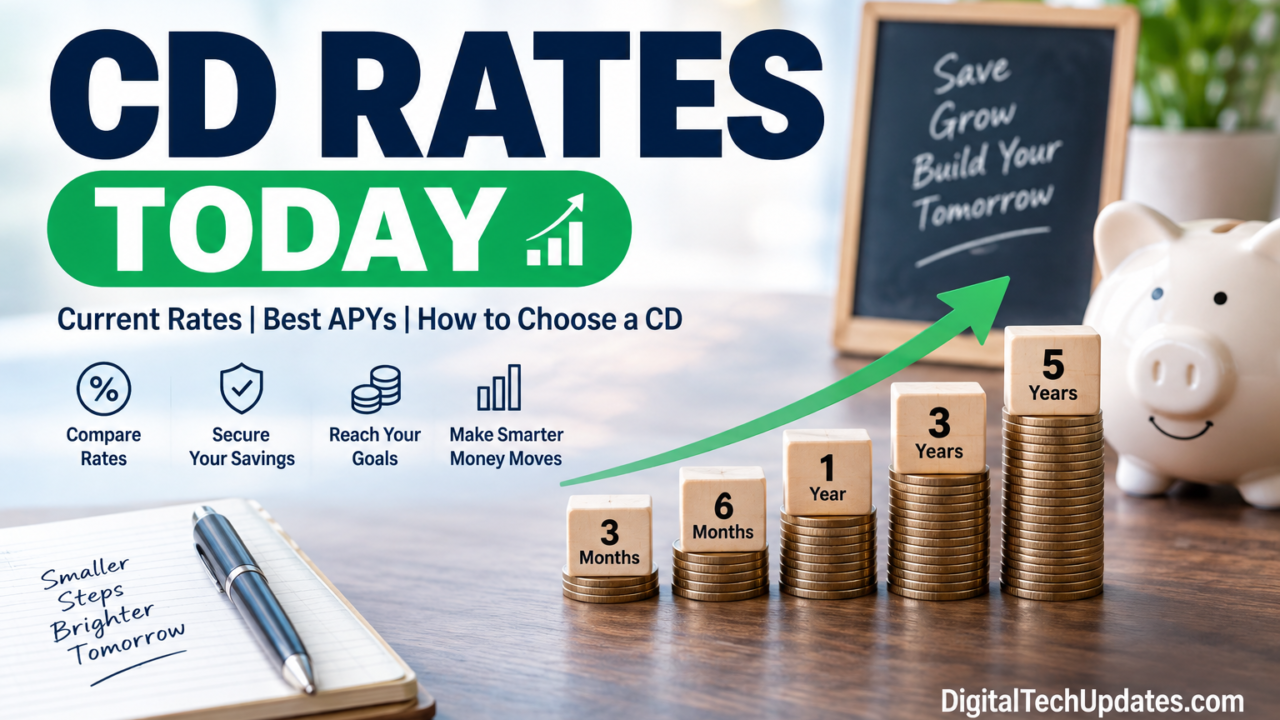
CD Rates Today: Current Rates, Best APYs and How to Choose a CD

If you have money sitting in a savings account and don’t expect to need it for several months or years, you may be wondering whether a certificate of deposit (CD) could earn you more interest.
CD rates remain competitive in September 2026, with some of the highest available offers around 4% to 4.5% APY depending on the term and financial institution. For example, current rate comparisons show some 6-month CDs above 4%, while several 1-year, 3-year and 5-year options are also around or above 4.3%.
But the highest CD rate isn’t automatically the best choice for everyone.
Your decision should also consider how long you can leave your money untouched, the minimum deposit, early-withdrawal rules, whether the institution is FDIC- or NCUA-insured, and what you expect interest rates to do next.
Here’s what to know about CD rates today and how to choose a CD that fits your savings goals.
Current CD Rates at a Glance
CD rates can change frequently, so treat the following figures as a snapshot rather than a permanent rate list.
| CD Term | Competitive APY Range* | What It May Suit |
|---|---|---|
| 3 months | Around 4% | Very short-term savings |
| 6 months | Around 4%–4.2% | Short-term goals |
| 1 year | Around 4.2%–4.35% | Medium-term savings |
| 3 years | Around 4.3%–4.5% | Longer-term goals |
| 5 years | Around 4.3%–4.5% | Money you can lock away longer |
*Rates vary by bank, credit union, deposit amount, location and date. Recent September 2026 comparisons from NerdWallet and Bankrate show top rates in these general ranges.
For example, NerdWallet’s September 2026 comparison listed a 4.20% APY for a top 6-month CD, 4.30% for a 1-year CD and up to 4.50% for 3-year and 5-year CDs.
What Are CD Rates?
A CD rate is the interest rate a bank or credit union pays you when you deposit money into a certificate of deposit for a specified period.
Unlike a regular savings account, a CD generally requires you to agree to leave your money deposited for a fixed term. That term could be a few months, one year, three years or even five years.
In exchange, the financial institution typically offers a fixed interest rate for the agreed term.
For example, suppose you deposit $10,000 into a one-year CD paying 4.30% APY. If the rate remains fixed and you meet the account’s terms, your money can earn interest over the year without being directly exposed to stock-market fluctuations.
The trade-off is flexibility. Taking money out before the CD matures may result in an early-withdrawal penalty.
What Are CD Rates Today?
As of September 2026, some of the most competitive CD rates are above 4%, although the best rate depends heavily on the term.
NerdWallet’s latest comparison showed top offers of approximately 4.05% for 3-month CDs, 4.20% for 6-month CDs, 4.30% for 1-year CDs and up to 4.50% for 3-year and 5-year CDs.
Bankrate’s September comparison similarly shows competitive rates above 4% across several popular terms. Its listings include rates of 4.35% for some 1-year CDs and 4.50% for certain 3-year and 5-year CDs.
However, don’t compare CDs using the advertised percentage alone. Always check the APY, minimum deposit, term, withdrawal penalty and insurance coverage before opening an account.
What Is a Good CD Rate Right Now?
A good CD rate is generally one that is competitive with other available CDs for the same term while coming from an institution that meets your requirements for safety, access and account terms.
Right now, an APY around 4% or higher can be competitive for many CD terms, based on current September 2026 rate comparisons.
But there’s an important distinction between the highest CD rate and the best CD for you.
Imagine two banks:
- Bank A offers 4.50% APY for five years.
- Bank B offers 4.20% APY for one year.
The first rate is higher, but you have to commit your money for much longer. If you expect rates to change or may need the money next year, the lower one-year rate could potentially be more appropriate.
The right comparison is therefore rate plus term plus flexibility, not rate alone.
Best CD Rates by Term
Best 3-Month CD Rates
Three-month CDs can make sense when you want a fixed return without committing your money for a long period.
They can be useful for money that you expect to need relatively soon, although a high-yield savings account may offer greater flexibility.
Current comparisons show some 3-month CD offers around 4% APY.
Best 6-Month CD Rates
Six-month CDs are popular with savers who want a balance between yield and a relatively short commitment.
NerdWallet’s September 2026 comparison showed a top 6-month rate of 4.20% APY, while Bankrate listed several competitive options above 4%.
A six-month CD can be particularly interesting if you don’t need the money immediately but don’t want to lock it up for several years.
Best 1-Year CD Rates
A one-year CD is one of the most commonly considered terms.
Current September 2026 comparisons show top one-year CD rates around 4.3% APY.
The one-year term can be a reasonable middle ground for someone who wants a predictable return but doesn’t want a long commitment.
Best 3-Year CD Rates
Three-year CDs generally require a larger commitment, but current offers can provide attractive yields.
Some of the best 3-year CDs are currently around 4.5% APY.
Before choosing a three-year CD, consider whether you might need access to the money before maturity.
Best 5-Year CD Rates
Five-year CDs are designed for savers who are comfortable leaving their money untouched for a longer period.
Current comparisons show some 5-year CDs around 4.5% APY.
The biggest question isn’t simply whether 4.5% looks attractive. It’s whether you’re comfortable committing your money for five years.
How Do CD Rates Work?
CD rates are generally quoted as an annual percentage yield (APY).
APY accounts for the effect of compounding and gives you a more useful way to compare deposit accounts.
Suppose you put $10,000 into a CD paying 4.50% APY for one year.
At a simple approximation, you could earn about $450 in interest over a year before taxes, assuming the CD’s terms and APY remain applicable for the entire period.
The actual amount can differ depending on the institution’s calculation and compounding method.
That’s why you should use the bank’s stated APY and maturity calculation rather than relying solely on a simple interest estimate.
Why Are CD Rates Different From One Bank to Another?
Banks and credit unions don’t all price their CDs the same way.
Several factors influence the rates you see.
Federal Reserve policy
Changes in the federal funds rate can influence what banks pay on deposits, including CDs.
Competition for deposits
Banks sometimes raise CD rates when they want to attract more deposits.
Term length
A bank may offer different rates for three-month, six-month, one-year and five-year CDs.
Institution strategy
Online banks and credit unions can sometimes offer more competitive deposit rates than traditional brick-and-mortar institutions, although this isn’t universally true.
Economic expectations
Banks consider broader economic conditions and expectations about future interest rates when setting deposit rates.
Should You Lock In a CD Rate Now?
This is one of the most important questions for people searching for CD rates today.
There isn’t a universal answer.
If you find a rate that fits your financial plan and you’re comfortable with the term, locking in a competitive fixed rate can provide predictable returns.
On the other hand, locking up money for several years can become less attractive if market rates subsequently rise substantially.
That’s why some savers prefer shorter CDs or a CD ladder rather than putting their entire savings into one long-term certificate.
What Is a CD Ladder?
A CD ladder is a strategy where you spread your money across CDs with different maturity dates.
For example, instead of putting $20,000 into one five-year CD, you could divide the money among several CDs with different terms.
As each CD matures, you can decide whether to:
- Spend the money
- Move it into a savings account
- Reinvest it into another CD
- Use a different investment strategy
The advantage is that you don’t have all your money locked away until the same date.
A CD ladder can also reduce the risk of having to make one large interest-rate decision at a single point in time.
CD vs. Savings Account: Which Is Better?
The answer depends on what you need from your money.
| Feature | CD | Savings Account |
|---|---|---|
| Fixed rate | Usually yes | Usually variable |
| Access to money | Limited during term | Generally easier |
| Early withdrawal | May incur penalty | Usually no CD-style penalty |
| Predictable return | Yes | Less predictable |
| Best for | Money you can set aside | Emergency/accessible savings |
A CD may be attractive if you know you won’t need the money during the term.
A savings account may be better if you want easy access to your cash.
For example, an emergency fund generally shouldn’t be locked into a long-term CD simply because the rate is higher.
Are CDs Safe?
CDs at FDIC-insured banks are generally considered low-risk deposit products from a bank-failure perspective.
The FDIC states that qualifying deposits, including CDs, are insured up to the applicable limit. The standard coverage amount is $250,000 per depositor, per insured bank, for each ownership category.
That doesn’t mean every financial product sold by a bank is automatically FDIC-insured. The FDIC specifically distinguishes insured deposit products from investments such as stocks, bonds and mutual funds.
If you’re considering a credit union CD, check whether the credit union is federally insured by the NCUA and understand the applicable coverage limits.
What Happens If You Withdraw Money From a CD Early?
This is one of the most important details to check before opening a CD.
Many CDs impose an early-withdrawal penalty if you take money out before maturity.
The penalty varies by institution and account.
Before opening a CD, look for:
- Early-withdrawal penalty
- Penalty calculation
- Minimum withdrawal requirements
- Whether partial withdrawals are permitted
- Automatic-renewal rules
- Maturity instructions
Don’t assume that every CD has identical withdrawal rules.
What Happens When a CD Matures?
When your CD reaches its maturity date, you typically have several choices depending on the account:
- Withdraw your principal and interest.
- Move the money into another account.
- Renew the CD.
- Choose another CD term.
Some CDs automatically renew if you don’t provide different instructions.
That’s why it’s important to know your maturity date and review the renewal terms before the CD reaches maturity.
How to Find the Best CD Rates
Don’t search only for the highest advertised number.
Instead, compare these factors:
1. APY
Use APY rather than simply looking at the nominal interest rate.
2. Term
Make sure the maturity period fits your financial plans.
3. Minimum deposit
Some high-rate CDs require hundreds or thousands of dollars to open.
4. Early-withdrawal penalty
A slightly higher rate may not be worthwhile if accessing your money early would be expensive.
5. Insurance
Confirm that the bank is FDIC-insured or that the credit union has the appropriate NCUA insurance.
6. Renewal terms
Check what happens automatically when your CD matures.
7. Interest payment options
Some institutions allow interest to be paid periodically, while others compound it or pay it at maturity.
Are CD Rates Going Up or Down?
The direction of CD rates is difficult to predict with certainty.
Recent 2026 market coverage shows that the rate environment has been changing, and some institutions have adjusted their CD pricing accordingly. NerdWallet noted that banks shifted from lowering CD rates to raising some rates during the summer as expectations around future Federal Reserve policy changed.
That uncertainty is one reason many savers avoid trying to perfectly predict the market.
Instead, consider your own timeline.
If you need the money in six months, a five-year CD may not make sense simply because it has a slightly higher APY.
Is a 4% CD Rate Good?
A 4% CD can be competitive in the current U.S. market, particularly for terms where many institutions are offering rates around that level.
Recent September 2026 comparisons show several competitive CD offers above 4%, with some reaching approximately 4.5%.
However, compare the rate with the national average, the CD term and other available options before deciding.
A higher APY doesn’t automatically mean a better account.
Can You Get a 5% CD Rate?
Five-percent CDs are not broadly available in the current market.
Current September 2026 comparisons from major rate-tracking publications generally show leading offers below 5%, with many competitive products in the 4%–4.5% range.
If you see a CD advertising an unusually high rate, read the fine print carefully.
The offer may have:
- A promotional period
- A maximum balance
- A special eligibility requirement
- A short introductory term
- A different product structure
Always verify the APY directly with the financial institution before depositing money.
Who Should Consider a CD?
A CD may be worth considering if:
- You have money you won’t need immediately.
- You want a predictable return.
- You prefer lower-risk savings products.
- You don’t want stock-market exposure for this particular money.
- You can accept limited access during the CD term.
- You find a competitive APY from an appropriately insured institution.
Who May Want to Avoid a CD?
A CD may not be appropriate if:
- You need immediate access to the money.
- You don’t have an emergency fund.
- You’re carrying expensive high-interest debt.
- You expect to need the money before maturity.
- You’re uncomfortable with locking in a rate.
- The available APY isn’t attractive compared with flexible alternatives.
Final Thoughts on CD Rates
CD rates remain worth watching in September 2026, particularly for savers looking for predictable returns without taking stock-market risk. Competitive rates are currently available around the 4% range, with some of the strongest offers reaching roughly 4.5% depending on the term and institution.
But don’t choose a CD simply because its APY is the highest number you can find.
Think about when you’ll need the money, how long you’re willing to lock it away, the early-withdrawal penalty, minimum deposit and insurance coverage.
For many savers, the best CD isn’t the one with the absolute highest rate. It’s the one that offers a competitive return without creating a problem when you need your money.
Rates mentioned in this article are time-sensitive and can change. Verify the current APY, terms, fees, withdrawal penalties and insurance status directly with the financial institution before opening an account. This article is for general educational purposes and is not personalized financial, tax or investment advice.
Frequently Asked Questions About CD Rates
What are CD rates today?
As of September 2026, competitive U.S. CD rates are generally around 4% or higher for several popular terms, with some leading offers reaching approximately 4.5%. Rates vary by institution and term.
What is a good CD rate right now?
A CD rate around 4% can be competitive in the current market, although the best rate depends on the term, institution and account requirements.
Are CD rates expected to go up?
CD-rate movements depend on factors including Federal Reserve policy, bank competition and broader economic conditions. No one can reliably guarantee the future direction of CD rates.
Can I get 5% on a CD?
Five-percent CD rates are not common among the leading U.S. offers currently tracked by major rate-comparison services. Many competitive rates are closer to 4%–4.5%.
Are CDs FDIC insured?
Eligible CDs held at FDIC-insured banks are covered by FDIC deposit insurance within applicable limits. The standard coverage is $250,000 per depositor, per insured bank, per ownership category.
What happens if I withdraw money from a CD early?
You may have to pay an early-withdrawal penalty. The amount depends on the financial institution and the specific CD agreement.
Is a CD better than a savings account?
Neither is automatically better. A CD may offer a fixed rate and predictable return, while a savings account generally provides easier access to your money.
How long should I put money in a CD?
Choose a term based on when you’ll need the money. Don’t lock up funds you’ll need for emergencies or near-term expenses simply to obtain a higher APY.
What is a CD ladder?
A CD ladder spreads money across CDs with different maturity dates. This can provide regular opportunities to access or reinvest money rather than having everything mature at the same time.
Are online banks good for CDs?
Online banks can offer competitive CD rates, but compare their APYs, terms, penalties, minimum deposits, customer service and deposit insurance before opening an account.

Thalla Lokesh
Thalla Lokesh is a Digital Marketing Strategist and SEO Specialist with over 12 years of experience in helping businesses grow their online presence. Since beginning his career in 2013, he has successfully worked across industries including healthcare, education, technology, and e-commerce. He specializes in search engine optimization (SEO), content marketing, keyword strategy, and link building, with a strong focus on delivering measurable results. Lokesh has helped brands achieve top rankings on Google through data-driven strategies, high-quality content, and ethical SEO practices aligned with search engine guidelines. As the founder of Honey Web Solutions , a Tirupati-based digital marketing company, he actively works with clients to improve organic traffic, lead generation, and online visibility. He also contributes expert insights on digital marketing trends, AI SEO, and content strategies through blogs and industry platforms.