
In today’s competitive digital landscape, having a great product or service isn’t enough. To succeed, you need a structured process that guides potential customers from awareness to purchase — and that’s where the sales funnel comes in.
A well-optimized sales funnel can help you attract qualified leads, nurture them effectively, and convert them into loyal customers. Whether you’re a marketer, entrepreneur, or business owner, understanding how sales funnels work can transform your growth strategy.
In this comprehensive guide, we’ll explore everything you need to know about sales funnels — including their stages, strategies, optimization techniques, and how to build one that drives consistent conversions.
What Is a Sales Funnel?
A sales funnel is a step-by-step process that illustrates how a potential customer moves from discovering your brand to making a purchase. It’s called a “funnel” because as prospects move through each stage, the number of people decreases — many enter, but only a few convert into paying customers.
Simply put, the sales funnel represents the customer journey — from awareness to decision.
Why Is a Sales Funnel Important?
A sales funnel is the backbone of any successful business strategy. It allows you to:
Visualize the buyer’s journey — understand how leads move through your sales process.
Improve conversion rates — identify bottlenecks and optimize each stage.
Build relationships — nurture leads with personalized communication.
Predict revenue — analyze conversion data and forecast sales growth.
Automate marketing — create targeted campaigns for different funnel stages.
Without a proper funnel, you risk losing leads because there’s no structured way to guide them toward conversion.
The 4 Main Stages of a Sales Funnel
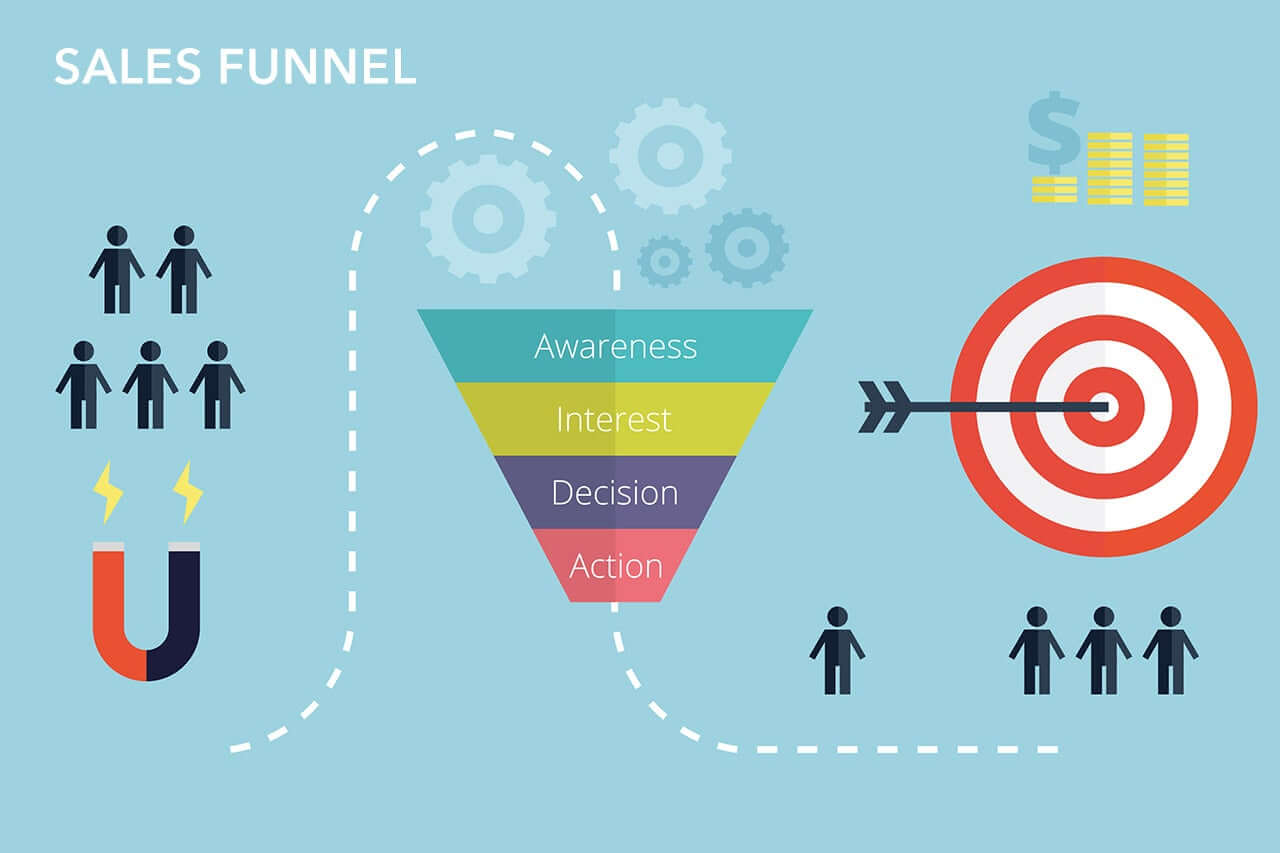
A traditional sales funnel has four core stages, often referred to as AIDA — Awareness, Interest, Decision, and Action.
1. Awareness (Top of the Funnel – TOFU)
This is where your potential customers first learn about your business. They may discover you through SEO, social media, ads, or word of mouth.
Goal: Attract attention and generate awareness.
Content Examples:
Social media campaigns
Paid ads
Infographics
Pro Tip: Focus on content marketing and brand storytelling to capture interest without being overly promotional.
2. Interest (Middle of the Funnel – MOFU)
Once people know who you are, they start exploring how your product or service can help them. This is your chance to educate and nurture leads.
Goal: Build trust and demonstrate value.
Content Examples:
Email newsletters
Case studies
E-books or whitepapers
Webinars
Product demos
Pro Tip: Use lead magnets to capture email addresses and start personalized follow-up sequences.
3. Decision (Bottom of the Funnel – BOFU)
At this stage, leads are comparing options and deciding whether to buy from you. Your goal is to convince them that your solution is the best choice.
Goal: Encourage a purchase decision.
Content Examples:
Free trials
Discount offers
Comparison charts
Testimonials and reviews
Product demos
Pro Tip: Address objections directly. Use social proof, guarantees, and clear calls-to-action (CTAs).
4. Action (Conversion and Retention)
This is the final stage — your lead becomes a customer by making a purchase. But the funnel doesn’t end here. Post-purchase engagement helps build customer loyalty and repeat business.
Goal: Convert and retain customers.
Content Examples:
Thank-you pages
Onboarding emails
Customer support
Loyalty programs
Feedback requests
Pro Tip: Offer post-purchase follow-ups and personalized offers to encourage upsells or referrals.
Extended Funnel: Adding Loyalty and Advocacy
Modern sales funnels include two additional stages beyond purchase:
Loyalty: Ensuring customers continue to buy and engage with your brand.
Advocacy: Turning satisfied customers into brand ambassadors who refer others.
These stages are crucial in building sustainable, long-term relationships rather than one-time sales.
Types of Sales Funnels
Not all sales funnels are created equal. Depending on your business model, you can use different types of funnels:
Lead Generation Funnel – Focuses on collecting email leads for nurturing.
Sales Funnel – Designed to directly sell products or services.
Webinar Funnel – Used for educational or high-ticket product promotion.
Email Funnel – A sequence of automated emails leading to conversions.
Product Launch Funnel – Builds hype and interest before releasing a new product.
Pro Tip: Choose your funnel type based on your sales cycle length and audience behavior.
How to Build an Effective Sales Funnel
Creating a sales funnel doesn’t have to be complex. Follow these actionable steps:
Step 1: Define Your Target Audience
Understand who your ideal customers are — their goals, challenges, and preferences. Create buyer personas to tailor your funnel messaging effectively.
Step 2: Create Awareness
Use digital marketing strategies such as:
SEO-optimized blog content
Social media ads
Influencer partnerships
YouTube videos
PPC campaigns
The goal is to attract potential leads and introduce them to your brand.
Step 3: Capture Leads
Convert visitors into leads using:
Lead magnets (free guides, checklists, templates)
Opt-in forms or landing pages
Webinars and free trials
Use email marketing to nurture these leads toward the next stage.
Step 4: Nurture Leads
Send personalized and automated emails that educate, engage, and build trust. Focus on:
Solving customer pain points
Sharing success stories
Providing exclusive content
Use tools like HubSpot, ActiveCampaign, or ConvertKit for automation.
Step 5: Convert Leads Into Customers
Now that your leads are engaged, guide them to make a purchase:
Offer limited-time discounts or bonuses.
Display testimonials and case studies.
Provide a clear, simple checkout process.
Step 6: Retain and Upsell
Customer retention is more profitable than acquisition. Use:
Loyalty programs
Email remarketing
Personalized upsells
Referral incentives
This ensures repeat sales and turns one-time buyers into long-term customers.
Sales Funnel Optimization Tips
To make your funnel perform better, focus on optimization:
Track Analytics: Monitor conversion rates at each stage.
A/B Testing: Experiment with CTAs, landing pages, and email subject lines.
Improve User Experience: Reduce friction in navigation and checkout.
Use Retargeting Ads: Re-engage users who didn’t convert.
Leverage CRM Tools: Track lead behavior and automate follow-ups.
Pro Tip: Small improvements at each funnel stage can drastically increase total conversions.
Common Sales Funnel Mistakes (and How to Avoid Them)
Ignoring the Top of the Funnel: You can’t convert what you don’t attract.
Weak Follow-Up Sequences: Leads need nurturing — don’t rely on one email.
Too Many Steps: Complicated funnels confuse users.
Not Segmenting Leads: Personalization increases conversions.
Neglecting Post-Sale Engagement: Retention drives profit, not just acquisition.
Real-World Example: The Perfect Sales Funnel in Action
Let’s imagine you run an online course business.
Awareness: You publish a blog titled “10 Ways to Start a Digital Business” (SEO optimized).
Interest: Readers download a free eBook in exchange for their email.
Decision: You send an email inviting them to a free webinar.
Action: At the end of the webinar, you offer a discounted course.
Loyalty: After purchase, you provide exclusive bonuses and updates.
Advocacy: Happy students share testimonials, bringing new leads.
That’s a full, automated sales funnel turning readers into customers — and then into promoters.
Best Tools to Build and Manage a Sales Funnel
ClickFunnels: All-in-one platform for building and automating funnels.
HubSpot: CRM with powerful email and automation tools.
Kartra: Funnel builder with integrated analytics.
GetResponse: Great for email and landing page creation.
Google Analytics: Essential for tracking conversions and behavior.
Tip: Choose tools that integrate easily with your CRM and ad platforms for seamless tracking.
Key Metrics to Measure Sales Funnel Success
Tracking your funnel performance helps identify what works and what doesn’t. Monitor these key metrics:
| Metric | Purpose |
|---|---|
| Conversion Rate | Measures how many leads turn into customers |
| Cost per Lead (CPL) | Tracks marketing spend efficiency |
| Average Order Value (AOV) | Average revenue per purchase |
| Customer Acquisition Cost (CAC) | Cost of acquiring one customer |
| Lifetime Value (LTV) | Total expected revenue from a customer |
| Funnel Drop-Off Rate | Identifies where leads lose interest |
Analyzing these metrics regularly helps refine your funnel strategy.
FAQs About Sales Funnels
Q1: What’s the difference between a sales funnel and a marketing funnel?
A: The marketing funnel focuses on attracting and nurturing leads, while the sales funnel focuses on converting those leads into customers.
Q2: How long should a sales funnel be?
A: It depends on your product and audience. B2B funnels are usually longer due to higher pricing, while B2C funnels are shorter and more direct.
Q3: Can I automate my sales funnel?
A: Absolutely. Tools like ClickFunnels, HubSpot, and ActiveCampaign can automate emails, lead scoring, and follow-ups.
Q4: How do I know if my funnel is working?
A: Measure metrics like conversion rate, cost per lead, and retention rate. Continuous testing helps you identify weak stages.
Q5: Do I need a sales funnel for small businesses?
A: Yes! Even small businesses benefit from structured funnels that automate lead nurturing and boost sales efficiency.
Conclusion
A sales funnel is more than a marketing concept — it’s a proven system for attracting, engaging, and converting leads into loyal customers.
Whether you’re a startup or an established enterprise, building a well-structured funnel can increase conversions, optimize marketing spend, and drive predictable growth.
Focus on understanding your audience, nurturing relationships, and delivering value at every stage. When done right, your sales funnel will become the most powerful engine behind your business success.