
Let me ask you something uncomfortable.
You have spent the last few years building your blog. Writing articles, chasing backlinks, optimising title tags. And maybe it was working — your Google traffic was growing and enquiries were coming in. Then sometime in the last year, something changed. Traffic flattened. Click-through rates dropped. You checked your rankings and you were still on page one. So what happened?
Here is what happened: a significant chunk of your readers stopped clicking. Not because your content got worse. But because Google, ChatGPT, and Perplexity started answering their questions before they ever reached your site.
60% of Google searches now end without a single click to any website — Bain & Company, 2025
That statistic should stop you in your tracks. And it is exactly why every serious blogger and digital marketer in 2026 is talking about GEO — Generative Engine Optimization.
This guide explains what GEO is, how it is different from the SEO you already know, and — most importantly — the specific steps you can take today to make sure AI-powered search engines cite your content instead of ignoring it.
📝 Editor note: ADD HERE: Open with a personal sentence like “When I checked my Google Search Console last month, I noticed something strange — my impressions went up by 49% but my clicks actually dropped.” Real experience here makes this intro far more relatable.
What is Generative Engine Optimization (GEO)?
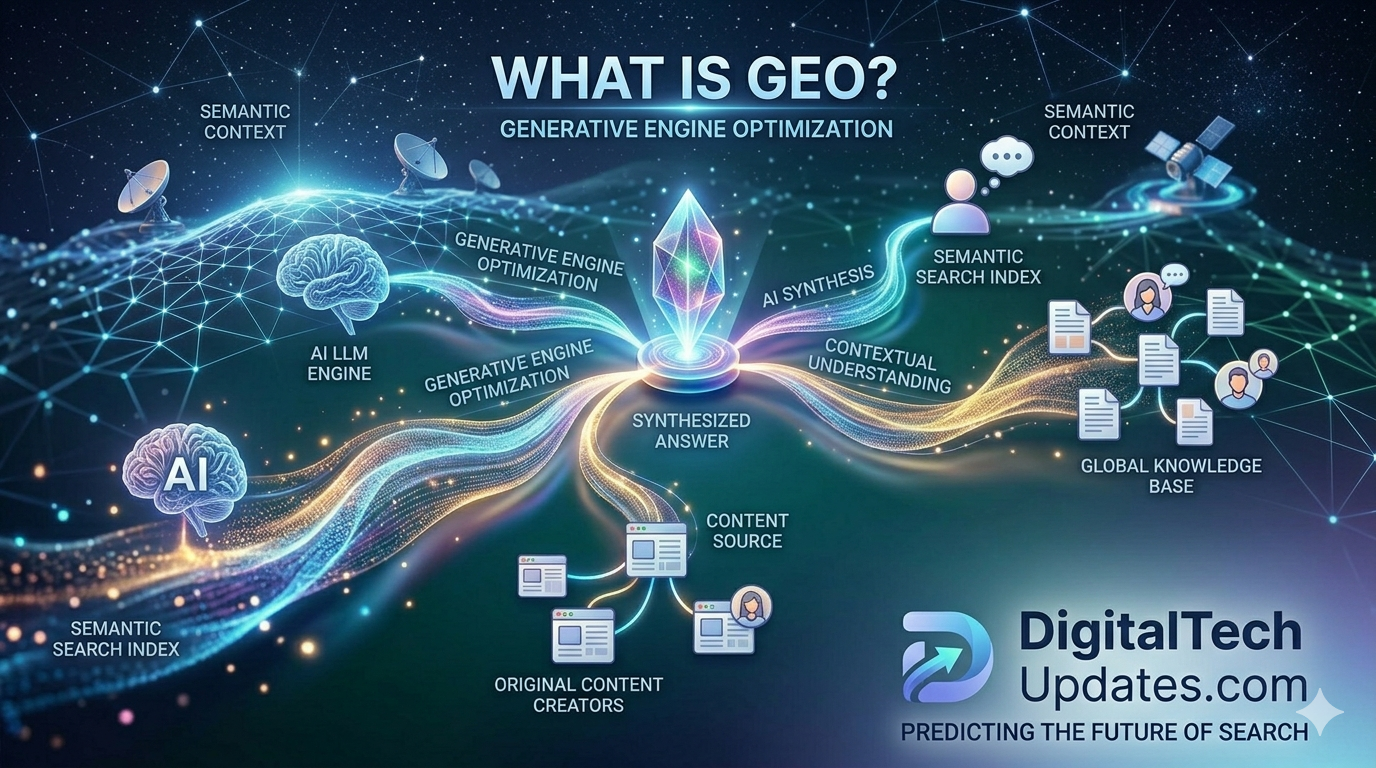
Generative Engine Optimization — GEO for short — is the practice of optimising your website and content so that AI-powered search systems like Google AI Overviews, ChatGPT, Perplexity, and Google Gemini select your content as a trusted source when they generate answers.
Traditional SEO gets your page ranked in a list of blue links. GEO gets your content quoted, cited, or summarised inside an AI-generated answer.
Think about the difference this way. A user types “best free SEO tools 2026″ into Google. Old SEO: your page appears at position 3 in the results. GEO: the AI Overview at the top of the page says “According to Digital Tech Updates, the best free SEO tools include…” — and your site gets cited directly, even before anyone scrolls to the blue links.
💡 GEO is not a replacement for SEO. It is the next layer on top of it. Sites with strong traditional SEO foundations are, in fact, better positioned for GEO than those starting from scratch. The two strategies work together.
Why GEO Has Become Urgent in 2026
Here is the honest picture of what the search landscape looks like right now, backed by data from multiple research sources:
800M+ weekly active users on ChatGPT as of late 2025 — up from 400M in February — OpenAI
25% of all Google searches now trigger an AI Overview (up 57% from Q4 2025) — Conductor Q1 2026
58% drop in click-through rates for top-ranking content when an AI Overview appears — Ahrefs 2026
4.4x higher conversion rate for visitors who arrive from AI-referred search vs traditional organic — Semrush
Let those numbers sink in. The number-one position on Google used to mean great click-through rates. In 2026, when an AI Overview is present, even the top result can see its CTR collapse to just 2.6%. That is not a small dent — it is a structural shift in how people consume information.
The good news in all of this? The visitors who do click through from AI citations convert at over four times the rate of traditional organic visitors. They arrive pre-informed, already trusting your brand because an AI just recommended you. That is an incredibly warm lead.
The window of competitive advantage is wide open right now. According to industry data, 47% of brands have zero GEO strategy in place. That means if you start today, you have a first-mover advantage in your niche.
GEO vs SEO vs AEO: How Are They Different?
You will see these three acronyms thrown around together. Here is a quick, no-jargon breakdown:
Traditional SEO (Search Engine Optimisation)
Getting your page to rank in the list of links Google shows after a search. Success is measured by position, impressions, and clicks. You optimise for crawlability, keywords, backlinks, and page experience.
GEO (Generative Engine Optimization)
Getting your content cited inside an AI-generated answer. Success is measured by brand mentions, citation frequency, and AI referral traffic. You optimise for content structure, authority signals, data richness, and answer-forward writing.
AEO (Answer Engine Optimisation)
Originally designed for voice search, AEO is now largely absorbed into GEO since most voice queries route through the same AI systems. If you are practising GEO, you are already doing AEO.
🔑 Key insight from recent research: The overlap between pages that rank in Google’s top 10 and pages that get cited by AI has dropped from 70% to below 20%. This means ranking well no longer guarantees AI visibility — and appearing in AI answers no longer requires ranking in the top 10. They are becoming two separate games.
A Real-World Example: How Zapier Used GEO to Fight Traffic Loss
✅ Real Example: Zapier’s GEO restructuring strategy
When Zapier noticed declining organic traffic coinciding with AI Overview expansion, they did not panic and add more keywords. Instead, they restructured existing content to feature clear, extractable summaries at the beginning of each integration guide. They added specific statistics about time saved, added FAQ sections addressing common follow-up questions, and made their content genuinely easier for AI systems to parse. Within three months, Zapier’s content began appearing in AI-generated responses for automation-related queries. Their brand mentions in ChatGPT responses for “workflow automation” queries increased substantially, driving qualified traffic despite fewer traditional SERP clicks. The key insight: they did not create new content. They restructured existing authority for AI comprehension.
That last sentence is the most important thing in this article. You almost certainly already have content on your blog that could be cited by AI systems — it just is not structured the right way yet.
How GEO Actually Works: What AI Systems Look For
To optimise for something, you need to understand how it works. Here is a simplified version of what happens when someone asks ChatGPT or Perplexity a question that is relevant to your content:
- The AI breaks the question into smaller sub-queries and searches across multiple sources simultaneously.
- It retrieves relevant passages from web pages using a technique called retrieval-augmented generation (RAG) — essentially pulling specific sections of content that directly answer the question.
- It synthesises those retrieved passages into a single, coherent answer — it does not copy and paste, it rewrites and merges.
- It cites the sources it used. Those citations are your traffic.
What this means for your content is that AI systems are not reading your articles the way a human does — top to bottom, appreciating your narrative arc. They are scanning for specific, directly answerable passages that can be extracted and used. If your content is buried under three paragraphs of preamble before it gets to the actual answer, an AI will skip it.
6 GEO Tactics You Can Implement This Week
These are not theoretical. Each one is based on what research and data show actually increases citation rates in 2026.
1. Lead with the answer, not the build-up
Every section of your article should answer its headline question in the first two sentences. Do not save the answer for the end of a section as a punchline. Put it first. Then provide the context, the examples, and the nuance. This is how AI systems find extractable answers.
Compare these two approaches:
❌ Before GEO: “There are many different approaches to keyword research, and experts have debated the best methods for years. Some prefer volume-first research, while others focus on difficulty scores…”
✅ After GEO: “Keyword research is the process of finding the specific words and phrases your target audience types into Google, so you can create content that ranks for those terms. The most reliable method in 2026 is to start with seed topics, then filter by keyword difficulty under 20 and volume above 500 monthly searches.”
Both cover the same topic. Only the second one will get cited.
2. Use structured data (schema markup) on every article
Research shows content with proper schema markup sees 30–40% higher visibility in AI-generated answers. Start with FAQ schema on every blog post — it is the most impactful and easiest to implement.
If you are on WordPress, the Rank Math and Yoast SEO plugins both let you add FAQ schema without touching any code. Simply add a FAQ section at the bottom of your article and enable the schema toggle in your plugin settings.
3. Add real statistics with clear attribution
AI systems overwhelmingly prefer content that cites specific data over content that makes general claims. According to Princeton, Georgia Tech, and Allen Institute of AI research, comparison articles and data-rich content make up 32.5% of all AI citations — the single largest category.
Every article you write should include at least three to five specific statistics, each clearly attributed to a source. “Studies show…” does not count. “According to Ahrefs’ 2026 keyword research report…” does.
4. Write shorter paragraphs
This one feels almost too simple, but it matters. AI retrieval systems parse content in chunks. Long walls of text are harder to extract clean answers from. Aim for paragraphs of two to three sentences maximum. Your content becomes scannable for both humans and machines.
An AI system encountering a website with 40 interconnected articles all covering different angles of SEO and digital marketing will trust that site far more than a website with one excellent article surrounded by unrelated content. This is why niche consistency matters more than ever.
For a tech and digital marketing blog like yours, this means every article you publish should be relevant to your core topics. Do not publish articles about defibrillation machines, K-pop, or crude oil prices (we covered this in our site audit). Each off-topic post actively dilutes your topical authority signal.
📝 Editor note: ADD HERE: Include a specific example of your own topical authority — e.g. “Over the past year, I have published 25 articles all focused on SEO and digital marketing. I have seen my articles start appearing in AI Overviews for competitive terms that I do not even rank in the top 5 for.” This kind of personal data is what earns E-E-A-T credibility.
6. Keep your content fresh
Research from Ahrefs found that ChatGPT is significantly more likely to cite newer pages. AI platforms prefer content that is 25.7% fresher on average than content cited in traditional search. That means updating your articles regularly — refreshing statistics, adding new examples, updating the publication date — is now an active GEO strategy, not just good housekeeping.
According to Semrush’s AI Visibility Index, 40 to 60% of cited sources in AI responses rotate every single month. That means you cannot optimise once and forget. GEO requires consistent content maintenance.
How to Measure Your GEO Performance
You cannot improve what you cannot measure. Here is how to track your GEO progress without spending money on expensive dedicated tools:
Track AI referral traffic in GA4
Set up a custom channel group in Google Analytics 4 to track referral traffic from ChatGPT, Perplexity, Gemini, and other AI platforms. Look for traffic sources containing “chat.openai.com”, “perplexity.ai”, and “gemini.google.com”. This gives you a baseline to grow from.
Manual citation testing
Every month, open ChatGPT, Perplexity, and Google AI search and type in 10 to 15 questions relevant to your blog. Note which questions mention your site or cite your content. Track this in a simple spreadsheet over time. This is the most direct measure of your GEO progress.
Monitor AI Overview appearances in Search Console
Google Search Console will show you which of your pages appear in AI Overviews through the Performance report. Filter by “Search type: Web” and look for impressions from queries where an AI Overview appeared. If your page is being shown in the context of an AI Overview, you are on the right track.
The Honest Reality: GEO Takes Time
Here is something most GEO guides will not tell you: the results are not instant. Building citation authority with AI systems works similarly to building domain authority in traditional SEO — it compounds over time.
The brands seeing the biggest GEO results in 2026 are those that started restructuring their content 6 to 12 months ago. The good news is that restructuring existing content — like Zapier did — tends to show results within 60 to 90 days, which is faster than waiting for new content to rank from scratch.
Start with your highest-traffic, most authoritative existing articles. Restructure them using the principles above. Then work backward through your content library, updating one or two articles per week.
⚠️ A word of caution: Do not chase GEO at the expense of traditional SEO. Google still sends 345 times more traffic than ChatGPT, Gemini, and Perplexity combined (as of September 2025). Traditional organic search is still king — GEO is the emerging channel you want to be in early.
Frequently Asked Questions About GEO
Does GEO replace SEO completely?
No. Traditional SEO remains essential — 99% of AI Overview citations come from pages already in Google’s organic top 10. Strong SEO is the foundation that makes GEO possible. Think of GEO as an additional optimisation layer, not a replacement.
Do I need to pay for GEO tools?
Not to start. Manual citation testing, GA4 tracking, schema markup via free WordPress plugins, and consistent content freshness all cost nothing. Dedicated GEO tracking platforms exist (averaging around $337 per month) but are not necessary for most bloggers at this stage.
Will AI-generated content hurt my GEO efforts?
Interestingly, research shows that 91.4% of content cited in AI Overviews is at least partially AI-assisted, which proves that AI-generated content does not automatically disqualify you. What matters is quality, accuracy, structure, and authority signals — not whether a human or a machine wrote the first draft.
How do I know if my site is being cited by AI?
Manual testing in ChatGPT, Perplexity, and Google AI is the most direct method. Type questions relevant to your content and see if your site gets mentioned. For scale, tools like Brandlight and Mention track AI citations automatically.
Conclusion: Start Before Your Competitors Do
GEO is not a future trend you can plan to adopt next year. The shift is happening now, and the brands establishing AI citation authority today are the ones that will dominate AI-generated recommendations in 2027 and beyond.
The practical path forward is straightforward. Pick your three best-performing articles. Rewrite the opening of each section to lead with a direct answer. Add FAQ schema. Cite real statistics with sources. Shorten your paragraphs. Then test those articles in ChatGPT and Perplexity to see if they get cited.
That is your GEO baseline. Build from there, one article at a time.
The 47% of brands with no GEO strategy right now are your opportunity. Start this week.
📝 Editor note: FINAL PERSONALISATION: End with your own call to action. Something like: “If you want to write for a blog that is actively building GEO authority and getting cited by AI systems, visit our Write For Us page. We publish guest posts on SEO, digital marketing, and technology — all topics that AI systems are actively looking for credible sources on.” This turns the article into a lead-generation asset for your guest post business.