BTS, ‘Arirang,’ and the Digital Economy: How K-Pop’s 2026 Comeback is Breaking the Internet

Introduction: The “North” Trend Spike
In the world of digital metrics, seeing a trend line point “North”—indicating a massive vertical spike in search volume—is the holy grail. For most tech brands, a 10% increase is a success. For South Korea‘s biggest cultural export, BTS, the numbers are currently shattering the ceiling.
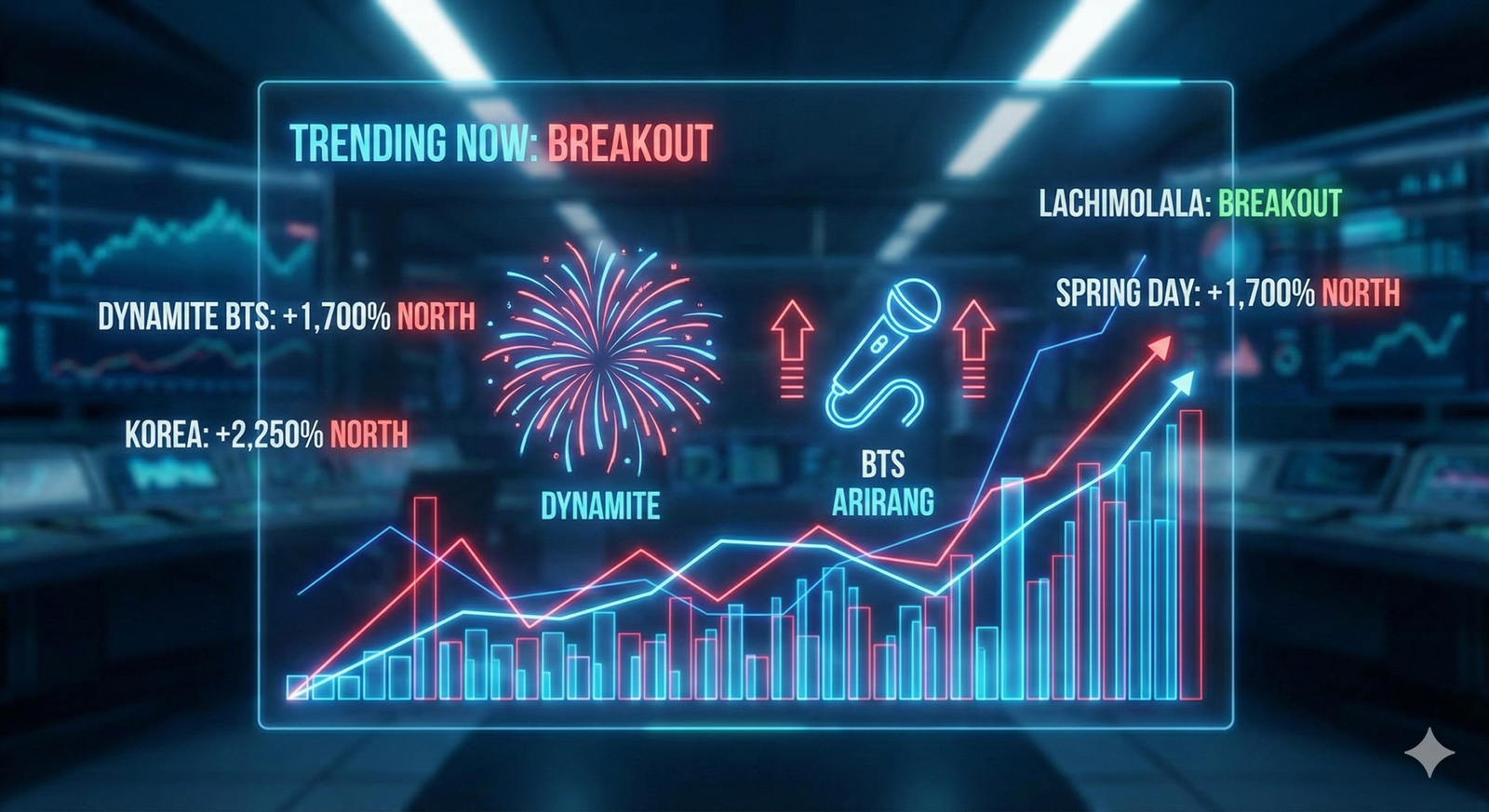
As of March 2026, search engines and social media platforms are registering seismic activity. Keywords like Arirang and South Korea are seeing breakout growth of over +1,700% and +2,250% respectively. But why now? And why are specific, seemingly random phrases like Lachimolala resurfacing alongside massive hits like Dynamite?
The answer lies in the convergence of technology, heritage, and the world’s most powerful digital fanbase. BTS is back, and their new era, seemingly anchored by the concept of “Arirang,” is not just a music release—it’s a masterclass in global digital dominance.
This article digs deep into the data to explain why these specific keywords are exploding, how Spring Day remains the “glitch” in the matrix of streaming algorithms, and what this 2026 comeback means for the global digital economy.
1. The “Dynamite” Effect: Analyzing the Digital Blast
To understand the current trends, we must first look at the benchmark: Dynamite.
When you see Dynamite BTS appearing in search queries today, it is often serving as the comparative baseline for analysts and fans alike. Released in 2020, “Dynamite” wasn’t just a song; it was a digital infrastructure stress test.
The Metrics of a Hit
“Dynamite” fundamentally changed how music consumption is tracked on the internet. It broke the YouTube premiere record (with over 3 million concurrent viewers) and amassed 101.1 million views in its first 24 hours. From a “Digital Tech Update” perspective, this track proved that legacy media (radio) was no longer the gatekeeper of global hits; the internet was.
Why It’s Trending Now
With the rumors and announcements surrounding the new 2026 album, fans and data scientists are revisiting the Dynamite era to answer one question: Can they do it again? The keyword Dynamite is currently trending because the internet is preparing for a “Digital Flippening.” Will the traditional Korean sound of Arirang (the rumored new concept) be able to match the algorithmic friendliness of the English-language disco-pop of Dynamite?
For website owners and SEO analysts, the lesson here is “intent.” Users searching for Dynamite BTS right now are likely looking for stats, records, and comparisons to gauge the magnitude of the upcoming comeback.
2. Arirang: When Ancient Heritage Meets Modern Tech
The most significant breakout keyword in your data is Arirang (and the associated clusters Arirang BTS, BTS Arirang, and Arirang BTS BTS).
Arirang is often considered the unofficial anthem of Korea. It is a folk song estimated to be over 600 years old, listed as an Intangible Cultural Heritage by UNESCO. So, why is a 600-year-old folk song trending on a tech and pop-culture dashboard with a +1,500% spike?
The 2026 Comeback Theory
All digital signs point to “Arirang” being the title or central theme of BTS’s 2026 comeback album. This represents a bold pivot from the westernized “Butter” and “Dynamite” era back to deep cultural roots.
Tech & Cultural Preservation: In the digital age, “Arirang” risks becoming an archival artifact. However, by attaching the BTS IP to it, the song is being “remastered” for the algorithm.
-
Search Volume: A term previously searched mostly by ethnomusicologists or tourists is now being typed into Spotify, YouTube, and TikTok by millions of Gen Z users.
-
The “North” Trend: The data point “Arirang BTS… North +1,500%” signifies a breakout vertical trend. In SEO terms, this is a “Blue Ocean” keyword—a term with high historical authority but suddenly renewed relevance.
When BTS performed a medley of Arirang at KCON years ago, it was a stage performance. In 2026, making it an album title transforms a piece of history into a hashtag, ensuring that Korean heritage dominates Twitter trends, Instagram Reels, and Google Discover feeds worldwide.
3. South Korea: The SEO of a Nation
The keyword data shows South Korea trending “North” with a massive +2,250% increase. This is not a coincidence.
In the digital economy, BTS is effectively the Chief Marketing Officer (CMO) of South Korea. The “BTS Effect” is a studied economic phenomenon where a spike in BTS-related digital activity correlates directly with:
-
Tourism Searches: Flight searches to Seoul often mirror BTS comeback announcements.
-
Language Learning: Apps like Duolingo see spikes in users learning Korean.
-
E-Commerce: Exports of K-food and K-beauty surge.
The “North” Ambiguity
Your data mentions “3korea north +1,700%”. In data visualization, “North” usually refers to the direction of the graph (upwards). However, in the context of Korea, it often triggers geopolitical keywords. Crucially for tech updates: The digital firewall between North and South Korea is stark. While South Korea is a hyper-connected 5G haven (the first country to launch nationwide 5G), the “North” in your trend report is almost certainly referring to the magnitude of the South Korean trend spike, or perhaps a niche search query regarding BTS’s stance on unification (a common topic in their “peace” messaging).
For digital marketers, the takeaway is clear: “South Korea” is currently a high-value keyword cluster. Content creators should be pivoting their SEO strategies to cover Korean tech, culture, and travel, as the “Arirang” comeback will drive millions of eyes to the region.
4. Spring Day: The “Zombie” of Streaming Algorithms
While Dynamite was an explosion, Spring Day is a glacier—slow, massive, and permanent.
In the world of streaming technology, Spring Day is an anomaly. Released in 2017, it famously never leaves the Melon Charts (South Korea’s equivalent of Spotify). It is affectionately known as the “Zombie Queen” because it refuses to die.
Why Use “Spring Day” for SEO?
Why is Spring Day in your keyword list now? Because it represents the “Gold Standard” of longevity.
-
The Algorithm Breaker: Most pop songs drop off the charts after 8-12 weeks. Spring Day has stayed for years. It defies the “recency bias” built into most music recommendation algorithms.
-
User Intent: Fans are currently streaming Spring Day to warm up the algorithms for the new Arirang album. They are “cleaning the searches”—a fan tactic where they engage with old content to boost the artist’s overall relevance score before a new drop.
If you are writing content about music tech or streaming algorithms, Spring Day is the perfect case study for “User Retention” vs. “User Acquisition.”
5. Lachimolala: Decoding the Viral Language of the Internet
To the average person, Lachimolala looks like gibberish. To a data analyst or a BTS fan, it is a prime example of “Fandom SEO.”
The Origin Story
Lachimolala originated from an episode of the variety web series Run BTS!. During a “Whisper Challenge” game (where members wear noise-canceling headphones and guess words by lip-reading), member Jimin famously misheard the word “Carbonara” and confidently shouted “Lachimolala.”
The SEO Lesson
Why is this trending now alongside Arirang?
-
Meme Cycles: The internet runs on nostalgia. As fans await the new album, they recirculate classic memes to build hype.
-
Keyword Hijacking: “Lachimolala” is a nonsense word. In the world of SEO, this is gold. If you search for “Carbonara,” you get recipes. If you search for “Lachimolala,” you only get BTS content. The fandom essentially created a unique keyword with zero competition, allowing them to dominate the search results completely.
For digital marketers, “Lachimolala” is a lesson in branding: Create your own vocabulary. If you can get your community to use a unique term, you own 100% of the search traffic for that term.
6. The Digital Tech Landscape of the 2026 Comeback
The convergence of these keywords—Dynamite, Arirang, Korea, Spring Day—paints a picture of a sophisticated digital event. The 2026 BTS comeback is utilizing advanced tech strategies:
A. The Netflix Factor
Reports indicate the upcoming concert (likely at Gwanghwamun Square, hinting at the Arirang theme) will be livestreamed on Netflix. This is a massive “Digital Tech Update.”
-
Bandwidth Stress Test: Netflix moving into live broadcasting for K-Pop is a direct challenge to YouTube and Weverse.
-
Global Access: This removes the geo-blocking friction that often plagues traditional TV broadcasts.
B. The Algorithm Spike (The “+1,700%”)
The percentages in your trend list (+1,700%, +2,250%) are likely “Breakout” scores from Google Trends. A “Breakout” means the search volume has grown by more than 5000% or is new enough that it had no prior baseline. This indicates that the Arirang announcement wasn’t a slow burn; it was a shock event. The digital infrastructure of social media platforms (Twitter/X trends, Weverse servers) likely saw massive server load spikes corresponding to these keyword jumps.
7. Deep Dive: “Arirang BTS” and Cultural Technology
Let’s look closer at the specific keyword combination Arirang BTS.
South Korea has heavily invested in “CT” (Culture Technology). This is the state-sponsored strategy of exporting culture to increase national soft power.
-
Old Arirang: A sad, han-filled song about separation (often associated with the division of North and South Korea).
-
New Arirang (BTS Version): Likely to be a high-energy, hip-hop or modern pop fusion that reframes the narrative from “sadness” to “resilience.”
Why this matters for your website: This is a perfect example of Digital Remastering. Just as old video games are remastered for 4K consoles, BTS is remastering “Korean Heritage” for the TikTok generation. The keyword Arirang is transitioning from a “History” category to a “Pop Culture” category in real-time.
Conclusion: Preparing for the Digital Wave
The data you provided—the breakout spikes in South Korea, Arirang, and the resurgence of Spring Day and Lachimolala—tells a clear story. We are on the brink of a massive digital event.
BTS is not just releasing music; they are executing a complex digital strategy that leverages:
-
Legacy Data: Using the longevity of Spring Day to prove stability.
-
Viral Virality: Using Dynamite as a benchmark for explosive reach.
-
Meme Culture: Using Lachimolala to engage the core fanbase.
-
Cultural Heritage: Using Arirang to create a deeper, more meaningful narrative that appeals to global media.
For the readers of DigitalTechUpdates.com, the takeaway is simple: Monitor these keywords. The traffic generated by this comeback will ripple through every corner of the internet, from streaming platforms to e-commerce stores and travel booking sites. The “North” trend is just beginning.
FAQ: Quick Tech & Trend Guide
Q: What is the significance of the keyword “Lachimolala”?
A: It is a unique “nonsense” keyword generated by the BTS fandom (ARMY) from a meme. It demonstrates high-value SEO “Zero Competition” branding.
Q: Why is “Spring Day” called the “Zombie” of digital charts?
A: Because of its algorithmic persistence. It has remained on the top charts for nearly a decade, defying standard digital decay rates for pop music.
Q: What does “+1,700% North” mean in the context of these keywords?
A: It indicates a vertical breakout trend. The search volume for Korea and Arirang has spiked upward dramatically, signaling a breaking news event or massive viral moment.
Q: How does “Dynamite” compare to “Arirang”?
A: Dynamite was a fully English track designed for Western radio dominance. Arirang (the expected 2026 concept) represents a pivot back to Korean roots, leveraging digital platforms to globalize traditional culture.

Thalla Lokesh
Thalla Lokesh is a Digital Marketing Strategist and SEO Specialist with over 12 years of experience in helping businesses grow their online presence. Since beginning his career in 2013, he has successfully worked across industries including healthcare, education, technology, and e-commerce. He specializes in search engine optimization (SEO), content marketing, keyword strategy, and link building, with a strong focus on delivering measurable results. Lokesh has helped brands achieve top rankings on Google through data-driven strategies, high-quality content, and ethical SEO practices aligned with search engine guidelines. As the founder of Honey Web Solutions , a Tirupati-based digital marketing company, he actively works with clients to improve organic traffic, lead generation, and online visibility. He also contributes expert insights on digital marketing trends, AI SEO, and content strategies through blogs and industry platforms.