Trigonometry Table 0° to 360° – Sin, Cos, Tan Values

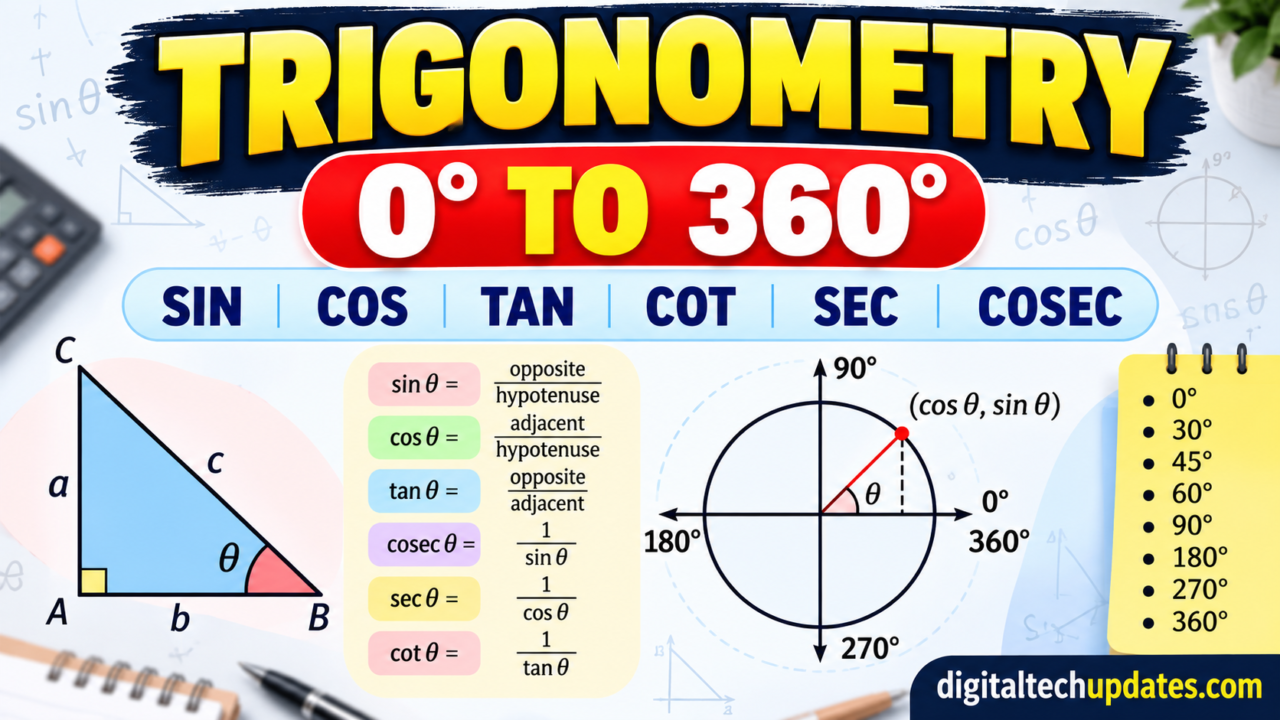
If you are studying Class 10 Maths, SSC Maths, or preparing for competitive exams, remembering trigonometric values is very important. The Trigonometry Table gives the values of sin, cos, tan, cot, sec and cosec for commonly used angles.
Students often search for the trigonometric table before exams because it makes solving many questions much easier. Instead of trying to calculate every value separately, you can use the table to quickly find the required trigonometric ratio.
In this guide, you will find the Trigonometry Table from 0° to 360°, important values from 0° to 90°, easy tricks to remember them, important formulas and a quick reference table for Class 10 students.
Trigonometry Table 0° to 90°
The following are the most commonly used trigonometric values:
| Angle | 0° | 30° | 45° | 60° | 90° |
|---|---|---|---|---|---|
| sin θ | 0 | 1/2 | 1/√2 | √3/2 | 1 |
| cos θ | 1 | √3/2 | 1/√2 | 1/2 | 0 |
| tan θ | 0 | 1/√3 | 1 | √3 | Not Defined |
| cot θ | Not Defined | √3 | 1 | 1/√3 | 0 |
| sec θ | 1 | 2/√3 | √2 | 2 | Not Defined |
| cosec θ | Not Defined | 2 | √2 | 2/√3 | 1 |
This is the main trigonometry table for Class 10 and is especially useful for questions involving standard angles.
Trigonometry Table 0° to 360°
For questions involving angles in all four quadrants, it is useful to know the signs and values of the trigonometric ratios.
| Angle | sin θ | cos θ | tan θ |
|---|---|---|---|
| 0° | 0 | 1 | 0 |
| 30° | 1/2 | √3/2 | 1/√3 |
| 45° | 1/√2 | 1/√2 | 1 |
| 60° | √3/2 | 1/2 | √3 |
| 90° | 1 | 0 | Not Defined |
| 120° | √3/2 | -1/2 | -√3 |
| 135° | 1/√2 | -1/√2 | -1 |
| 150° | 1/2 | -√3/2 | -1/√3 |
| 180° | 0 | -1 | 0 |
| 210° | -1/2 | -√3/2 | 1/√3 |
| 225° | -1/√2 | -1/√2 | 1 |
| 240° | -√3/2 | -1/2 | √3 |
| 270° | -1 | 0 | Not Defined |
| 300° | -√3/2 | 1/2 | -√3 |
| 315° | -1/√2 | 1/√2 | -1 |
| 330° | -1/2 | √3/2 | -1/√3 |
| 360° | 0 | 1 | 0 |
How to Remember the Sin Table Easily
There is a simple pattern that students can use to remember the values of sin θ for 0°, 30°, 45°, 60° and 90°.
Write:
√0/2, √1/2, √2/2, √3/2, √4/2
Now simplify:
- √0/2 = 0
- √1/2 = 1/2
- √2/2 = 1/√2
- √3/2 = √3/2
- √4/2 = 1
So the sequence is:
0, 1/2, 1/√2, √3/2, 1
How to Remember the Cos Table
The cosine table follows the same values but in reverse order.
For 0° to 90°:
1, √3/2, 1/√2, 1/2, 0
A simple way to remember it is:
cos θ = sin (90° − θ)
For example:
- cos 0° = sin 90° = 1
- cos 30° = sin 60° = √3/2
- cos 45° = sin 45° = 1/√2
- cos 60° = sin 30° = 1/2
- cos 90° = sin 0° = 0
How to Find Tan Values
The basic relationship is:
tan θ = sin θ / cos θ
For example:
tan 30°
tan 30° = (1/2) ÷ (√3/2)
= 1/√3
tan 45°
tan 45° = (1/√2) ÷ (1/√2)
= 1
tan 60°
tan 60° = (√3/2) ÷ (1/2)
= √3
Therefore:
tan 0° = 0
tan 30° = 1/√3
tan 45° = 1
tan 60° = √3
tan 90° = Not Defined
Trigonometric Ratios and Their Relationships
There are six important trigonometric ratios:
- sin θ
- cos θ
- tan θ
- cot θ
- sec θ
- cosec θ
Their basic relationships are:
tan θ = sin θ / cos θ
cot θ = cos θ / sin θ
sec θ = 1 / cos θ
cosec θ = 1 / sin θ
cot θ = 1 / tan θ
These relationships are frequently useful when solving Class 10 Maths questions.
Important Trigonometric Identities
Students should also remember these important identities:
sin²θ + cos²θ = 1
1 + tan²θ = sec²θ
1 + cot²θ = cosec²θ
These identities are commonly used to simplify trigonometric expressions and prove equations.
Signs of Trigonometric Ratios in Four Quadrants
When an angle goes beyond 90°, the values of trigonometric ratios can be positive or negative.
A useful shortcut is:
ASTC
It represents:
- A – All positive in the first quadrant
- S – Sin positive in the second quadrant
- T – Tan positive in the third quadrant
- C – Cos positive in the fourth quadrant
First Quadrant: 0° to 90°
All six trigonometric ratios are positive.
Second Quadrant: 90° to 180°
Only sin and cosec are positive.
Third Quadrant: 180° to 270°
Only tan and cot are positive.
Fourth Quadrant: 270° to 360°
Only cos and sec are positive.
This trick can make questions involving angles such as 120°, 150°, 210°, 225°, 300° and 330° much easier.
Why Is the Trigonometry Table Important?
The trigonometric table is useful because many questions directly or indirectly require standard-angle values.
For example, you may be asked to find:
sin 60° + cos 60°
Using the table:
sin 60° = √3/2
cos 60° = 1/2
Therefore:
sin 60° + cos 60° = (√3 + 1)/2
Without remembering the standard values, solving such questions takes more time.
Trigonometry Table for Class 10 Students
If you are preparing for a Class 10 Maths examination, concentrate first on these five angles:
0°, 30°, 45°, 60° and 90°
Make sure you know the values of:
- sin
- cos
- tan
- cosec
- sec
- cot
Once these values are familiar, questions involving complementary angles and trigonometric identities become much easier.
Quick Trigonometry Revision Table
| Ratio | 0° | 30° | 45° | 60° | 90° |
|---|---|---|---|---|---|
| sin θ | 0 | 1/2 | 1/√2 | √3/2 | 1 |
| cos θ | 1 | √3/2 | 1/√2 | 1/2 | 0 |
| tan θ | 0 | 1/√3 | 1 | √3 | Not Defined |
| cosec θ | Not Defined | 2 | √2 | 2/√3 | 1 |
| sec θ | 1 | 2/√3 | √2 | 2 | Not Defined |
| cot θ | Not Defined | √3 | 1 | 1/√3 | 0 |
Easy Tips to Memorize the Trigonometry Table
Instead of trying to memorize the entire table at once, learn it in small steps.
Step 1: Learn Sin
Remember:
0, 1/2, 1/√2, √3/2, 1
Step 2: Reverse It for Cos
Remember:
1, √3/2, 1/√2, 1/2, 0
Step 3: Calculate Tan
Use:
tan θ = sin θ / cos θ
Step 4: Remember Reciprocal Ratios
- cosec θ = 1/sin θ
- sec θ = 1/cos θ
- cot θ = 1/tan θ
This method is generally easier than memorizing all six rows separately.
Common Mistakes Students Make
While using the trigonometry table, students sometimes make simple mistakes.
1. Confusing sin and cos
Remember that the sin values increase from 0 to 1 between 0° and 90°, while the cos values decrease from 1 to 0.
2. Forgetting that tan 90° is not defined
Since:
tan θ = sin θ / cos θ
and cos 90° = 0, tan 90° is not defined.
3. Missing negative signs
For angles above 90°, don’t simply use the positive value from the 0°–90° table. First identify the quadrant and then apply the correct sign.
4. Mixing up reciprocal ratios
Remember:
sec = 1/cos
cosec = 1/sin
cot = 1/tan
Frequently Asked Questions
What is the trigonometry table?
The trigonometry table is a reference table containing the values of sin, cos, tan, cot, sec and cosec for commonly used angles.
What are the important angles in the trigonometry table?
For Class 10 Maths, the most important standard angles are 0°, 30°, 45°, 60° and 90°.
What is sin 30°?
sin 30° = 1/2
What is cos 60°?
cos 60° = 1/2
What is tan 45°?
tan 45° = 1
What is sin 90°?
sin 90° = 1
What is cos 90°?
cos 90° = 0
What is tan 90°?
tan 90° is not defined.
How can I memorize the trigonometry table quickly?
Start by memorizing the five sin values for 0°, 30°, 45°, 60° and 90°. Reverse those values to get the cos values, and then use the relationships between sin, cos and tan to find the remaining ratios.
Conclusion
The Trigonometry Table is one of the most useful quick-reference resources for Class 10 Maths and other competitive examinations. Learning the standard values of sin, cos, tan, cot, sec and cosec can save considerable time while solving problems.
Start with the five standard angles — 0°, 30°, 45°, 60° and 90° — and gradually learn how these values change in the four quadrants. With regular practice, the table becomes much easier to remember.
For exam preparation, keep this table handy and revise it regularly rather than trying to memorize everything just before the examination.

Thalla Lokesh
Thalla Lokesh is a Digital Marketing Strategist and SEO Specialist with over 12 years of experience in helping businesses grow their online presence. Since beginning his career in 2013, he has successfully worked across industries including healthcare, education, technology, and e-commerce. He specializes in search engine optimization (SEO), content marketing, keyword strategy, and link building, with a strong focus on delivering measurable results. Lokesh has helped brands achieve top rankings on Google through data-driven strategies, high-quality content, and ethical SEO practices aligned with search engine guidelines. As the founder of Honey Web Solutions , a Tirupati-based digital marketing company, he actively works with clients to improve organic traffic, lead generation, and online visibility. He also contributes expert insights on digital marketing trends, AI SEO, and content strategies through blogs and industry platforms.