RPF SI Syllabus 2026: Exam Pattern, Subject-Wise Topics and Preparation Tips

Introduction
Candidates preparing for the Railway Protection Force (RPF) Sub-Inspector examination should understand the syllabus before beginning their preparation. Knowing which subjects carry more marks, what topics to study, and how the computer-based test is structured can help candidates build a practical study plan.
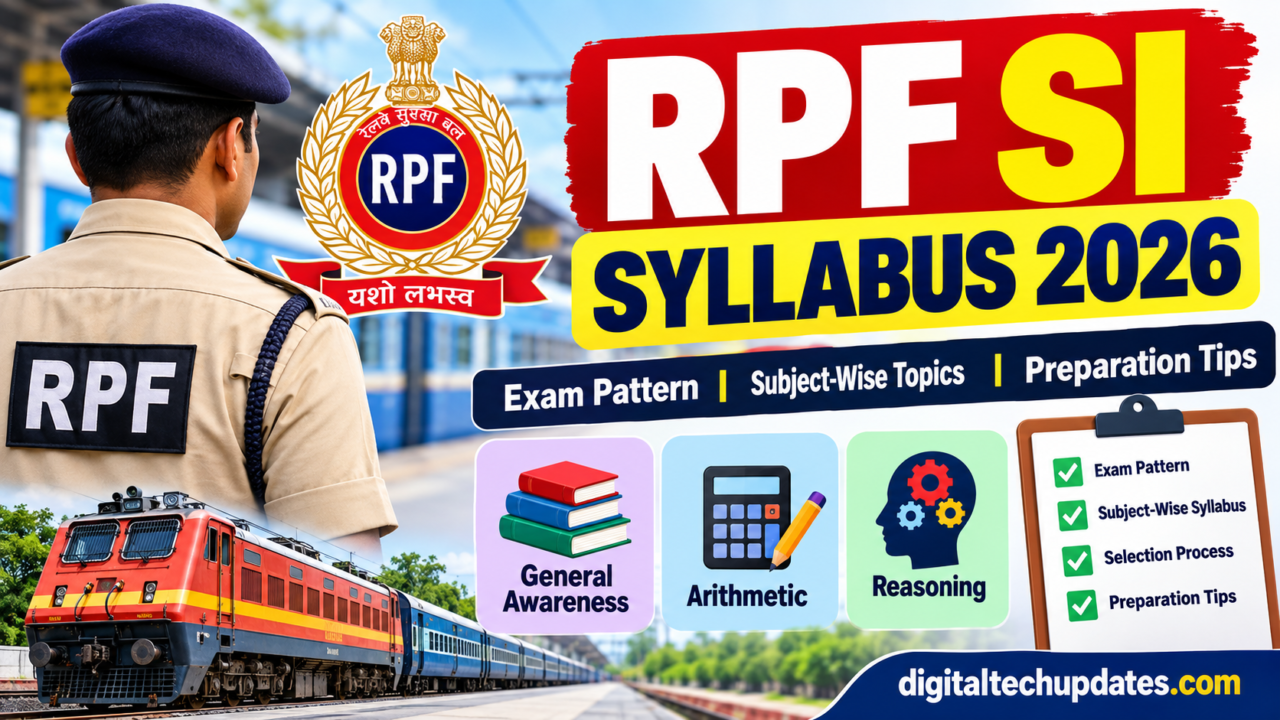
The RPF SI syllabus covers three main areas: General Awareness, Arithmetic, and General Intelligence and Reasoning. Under the previous official recruitment notification, the computer-based test consisted of 120 questions for 120 marks, with a duration of 90 minutes.
However, candidates searching for the RPF SI syllabus 2026 should note an important update. The previous recruitment cycle was conducted under RRB Centralised Employment Notice CEN RPF 01/2024. The RPF (Amendment) Rules, 2025 introduced changes to the recruitment framework, and the next recruitment cycle may follow a different process. Candidates should therefore check the latest official notification before treating the previous exam pattern as final.
In this guide, you will find the previous official RPF SI exam pattern, the complete subject-wise syllabus, the selection process, and practical preparation tips.
RPF SI Syllabus 2026: Overview
The following table summarizes the key details of the previous official RPF SI recruitment examination. These details are a reference for preparation, not confirmation of the next recruitment cycle’s pattern.
| Particulars | Details |
|---|---|
| Exam name | RPF Sub-Inspector (Executive) |
| Recruiting authority | RRBs under the previous CEN RPF 01/2024 |
| Exam mode | Computer-Based Test (CBT) |
| Subjects | General Awareness, Arithmetic, General Intelligence and Reasoning |
| Total questions | 120 |
| Total marks | 120 |
| Exam duration | 90 minutes |
| Marks per correct answer | 1 mark |
| Negative marking | One-third mark for each incorrect answer |
| Selection stages in the previous cycle | CBT, PET, PMT and Document Verification |
Important: The next recruitment notification may specify a different recruiting authority, exam structure, eligibility requirements, or physical standards. Always follow the applicable official notification.
RPF SI Exam Pattern
Under the previous official RPF SI notification, the CBT was divided into three sections. General Awareness carried the highest weightage, making it an important part of the preparation strategy.
Subject-wise marks distribution
| Subject | Questions | Marks |
|---|---|---|
| General Awareness | 50 | 50 |
| Arithmetic | 35 | 35 |
| General Intelligence and Reasoning | 35 | 35 |
| Total | 120 | 120 |
Candidates had 90 minutes to complete the test. Each correct answer earned one mark, while each incorrect answer resulted in a deduction of one-third of a mark. Unattempted questions did not attract negative marking under the previous notification.
The previous notification also prescribed minimum qualifying percentages of 35% for UR, EWS and OBC-NCL candidates and 30% for SC and ST candidates. These should not be assumed to apply unchanged to a future recruitment cycle. Refer to the new notification for the applicable rules.
RPF SI Subject-Wise Syllabus
The following sections explain the topics listed in the previous official syllabus. The official notification describes broad subject areas rather than guaranteeing that every example below will appear in the examination.
1. RPF SI General Awareness Syllabus
General Awareness carried 50 marks in the previous CBT, making it the largest section by marks. Candidates should prepare both static general knowledge and current affairs.
Important topics include:
- Current affairs and important national and international events
- Indian history
- Indian art and culture
- Indian and world geography
- Indian economy
- General polity
- Indian Constitution
- Sports and sporting events
- General science
- Important developments in science and technology
- Important personalities, awards and significant events
How to prepare: Study one current-affairs topic each day and revise static GK regularly. Focus on understanding important historical events, constitutional concepts, geographical facts and basic scientific principles rather than relying entirely on memorization.
For current affairs, use reliable news sources and revise important developments from the months leading up to the examination. The relevant period and emphasis should be adjusted to the next official notification and the observed question pattern.
2. RPF SI Arithmetic Syllabus
Arithmetic tests numerical understanding, calculation accuracy and the ability to solve mathematical problems within a limited time.
The previous official syllabus included the following areas:
- Number systems
- Whole numbers
- Decimals and fractions
- Relationships between numbers
- Fundamental arithmetic operations
- Percentages
- Ratio and proportion
- Averages
- Interest
- Profit and loss
- Discount
- Tables and graphs
- Mensuration
- Time and distance
Candidates should practise different question formats within these topics. For example, percentage questions may involve changes in prices, while time-and-distance questions may involve calculating travel time from speed and distance.
How to prepare: Start with number systems, fractions, percentages and ratio and proportion. Once the basic concepts are clear, move to averages, profit and loss, interest, time and distance, and mensuration.
Practise calculations without relying on a calculator. Keep a separate notebook for formulas and mistakes, and revisit questions that take too long to solve.
3. RPF SI General Intelligence and Reasoning Syllabus
The reasoning section tests logical thinking, pattern recognition, analytical ability and decision-making skills.
The previous official syllabus included:
- Analogies
- Similarities and differences
- Spatial visualization
- Spatial orientation
- Problem-solving analysis
- Judgment and decision-making
- Visual memory
- Discriminating observation
- Relationship concepts
- Arithmetical reasoning
- Verbal and figure classification
- Arithmetic number series
- Non-verbal series
- Coding and decoding
- Statement and conclusion
- Syllogistic reasoning
How to prepare: Begin with analogy, classification, number series, coding-decoding and relationship questions. Practise directions, syllogisms and other logical reasoning topics as you become more comfortable.
Review incorrect answers carefully. The objective is not simply to solve more questions but to understand the logic behind each answer and apply it consistently.
RPF SI Physical Efficiency Test (PET) and Physical Measurement Test (PMT)
In the previous recruitment cycle, candidates shortlisted through the CBT proceeded to the Physical Efficiency Test, Physical Measurement Test and Document Verification, subject to the applicable recruitment rules.
The PET assessed physical performance through activities such as running, long jump and high jump. The PMT checked prescribed physical measurements.
Candidates should not rely on old physical standards without checking the next notification. The applicable requirements may depend on the recruitment rules, category and candidate group.
How to prepare for the physical tests
- Begin regular physical training well before the examination stages.
- Increase running distance and intensity gradually.
- Practise jumping techniques safely and consistently.
- Include warm-ups, recovery and rest days in your routine.
- Check the official medical and physical requirements before applying.
Candidates should follow the official notification for the exact PET events, timings, jump requirements, height and chest measurements, and any applicable relaxations.
RPF SI Selection Process
The previous RPF SI recruitment cycle used the following stages:
- Computer-Based Test: Candidates appeared for the objective examination covering General Awareness, Arithmetic, and General Intelligence and Reasoning.
- Physical Efficiency Test: Shortlisted candidates underwent the prescribed physical performance tests.
- Physical Measurement Test: Candidates were assessed against the applicable physical measurement requirements.
- Document Verification: Educational qualifications, identity, category certificates and other required documents were checked.
Medical fitness and other applicable recruitment requirements must also be satisfied. Candidates should check the current notification for the complete selection procedure and the order of stages.
How to Prepare for the RPF SI Exam
A useful preparation plan should balance all three subjects instead of concentrating on only one area.
Step 1: Understand the syllabus
Read the official syllabus and divide each subject into smaller topics. Mark topics you already understand and those that need additional practice.
Step 2: Build your arithmetic fundamentals
Practise basic calculations and formulas before attempting difficult questions. Work on speed only after you can solve questions accurately.
Step 3: Practise reasoning every day
Reasoning improves with regular practice. Solve a mixture of question types and review the logic behind mistakes.
Step 4: Revise General Awareness consistently
Use concise notes for history, geography, polity, science and current affairs. Short, frequent revision sessions are more manageable than trying to memorize everything at once.
Step 5: Attempt mock tests
Once you have covered the basic topics, take timed mock tests. Use the results to identify weak subjects and track whether your accuracy is improving.
Step 6: Learn to manage negative marking
Under the previous pattern, an incorrect answer reduced the score by one-third of a mark. Avoid guessing blindly. Practise eliminating clearly incorrect options and deciding when a question is worth attempting.
Step 7: Prepare physically alongside written study
Do not postpone physical preparation until after the CBT results. Build a sustainable routine and adjust it to the physical requirements confirmed in the relevant notification.
Suggested Daily Study Timetable
Candidates who are studying alongside college or work can adapt the following example to their available time.
| Study session | Activity | Suggested duration |
|---|---|---|
| Morning | General Awareness and current affairs | 45 minutes |
| Afternoon | Arithmetic concepts and practice | 60 minutes |
| Evening | Reasoning questions | 45 minutes |
| Night | Revision and error analysis | 30 minutes |
This is a sample schedule, not an official requirement. Candidates with more preparation time can increase their practice sessions and include regular full-length mock tests.
Best Preparation Strategy for Each Subject
| Subject | Main focus | Recommended practice |
|---|---|---|
| General Awareness | Static GK and current affairs | Daily revision and topic-based quizzes |
| Arithmetic | Concepts, formulas and calculation speed | Timed problem sets |
| Reasoning | Logic and pattern recognition | Daily mixed question sets |
| Physical preparation | Stamina and prescribed physical events | Consistent, gradual training |
The best strategy is to measure progress using practice-test performance rather than simply counting the number of hours studied.
RPF SI Syllabus PDF: Where to Check the Official Details
Candidates should use the official recruitment notification as the final reference for the syllabus and examination rules.
You can consult the following resources:
- RRB Chandigarh – RPF SI CEN 01/2024: Previous official recruitment notification and related notices.
- Official RRB recruitment notices: Recruitment notifications published by the Railway Recruitment Boards.
- Staff Selection Commission: Check this portal for any applicable future recruitment announcement under the revised framework.
Before downloading a syllabus PDF from another website, confirm that it reproduces the applicable official notification and does not present an old syllabus as a newly announced one.
Frequently Asked Questions
1. What is the RPF SI syllabus?
Under the previous official recruitment notification, the RPF SI CBT covered General Awareness, Arithmetic, and General Intelligence and Reasoning. The detailed topics included history, geography, current affairs, percentages, profit and loss, number series, coding-decoding and other specified areas.
2. What was the RPF SI exam pattern in the previous recruitment cycle?
The previous CBT consisted of 120 questions carrying 120 marks, with a duration of 90 minutes. General Awareness carried 50 marks, while Arithmetic and General Intelligence and Reasoning carried 35 marks each.
3. Is there negative marking in the RPF SI examination?
Under the previous official pattern, one-third of a mark was deducted for each incorrect answer. Candidates should confirm the marking scheme in the notification applicable to their recruitment cycle.
4. What is the RPF SI Maths syllabus?
The previous official Arithmetic syllabus included number systems, whole numbers, decimals, fractions, arithmetic operations, percentages, ratio and proportion, averages, interest, profit and loss, discount, tables and graphs, mensuration, and time and distance.
5. What is the RPF SI reasoning syllabus?
The previous syllabus included analogies, similarities and differences, spatial visualization, spatial orientation, problem-solving, decision-making, visual memory, relationship concepts, arithmetic reasoning, number series, non-verbal series, coding-decoding, statement and conclusion, and syllogistic reasoning.
6. Has the RPF SI Syllabus 2026 been officially released?
The previous official syllabus is available in CEN RPF 01/2024. As of 24 October 2026, I could not verify a new official RPF SI 2026 notification establishing a replacement syllabus. Candidates should check the official RRB recruitment notices and SSC website for updates.
7. How should candidates start preparing for the RPF SI examination?
Start by reviewing the applicable syllabus, learning the fundamentals of Arithmetic, practising reasoning questions and revising General Awareness. Add timed mock tests and physical training to your routine as your preparation progresses.
Conclusion
Understanding the RPF SI syllabus is an important first step toward preparing for the Sub-Inspector examination. The previous official CBT covered General Awareness, Arithmetic, and General Intelligence and Reasoning, with 120 questions to be completed in 90 minutes.
Candidates can begin strengthening these subjects using the previous official syllabus while monitoring announcements about the next recruitment cycle. Before making final decisions about eligibility, physical standards, the exam pattern or application dates, verify the latest official notification.
A consistent study routine, regular revision, timed practice and early physical preparation can help candidates approach the recruitment process with greater confidence.

Thalla Lokesh
Thalla Lokesh is a Digital Marketing Strategist and SEO Specialist with over 12 years of experience in helping businesses grow their online presence. Since beginning his career in 2013, he has successfully worked across industries including healthcare, education, technology, and e-commerce. He specializes in search engine optimization (SEO), content marketing, keyword strategy, and link building, with a strong focus on delivering measurable results. Lokesh has helped brands achieve top rankings on Google through data-driven strategies, high-quality content, and ethical SEO practices aligned with search engine guidelines. As the founder of Honey Web Solutions , a Tirupati-based digital marketing company, he actively works with clients to improve organic traffic, lead generation, and online visibility. He also contributes expert insights on digital marketing trends, AI SEO, and content strategies through blogs and industry platforms.