What Is the Purpose of the W-4 Form? (Complete 2026 Guide for Employees)

What Is the Purpose of the W-4 Form?
If you’ve recently started a new job or changed your financial situation, you’ve probably been asked to complete a W-4 Form. Many employees fill it out without understanding what it actually does. However, making the wrong choices on this form could mean paying too much tax throughout the year—or not enough.
In this complete guide, we’ll explain what the purpose of the W-4 form is, why it’s important, how it works, and how to complete it correctly in 2026.
What Is a W-4 Form?
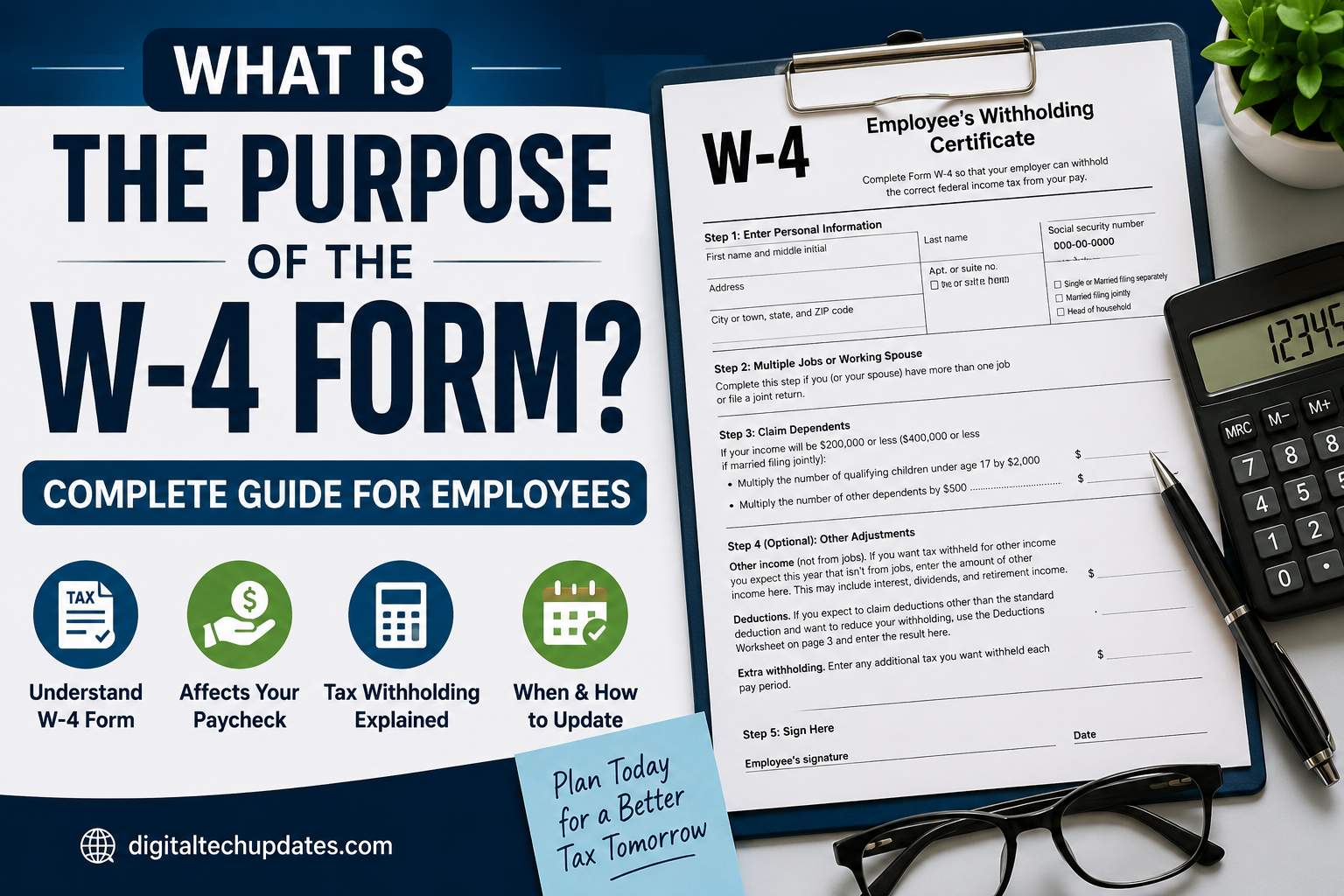
A W-4 Form, officially called the Employee’s Withholding Certificate, is a tax document that employees complete and give to their employer.
Its primary purpose is to tell your employer how much federal income tax should be withheld from each paycheck and sent to the Internal Revenue Service (IRS).
The information on your W-4 directly affects:
- Your take-home pay
- Your tax refund
- Whether you’ll owe taxes when filing your tax return
The form does not determine how much tax you owe overall. Instead, it determines how much tax is paid in advance through payroll withholding.
What Is the Purpose of the W-4 Form?
The main purpose of the W-4 Form is to make sure that the correct amount of federal income tax is withheld from your paycheck throughout the year.
Without accurate withholding:
- You may receive a very large tax refund.
- You may owe hundreds or even thousands of dollars during tax season.
- You could even face underpayment penalties in certain situations.
The W-4 helps balance your tax payments so that you pay approximately what you owe over the course of the year.
Why Is the W-4 Form Important?
The W-4 plays an important role in your financial planning because it affects every pay check you receive.
Benefits include:
- Prevents unexpected tax bills
- Helps avoid IRS penalties
- Gives more accurate paycheck withholding
- Reduces the chance of overpaying taxes
- Allows adjustments after life changes
Completing the form correctly helps you better manage your monthly budget.
Who Needs to Fill Out a W-4 Form?
You generally need to complete a W-4 if you:
- Start a new job
- Change employers
- Want to update your withholding
- Get married or divorced
- Have a child
- Begin a second job
- Stop working a second job
- Experience significant changes in income
- Become eligible for new tax credits
You can submit a new W-4 at any time during the year.
How Does the W-4 Form Work?
The information you enter tells your employer’s payroll system how much federal income tax should be deducted.
Payroll uses factors such as:
- Filing status
- Multiple jobs
- Dependents
- Additional income
- Extra withholding requests
The employer then withholds taxes every pay period based on IRS withholding tables.
Sections of the W-4 Form Explained
Step 1: Personal Information
Provide:
- Name
- Address
- Social Security Number
- Filing status
Filing status options include:
- Single
- Married filing jointly
- Head of household
Step 2: Multiple Jobs or Working Spouse
Complete this section if:
- You work two jobs
- Your spouse also works
This helps prevent under-withholding.
Step 3: Claim Dependents
If eligible, you can claim:
- Qualifying children
- Other dependents
Doing so may reduce the amount of tax withheld from each paycheck.
Step 4: Other Adjustments
You may include:
- Other income
- Additional deductions
- Extra withholding
This section is optional but useful for employees with more complex tax situations.
Step 5: Signature
Sign and date the form before submitting it to your employer.
Without your signature, the form is generally not valid.
What Happens If You Don’t Fill Out a W-4?
If you don’t submit a W-4:
- Your employer will still withhold taxes.
- The withholding may not reflect your personal situation.
- You could have more tax withheld than necessary.
Completing the form gives you greater control over your paycheck.
Does the W-4 Affect Your Tax Refund?
Yes.
Your W-4 determines how much tax is withheld, which directly affects your refund or balance due.
More withholding
- Smaller paycheck
- Larger refund
Less withholding
- Bigger paycheck
- Smaller refund
- Possible tax bill if too little is withheld
When Should You Update Your W-4?
You should consider updating your W-4 after:
- Marriage
- Divorce
- Birth or adoption of a child
- Buying a home
- Starting freelance work
- Getting a second job
- Losing a job
- Significant pay increase
- Retirement
Reviewing your withholding annually can help keep it accurate.
Common Mistakes People Make
Avoid these common errors:
Ignoring multiple jobs
Working more than one job without adjusting withholding can lead to underpayment.
Forgetting dependents
Not claiming eligible dependents may result in more tax being withheld than necessary.
Never updating the form
Life changes often require withholding adjustments.
Guessing instead of estimating
Using IRS tools or consulting a tax professional can improve accuracy.
W-4 vs W-2: What’s the Difference?
| W-4 Form | W-2 Form |
|---|---|
| Completed by employee | Issued by employer |
| Determines tax withholding | Reports annual wages and taxes withheld |
| Used during employment | Used when filing your tax return |
| Can be updated anytime | Issued once each year |
Tips for Filling Out Your W-4 Correctly
- Read all instructions carefully.
- Update it whenever your financial situation changes.
- Double-check your filing status.
- Account for multiple jobs if applicable.
- Claim eligible dependents accurately.
- Consider additional withholding if you have extra income.
- Keep a copy for your records.
Frequently Asked Questions (FAQs)
What is the purpose of the W-4 form?
The W-4 form tells your employer how much federal income tax to withhold from your paycheck so your tax payments throughout the year more closely match your expected tax liability.
Is filling out a W-4 mandatory?
Employers generally require a completed W-4 for payroll purposes. If you do not provide one, withholding will be calculated using default IRS rules.
Can I change my W-4 anytime?
Yes. You can submit a new W-4 to your employer whenever your circumstances change or you want to adjust your withholding.
Does claiming dependents reduce taxes?
Claiming eligible dependents may reduce the amount of tax withheld from your paycheck and could lower your overall tax liability, depending on your situation.
Does the W-4 affect state taxes?
The federal W-4 only affects federal income tax withholding. Many states have their own withholding forms or use different rules.
Is the W-4 only for new employees?
No. Any employee can submit an updated W-4 whenever needed.
Best Practices for Employees
To make the most of your W-4:
- Review it every year.
- Update it after major life events.
- Keep your payroll information accurate.
- Check your pay stub regularly.
- Use IRS withholding tools if your situation changes significantly.
These habits can help you avoid surprises at tax time.
Final Thoughts
Understanding the purpose of the W-4 form is essential for managing your taxes and your take-home pay. Rather than viewing it as just another hiring document, think of it as a tool that helps ensure the right amount of federal income tax is withheld throughout the year.
By completing your W-4 accurately and updating it when your circumstances change, you can reduce the risk of owing unexpected taxes, avoid excessive withholding, and make your finances more predictable.
If you’re starting a new job or experiencing a major life event, take a few minutes to review your W-4—it can make a meaningful difference when tax season arrives.
Thalla Lokesh
Thalla Lokesh is a Digital Marketing Strategist and SEO Specialist with over 12 years of experience in helping businesses grow their online presence. Since beginning his career in 2013, he has successfully worked across industries including healthcare, education, technology, and e-commerce. He specializes in search engine optimization (SEO), content marketing, keyword strategy, and link building, with a strong focus on delivering measurable results. Lokesh has helped brands achieve top rankings on Google through data-driven strategies, high-quality content, and ethical SEO practices aligned with search engine guidelines. As the founder of Honey Web Solutions , a Tirupati-based digital marketing company, he actively works with clients to improve organic traffic, lead generation, and online visibility. He also contributes expert insights on digital marketing trends, AI SEO, and content strategies through blogs and industry platforms.