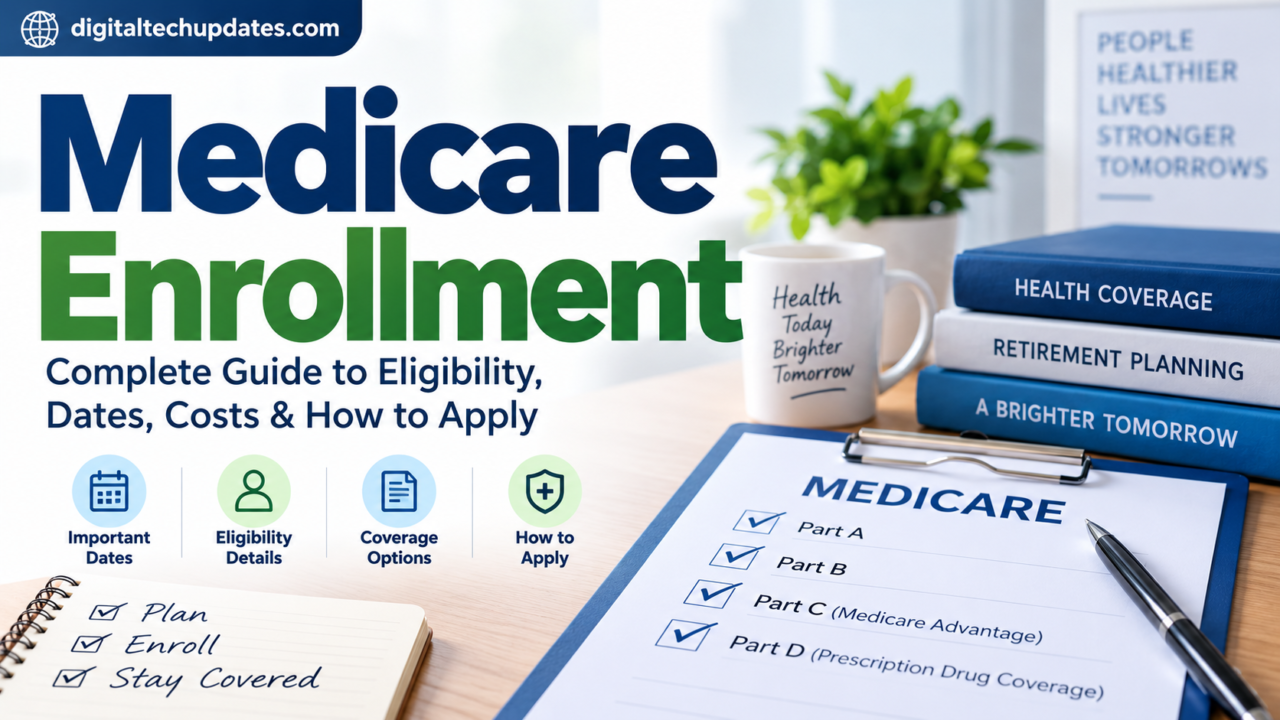
Medicare Enrollment: Complete Guide to Eligibility, Dates, Costs & How to Apply

Turning 65 is a major milestone, and for many people, it also means making some important decisions about health coverage.
That’s where Medicare enrollment comes in.
If you’re approaching 65, still working, already receiving Social Security benefits, or helping a parent or family member navigate Medicare, it can be difficult to know when to sign up and which parts of Medicare you actually need.
The timing matters, too. Missing an enrollment window can sometimes result in a gap in coverage or a late enrollment penalty.
The good news is that Medicare enrollment becomes much easier once you understand the different enrollment periods and how Parts A, B, C, and D fit together.
This guide explains Medicare enrollment in straightforward terms, including who qualifies, when to enroll, how to apply, what happens if you miss your initial enrollment period, and what to know about Medicare costs in 2026.
Important: Medicare rules, premiums, deductibles, and enrollment policies can change. Always verify your situation and the latest information through official Medicare or Social Security resources before making an enrollment decision.
What Is Medicare Enrollment?
Medicare enrollment is the process of signing up for Medicare coverage when you’re eligible.
Medicare is a federal health insurance program primarily for people age 65 and older. Some people can qualify earlier because of certain disabilities, End-Stage Renal Disease (ESRD), or ALS.
Medicare is divided into different parts:
- Part A: Hospital insurance
- Part B: Medical insurance
- Part C: Medicare Advantage
- Part D: Prescription drug coverage
You don’t necessarily enroll in every part at the same time.
In fact, one of the most important things to understand is that enrolling in Medicare and choosing a Medicare health or drug plan are not exactly the same thing.
Your circumstances, existing health coverage, and the type of Medicare coverage you want will determine what you need to do.
Who Is Eligible for Medicare?
Most people first become eligible for Medicare when they turn 65.
However, Medicare eligibility isn’t limited to age.
You may qualify for Medicare before 65 if you meet certain requirements related to disability, ESRD, or ALS.
There are also citizenship and residency requirements.
Because eligibility can depend on individual circumstances, don’t assume that turning 65 automatically means every part of Medicare will work the same way for you.
When Should You Enroll in Medicare?
For most people approaching 65, the first opportunity to enroll is called the Initial Enrollment Period (IEP).
It lasts for seven months:
- 3 months before the month you turn 65
- Your birthday month
- 3 months after the month you turn 65
For example, if you turn 65 in October, your Initial Enrollment Period generally runs from July through January.
This is the enrollment period you should pay close attention to if you’re approaching 65.
Why is the timing important?
Waiting too long can sometimes mean:
- Delayed coverage
- Having to wait for another enrollment period
- Late enrollment penalties
- A gap in health coverage
However, there are exceptions.
For example, people who continue working and have qualifying employer health coverage may have a Special Enrollment Period that allows them to delay Part B without the same penalty that could apply to someone who simply waits.
That’s why your employment and current health insurance situation matter.
Medicare Initial Enrollment Period
Your Initial Enrollment Period is your first major opportunity to enroll in Medicare.
For someone becoming eligible because of age, it generally lasts seven months.
The earlier you enroll during that window, the more time you give yourself to get your coverage arranged and understand what comes next.
Medicare explains that coverage start dates can depend on when you enroll during your Initial Enrollment Period. Coverage generally starts on the first day of a month, although the exact timing depends on the circumstances.
If you’re close to 65, don’t wait until the last minute simply because you have several months available.
Use the time to compare your options and find out whether you’ll be automatically enrolled or need to take action.
Medicare General Enrollment Period
If you miss your Initial Enrollment Period and don’t qualify for a Special Enrollment Period, the General Enrollment Period provides another opportunity to sign up for Medicare Part A and/or Part B.
The General Enrollment Period runs from:
January 1 through March 31 each year.
Coverage timing and penalties can depend on the circumstances, so missing the Initial Enrollment Period is something you generally want to avoid when possible.
Medicare Special Enrollment Period
A Special Enrollment Period (SEP) can give certain people an opportunity to enroll outside the standard enrollment periods.
One common situation involves people who are still working after becoming eligible for Medicare and have qualifying health coverage through their own or a spouse’s current employment.
Medicare says that the Part B Special Enrollment Period related to job-based coverage generally lasts while the person is still working and for up to eight months after the employment or qualifying coverage ends, whichever comes first.
Other circumstances can also create Special Enrollment Periods.
For example, Medicare has special rules for certain exceptional situations and changes in circumstances.
Because SEPs vary depending on the reason you’re eligible, don’t assume that one person’s Special Enrollment Period will apply to someone else.
Medicare Open Enrollment Period
The term “Medicare Open Enrollment” is often used broadly, but it is important to understand what this period actually allows you to do.
The Medicare Open Enrollment Period runs from:
October 15 through December 7 each year.
During this period, eligible beneficiaries can generally make certain changes to Medicare Advantage and Medicare prescription drug coverage.
Changes made during Open Enrollment generally take effect January 1 of the following year.
This is different from your Initial Enrollment Period when you’re first becoming eligible for Medicare.
Medicare Part A Enrollment
Medicare Part A is hospital insurance.
It generally helps cover certain inpatient hospital care, skilled nursing facility care, hospice care, and some home health care.
Many people qualify for premium-free Part A because of their work history.
However, not everyone qualifies for premium-free Part A.
If you need to buy Part A, enrollment rules can be different, and delaying enrollment can potentially result in a penalty.
If you’re approaching 65, check whether you’ll automatically receive Part A or need to actively enroll.
Medicare Part B Enrollment
Medicare Part B covers medical services and supplies, including many doctors’ services and outpatient services.
Unlike premium-free Part A for many beneficiaries, Part B generally comes with a monthly premium.
For 2026, the standard Part B premium is $202.90 per month, although people with higher incomes may pay more. The annual Part B deductible is $283 in 2026.
Part B enrollment deserves particular attention because delaying it without qualifying coverage can lead to a late enrollment penalty.
Medicare says the Part B penalty is generally an additional 10% for each full 12-month period you could have had Part B but didn’t enroll, and the penalty generally continues for as long as you have Part B.
Medicare Advantage Enrollment
Medicare Advantage, also called Medicare Part C, is an alternative way to receive your Medicare benefits through a private Medicare-approved plan.
These plans may offer additional benefits beyond Original Medicare, depending on the plan.
To join a Medicare Advantage plan, you generally need both Medicare Part A and Part B.
Plan availability, costs, provider networks, covered services, and benefits vary by location and plan.
That means choosing a Medicare Advantage plan isn’t simply about finding the plan with the lowest monthly premium.
You should also look at:
- Doctor and hospital networks
- Prescription coverage
- Copayments and coinsurance
- Maximum out-of-pocket costs
- Additional benefits
- Referral requirements
- Whether your preferred providers participate
Medicare Part D Enrollment
Medicare Part D provides prescription drug coverage through private Medicare-approved plans.
Drug plan costs and coverage vary.
If you don’t have creditable prescription drug coverage and go without Part D for a sufficiently long period after becoming eligible, you may face a late enrollment penalty.
Medicare says the Part D penalty is generally calculated as 1% of the national base beneficiary premium for each month you went without Part D or other creditable prescription drug coverage after becoming eligible.
In 2026, Medicare states that no standard Part D plan may have a deductible above $615, although individual plans can have lower deductibles or no deductible.
Medicare Enrollment While You’re Still Working
This is one of the most common areas of confusion.
Turning 65 doesn’t automatically mean you must make exactly the same Medicare decisions as someone who has already retired.
If you’re still working and have health insurance through your employer, you may have options for delaying certain Medicare coverage without facing the same late enrollment consequences.
Medicare says people with qualifying employer coverage can generally enroll in Part B while they or their spouse are still working and during an eight-month Special Enrollment Period after the employment or coverage ends, whichever happens first.
However, employer health plans can have different rules.
Before deciding to delay Medicare, talk with your employer’s benefits administrator and confirm how your existing coverage works with Medicare.
This is particularly important if you contribute to a Health Savings Account (HSA), because Medicare enrollment can affect HSA contribution eligibility.
What Happens If You Miss Medicare Enrollment?
Missing your enrollment window doesn’t necessarily mean you can never get Medicare.
However, it can make the process more complicated.
Depending on your circumstances, you may have to wait for another enrollment period.
You may also face a late enrollment penalty.
For example, Medicare says the Part B penalty generally increases by 10% for each full 12-month period you were eligible for Part B but didn’t enroll and didn’t qualify for an exception.
Part A penalties can apply to people who have to pay a premium for Part A and delay enrollment.
Part D has its own late enrollment penalty rules.
The key point is simple:
Don’t assume that missing your enrollment period is harmless.
If you’re unsure whether you’re already covered or whether an exception applies, check your situation with Medicare or Social Security.
How Do You Enroll in Medicare?
The enrollment process depends partly on whether you’re automatically enrolled.
Some people are automatically enrolled in Medicare because they’re already receiving certain Social Security or Railroad Retirement Board benefits when they become eligible. Others need to actively sign up.
If you need to enroll yourself, Medicare and Social Security provide online and other enrollment options depending on your situation.
Before applying, gather the information you’ll need and understand whether you’re applying for Part A, Part B, or both.
If you’re still working, also check how your employer coverage interacts with Medicare before making a decision.
Medicare Enrollment Checklist
If you’re approaching Medicare eligibility, this checklist can help keep things organized.
Before turning 65
- Check when your Initial Enrollment Period begins.
- Find out whether you’ll be automatically enrolled.
- Review your current health insurance.
- If you’re still working, talk to your employer’s benefits department.
- Check whether you qualify for premium-free Part A.
- Review Part B costs.
- Consider whether you’ll need prescription drug coverage.
- Research Medicare Advantage and Original Medicare options.
During enrollment
- Confirm your eligibility.
- Complete the appropriate enrollment application if required.
- Keep copies of submitted documents.
- Confirm when your coverage begins.
- Review your Medicare card and coverage details.
After enrollment
- Review your health and drug coverage.
- Check your doctors and prescriptions.
- Compare plan costs and benefits.
- Watch for annual enrollment periods.
- Reassess your coverage when your circumstances change.
Common Medicare Enrollment Mistakes
Waiting until the last minute
Even if you have several months to enroll, starting early gives you time to understand your choices.
Assuming everyone is automatically enrolled
Some people are automatically enrolled, while others need to actively sign up.
Don’t assume which category you fall into.
Confusing Medicare Open Enrollment with Initial Enrollment
These are different periods with different purposes.
Your Initial Enrollment Period is tied to when you’re first eligible.
The annual October 15–December 7 Open Enrollment Period is primarily used for certain changes to Medicare Advantage and prescription drug coverage.
Ignoring employer coverage
If you’re working beyond 65, don’t make a Medicare decision without understanding how your employer insurance works with Medicare.
A low premium doesn’t necessarily mean a plan will cost you less overall.
Consider deductibles, copayments, coinsurance, networks, prescriptions, and out-of-pocket limits.
Medicare Enrollment vs. Medicare Plan Enrollment
These terms sound similar, but they aren’t always referring to the same thing.
Medicare enrollment generally refers to becoming enrolled in Medicare Part A and/or Part B.
Medicare plan enrollment can refer to joining a Medicare Advantage plan or a Medicare prescription drug plan.
For example, joining a Medicare Advantage plan generally requires both Part A and Part B.
Understanding this difference can make the entire Medicare process much less confusing.
What About Medigap Enrollment?
Medigap, also called Medicare Supplement Insurance, is separate from Medicare Advantage.
If you have Original Medicare and want supplemental coverage, timing can matter.
Under federal law, the Medigap Open Enrollment Period generally lasts six months and begins when you’re 65 or older and enrolled in Part B.
During this period, you generally have important protections when buying a Medigap policy.
Because Medigap rules can vary by state and circumstances, it’s worth researching your specific situation rather than assuming that you can always buy any Medigap policy later on the same terms.
Medicare Enrollment Costs in 2026
Medicare costs depend on the type of coverage you have and your individual circumstances.
For 2026:
| Medicare Cost | 2026 Amount |
|---|---|
| Standard Part B monthly premium | $202.90 |
| Part B annual deductible | $283 |
| Part D deductible maximum | $615 |
The standard Part B premium and deductible are set annually and can change in future years. People with higher incomes may pay more than the standard Part B premium.
Medicare Advantage and Part D plan premiums can vary by plan and location.
So the figures above shouldn’t be treated as a complete estimate of what every Medicare beneficiary will spend.
Frequently Asked Questions About Medicare Enrollment
When should I enroll in Medicare?
For most people becoming eligible at 65, the first opportunity is the seven-month Initial Enrollment Period, which starts three months before the month you turn 65 and ends three months afterward.
What is the Medicare Initial Enrollment Period?
It is the seven-month period surrounding your 65th birthday during which most people first enroll in Medicare.
When is Medicare Open Enrollment?
Medicare’s annual Open Enrollment Period runs from October 15 through December 7.
When is the Medicare General Enrollment Period?
The General Enrollment Period runs from January 1 through March 31 each year.
Can I enroll in Medicare after age 65?
Yes. The appropriate enrollment period depends on your circumstances. For example, someone who delayed Part B because of qualifying employer coverage may have a Special Enrollment Period.
Do I have to enroll in Medicare at 65 if I’m still working?
Not necessarily. Your employer coverage and individual circumstances matter. Check how your current insurance works with Medicare before deciding whether to delay enrollment.
What happens if I don’t enroll in Medicare at 65?
You may have to wait for another enrollment period and could face late enrollment penalties, depending on the circumstances and the part of Medicare involved.
How much is Medicare Part B in 2026?
The standard Part B premium is $202.90 per month in 2026, although higher-income beneficiaries may pay more. The 2026 Part B deductible is $283.
Is Medicare enrollment automatic?
For some people, yes. Others need to actively enroll. Whether you’re automatically enrolled can depend on whether you’re already receiving certain Social Security or Railroad Retirement Board benefits.
Can I get Medicare before age 65?
Some people can qualify before 65 because of certain disabilities, ESRD, or ALS.
What is the difference between Medicare and Medicare Advantage?
Original Medicare consists primarily of Part A and Part B. Medicare Advantage is a Medicare-approved alternative offered through private plans. Joining a Medicare Advantage plan generally requires both Part A and Part B.
Do I need Medicare Part D?
It depends on whether you have other creditable prescription drug coverage and your individual situation. Going without creditable drug coverage for too long after becoming eligible can result in a Part D late enrollment penalty.
Final Thoughts
Medicare enrollment doesn’t have to be confusing, but it does require some planning.
The most important thing is to understand when you’re eligible, which enrollment period applies to you, and whether your current health coverage changes the decision.
For most people turning 65, the seven-month Initial Enrollment Period is the starting point. From there, you’ll need to consider Part A, Part B, prescription drug coverage, and whether Medicare Advantage or Original Medicare makes more sense for your situation.
If you’re still working, don’t automatically assume that you should enroll immediately or delay everything. Your employer coverage can make a significant difference.
And if you’re already enrolled, remember that Medicare enrollment isn’t a one-time decision. Your coverage and plan options can change, and the annual October 15–December 7 Open Enrollment Period provides an opportunity to review certain Medicare Advantage and prescription drug coverage choices.
Most importantly, use official Medicare and Social Security information when making decisions. Medicare rules and costs can change from year to year, so information published several years ago may no longer be accurate.
For current enrollment information, visit the official Medicare website before submitting an application or changing your coverage.

Thalla Lokesh
Thalla Lokesh is a Digital Marketing Strategist and SEO Specialist with over 12 years of experience in helping businesses grow their online presence. Since beginning his career in 2013, he has successfully worked across industries including healthcare, education, technology, and e-commerce. He specializes in search engine optimization (SEO), content marketing, keyword strategy, and link building, with a strong focus on delivering measurable results. Lokesh has helped brands achieve top rankings on Google through data-driven strategies, high-quality content, and ethical SEO practices aligned with search engine guidelines. As the founder of Honey Web Solutions , a Tirupati-based digital marketing company, he actively works with clients to improve organic traffic, lead generation, and online visibility. He also contributes expert insights on digital marketing trends, AI SEO, and content strategies through blogs and industry platforms.