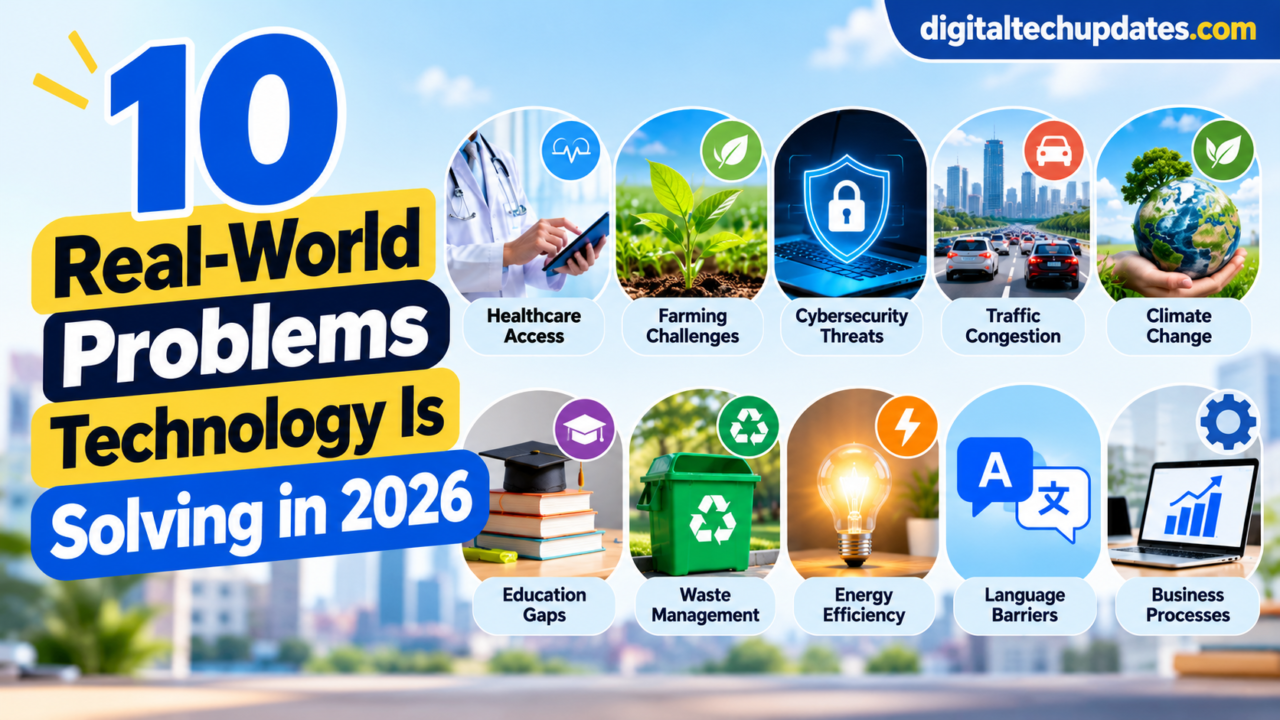
10 Real-World Problems Technology Is Solving in 2026

Introduction
Technology is most valuable when it solves a problem that people face every day. A farmer trying to identify a crop disease, a doctor examining a medical scan, or a family living in an area with unreliable electricity may have very different needs. Yet all three can benefit from practical technological solutions.
In 2026, artificial intelligence (AI), connected sensors, satellite imaging, renewable energy systems, and digital platforms are helping address challenges that once required significant time, money, or specialized expertise. These technologies are moving beyond experimental projects and finding practical uses in healthcare, agriculture, education, transportation, and environmental protection.
India offers some particularly relevant examples. AI-powered agricultural advisory tools, digital healthcare services, and technology-assisted public services demonstrate how innovation can help people access information and make better decisions. Government initiatives and research projects are also exploring ways to extend these benefits to underserved communities.
However, technology is not a solution to every problem by itself. Cost, internet access, privacy, reliability, and human oversight still matter.
Here are 10 real-world problems technology is helping solve in 2026, along with practical examples of how these solutions work.
1. Limited Access to Healthcare
Accessing quality healthcare remains difficult for people who live far from hospitals, cannot easily travel, or have limited access to medical specialists. Delayed consultations and missed warning signs can make existing health problems more difficult to manage.
Digital health technology is helping bridge some of these gaps.
How technology helps
- Telemedicine: Patients can consult healthcare professionals through video calls or other digital services without always travelling to a hospital.
- AI-assisted medical analysis: AI systems can help qualified professionals examine medical images and identify patterns that deserve further investigation.
- Remote patient monitoring: Connected devices can record measurements such as heart rate or blood glucose, where appropriate, and share them with healthcare teams.
- Digital health records: Electronic records can make medical information easier to organize and share securely between authorized providers.
The World Health Organization recognizes digital health as an important area for improving health services, while emphasizing the need for evidence-based implementation and equitable access.
For example, a patient in a rural area may be able to speak with a specialist remotely after an initial consultation at a nearby healthcare centre. This can reduce unnecessary travel and help the patient understand the next steps.
What still needs attention: Digital consultations cannot replace every physical examination or emergency service. Medical decisions must remain under appropriate professional supervision, and patient data needs strong protection.
2. Crop Diseases and Unpredictable Farming Conditions
Farmers face several interconnected challenges, including changing weather, crop diseases, pest infestations, rising input costs, and uncertainty about when to sow or irrigate.
A problem identified too late can damage a harvest and reduce a farmer’s income.
How technology helps
AI, satellite imagery, weather forecasting, mobile applications, and connected sensors can provide farmers with more timely information.
- Crop disease identification: Some tools analyse photographs of affected leaves to help identify possible diseases or pest damage.
- Weather forecasting: Localized forecasts help farmers plan sowing, irrigation, and harvesting activities.
- Smart irrigation: Soil-moisture sensors can help determine when crops need water.
- Pest monitoring: Digital surveillance systems can help identify pest threats and provide alerts.
- Digital marketplaces: Online platforms can help farmers access market information and connect with potential buyers.
India’s agricultural technology initiatives include the National Pest Surveillance System and AI-assisted advisory services. In February 2026, the Press Information Bureau reported that the Kisan e-Mitra chatbot had answered more than 93 lakh queries, with support for 11 regional languages.
Consider a farmer who notices unusual spots on a crop. A suitable mobile tool may help identify the likely cause and suggest what to investigate next. The farmer can then confirm the diagnosis and treatment with a reliable agricultural adviser.
What still needs attention: AI recommendations can be wrong, especially when images are unclear or local conditions differ from the data used to develop a model. Farmers also need affordable smartphones, reliable advice, and access to agricultural support.
3. Online Scams and Cybersecurity Threats
As banking, shopping, communication, and business activities move online, criminals have more opportunities to exploit weak passwords, stolen credentials, fake websites, and social engineering.
A convincing fraudulent message can look almost identical to a genuine communication from a bank, delivery company, or service provider.
How technology helps
Cybersecurity systems combine several methods to identify and prevent suspicious activity.
- AI-based fraud detection: Systems can flag unusual transaction patterns for additional checks.
- Multi-factor authentication: An additional verification step can make an account harder to access with a stolen password alone.
- Spam and phishing filters: Email and messaging platforms can detect known malicious links and suspicious messages.
- Identity verification: Digital verification systems can help services establish whether a user is authorized to perform an action.
- Automated security monitoring: Businesses can receive alerts about unusual network activity and potential attacks.
For example, if a payment account suddenly shows activity that differs significantly from its usual pattern, a fraud detection system may flag the transaction for review or request additional authentication.
Technology can reduce the time needed to detect certain threats, but it cannot eliminate fraud. Criminals continually change their methods, and legitimate transactions can also be incorrectly flagged.
What users should do: Use unique passwords, enable multi-factor authentication, keep devices updated, and never share banking PINs or one-time passwords with someone who contacts them unexpectedly.
4. Traffic Congestion and Road Safety
Traffic congestion wastes time, increases fuel consumption, and makes daily travel less predictable. Poorly coordinated signals and limited visibility into traffic conditions can make the situation worse.
Smart transportation systems are helping cities and transport operators manage these challenges more effectively.
How technology helps
- Intelligent traffic signals: Sensors and traffic data can help adjust signal timings to changing road conditions.
- Navigation applications: Real-time traffic information can help drivers choose alternative routes.
- Connected vehicle systems: Vehicle sensors and communication technologies can provide information about vehicle condition, location, and potential hazards.
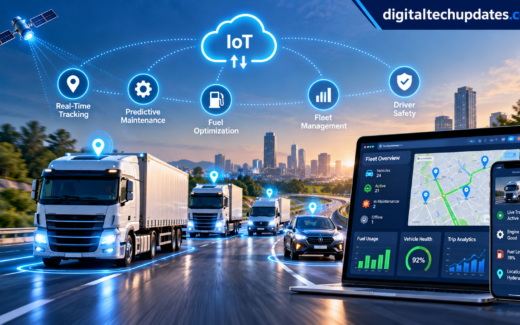
- Fleet management software: Businesses can monitor vehicles, plan routes, and identify inefficient driving patterns.
- Driver assistance systems: Depending on the vehicle, features such as automatic emergency braking and lane-departure warnings can help reduce certain driving risks.
Imagine a delivery company operating dozens of vehicles across a busy city. Fleet management software can help dispatchers identify delays, revise routes, and reduce unnecessary travel.
Cities can also use traffic data to identify persistent bottlenecks and improve transport planning.
What still needs attention: Smart systems require reliable infrastructure, maintenance, and appropriate data protection. Driver assistance features are not a substitute for attentive driving, and navigation software cannot solve congestion when road capacity is fundamentally inadequate.
5. Climate Change and Extreme Weather Risks
Floods, heatwaves, droughts, wildfires, and other extreme weather events can threaten homes, livelihoods, infrastructure, and public health.
Although technology cannot independently stop climate change, it can help communities prepare for some risks, reduce emissions, and use resources more efficiently.
How technology helps
- Satellite monitoring: Earth-observation data can help track land-use changes, vegetation, water conditions, and environmental damage.
- Early warning systems: Weather forecasts, sensors, and communication networks can help authorities issue warnings before certain hazards occur.
- Renewable energy: Solar and wind power can reduce reliance on fossil fuels when integrated appropriately into energy systems.
- Smart energy management: Connected meters and software can help businesses and households understand and manage electricity use.
- Environmental monitoring: Sensors can measure certain forms of air and water pollution, supporting investigations and response planning.
For example, a flood monitoring system may combine rainfall forecasts, river-level sensors, and communication networks to alert communities when water levels approach a dangerous threshold.
Early warnings are most useful when people receive them in time, understand what action to take, and have a safe place to go.
What still needs attention: Forecasts contain uncertainty, and not every disaster can be predicted accurately. Warning systems must be maintained, reach vulnerable populations, and connect to practical emergency plans.
6. Educational Gaps and Unequal Access to Learning
Students do not all learn at the same pace. Some need additional explanations, others need more practice, and many have limited access to private tutoring or specialist educational resources.
Digital learning tools can make additional educational support available beyond the traditional classroom.
How technology helps
- AI learning assistants: Students can request explanations of difficult concepts and ask follow-up questions.
- Adaptive learning platforms: Some systems adjust exercises based on a student’s progress.
- Online courses: Learners can access lessons from universities, training providers, and educational organizations.
- Language tools: Translation, captions, and speech technologies can make selected learning materials easier to access.
- Digital assessments: Online quizzes can help students identify topics that need further revision.
For instance, a student struggling with algebra can use a digital tutor to review a concept, work through examples, and practise similar questions at their own pace.
For teachers, technology can also help prepare practice materials and identify areas where students may need additional support.
What still needs attention: AI-generated explanations can contain mistakes, and excessive reliance on automated answers may discourage independent thinking. Students still benefit from teachers, structured learning, feedback, and hands-on activities.
Reliable internet access and affordable devices are also essential if digital education is to reach more learners.
7. Waste Management and Environmental Pollution
Growing cities produce large amounts of household waste, packaging, electronic waste, and industrial by-products. When waste is not collected, sorted, or processed correctly, it can pollute land and water and create public health risks.
Technology is helping improve how waste is tracked, collected, and processed.
How technology helps
- Smart waste bins: Sensors can indicate when certain bins need to be emptied.
- AI-powered sorting: Computer vision can help identify different materials on suitable recycling lines.
- Route optimization: Waste collection vehicles can use route-planning software to reduce unnecessary trips.
- Digital recycling platforms: Online services can connect waste generators with authorized collection and recycling providers.
- Material tracking: Digital records can help organizations monitor waste movement and improve reporting.
For example, a municipality managing many collection points could use sensor readings and route-planning software to prioritize bins that are nearly full rather than following the same collection pattern every day.
Businesses can also use waste-tracking systems to identify where materials are being discarded unnecessarily.
What still needs attention: Sensors and sorting systems require investment and maintenance. Recycling also depends on suitable processing facilities, effective collection systems, and markets for recovered materials. Technology cannot compensate for poor waste management practices on its own.
8. Energy Waste and Unreliable Electricity Access
Homes, offices, factories, and public buildings often consume electricity inefficiently. At the same time, some communities still face challenges with reliable power access.
Smart energy systems can improve visibility into electricity consumption and help integrate cleaner energy sources.
How technology helps
- Smart meters: Provide more detailed information about electricity consumption.
- Building automation: Controls can adjust lighting, heating, cooling, and other equipment based on occupancy or operating conditions.
- Solar power systems: Generate electricity from sunlight, reducing dependence on other sources when conditions permit.
- Battery storage: Stores electricity for use when generation is low or demand is high.
- Smart grids: Digital monitoring and control systems help utilities manage electricity networks.
Consider a commercial building where air conditioning runs at full capacity even when several areas are unoccupied. A properly configured building management system can adjust cooling to actual usage and reduce unnecessary consumption.
Similarly, solar power combined with suitable battery storage can provide greater flexibility where the equipment, weather, and local electricity arrangements support it.
What still needs attention: Installation costs, maintenance, local infrastructure, and equipment efficiency all affect the outcome. Renewable energy systems also require careful planning to manage fluctuations in generation.
9. Communication Barriers and Language Differences
Language can prevent people from accessing education, healthcare information, government services, and business opportunities. It can also create challenges for companies working with customers in different regions.
Advances in machine translation, speech recognition, and text-to-speech technology are helping reduce some of these barriers.
How technology helps
- Machine translation: Converts text from one language into another.
- Speech-to-text tools: Turn spoken words into written text.
- Text-to-speech systems: Read digital content aloud.
- Live captions: Display spoken content as text during supported calls or presentations.
- Voice-based assistants: Let users interact with certain digital services through speech.
For example, a person who is more comfortable speaking Telugu than English may be able to use a language-supported digital service to understand instructions or ask basic questions.
Businesses can also use translation tools to prepare customer support materials for different language groups.
What still needs attention: Translation quality varies across languages, dialects, and specialized subjects. Errors can be particularly serious in legal, medical, or financial contexts. Important information should be reviewed by qualified people when accuracy is critical.
10. Slow Business Processes and Repetitive Administrative Work
Many businesses still spend considerable time on repetitive tasks, including entering data, preparing reports, organizing documents, processing routine requests, and answering common customer questions.
These activities can consume time that employees could otherwise spend on problem-solving, customer relationships, and strategic work.
How technology helps
- Workflow automation: Moves information between systems and triggers routine actions based on defined rules.
- AI document processing: Extracts information from suitable invoices, forms, and other documents.
- Customer service chatbots: Answer common questions and direct more complicated requests to human staff.
- Business intelligence tools: Turn operational data into reports and dashboards.
- AI assistants: Help draft documents, summarize information, and support research or coding tasks.
For example, a small business receiving hundreds of invoices may use document-processing software to extract supplier names, invoice numbers, and amounts before sending the information into its accounting workflow.
Employees can then focus on checking exceptions, resolving discrepancies, and making decisions rather than entering every field manually.
What still needs attention: Automation can reproduce errors when the underlying data is incorrect. Businesses need suitable access controls, quality checks, privacy safeguards, and clear procedures for handling unusual cases.
Not every task should be automated, particularly when it involves sensitive decisions or requires human judgment.
Why Technology Does Not Solve Every Problem Automatically
The examples above demonstrate the potential of modern technology, but successful implementation depends on more than choosing the latest software or installing a new device.
Four factors deserve particular attention.
1. Accessibility and affordability: A solution cannot help people who cannot afford it, use it, or access the infrastructure it requires.
2. Reliable information: AI and automated systems depend on the quality of their data, design, and implementation. Incorrect information can lead to poor decisions.
3. Privacy and security: Healthcare records, financial information, location data, and personal communications must be handled responsibly.
4. Human oversight: Technology should support appropriate human judgment, especially in healthcare, education, public safety, and other sensitive areas.
The most successful solutions address a clearly defined problem, fit the needs of the people using them, and demonstrate meaningful results in practice.
What Is the Future of Technology-Based Problem Solving?
In the coming years, AI, robotics, connected devices, and data-driven services are likely to become more closely integrated into everyday activities.
Agricultural tools may provide more localized advice. Healthcare systems may use digital monitoring to support earlier intervention. Businesses may automate more routine workflows, while smart infrastructure may help cities manage energy, transport, and public services.
However, the direction of progress will depend on investment, regulation, public trust, and the ability to make these tools accessible beyond large companies and wealthy communities.
For India, solutions that work in regional languages, on affordable devices, and in areas with inconsistent internet connectivity could be particularly valuable.
The important question is not simply how advanced a technology is. It is whether that technology solves a real problem reliably, safely, and at a cost people can afford.
Frequently Asked Questions
1. What are some real-world problems technology is solving?
Technology is helping address limited healthcare access, crop diseases, online fraud, traffic congestion, extreme weather risks, educational gaps, waste management, energy inefficiency, language barriers, and repetitive business tasks.
2. How is AI solving real-world problems in 2026?
AI is being used to assist with medical image analysis, agricultural advice, fraud detection, language translation, personalized learning, environmental monitoring, and business automation. Its effectiveness depends on the specific application, data quality, and appropriate human oversight.
3. How does technology help farmers?
Farmers can use digital tools for weather information, crop monitoring, pest surveillance, irrigation planning, and market access. These tools can support better decisions, although local expertise and reliable agricultural advice remain important.
4. Can technology solve climate change?
Technology can contribute through renewable energy, energy efficiency, environmental monitoring, and early warning systems. However, addressing climate change also requires policy decisions, investment, changes in infrastructure, and coordinated action across society.
5. What are the disadvantages of using technology to solve problems?
Potential disadvantages include high costs, privacy risks, cybersecurity threats, inaccurate automated decisions, unequal access, and dependence on infrastructure. Responsible implementation and human oversight help reduce these risks.
Conclusion
Technology is becoming increasingly useful when it addresses practical challenges rather than simply introducing new features. From helping farmers identify crop problems to supporting healthcare professionals, improving cybersecurity, and reducing repetitive business work, digital tools can make important services more accessible and efficient.
The 10 examples in this article show that meaningful progress does not always require a futuristic invention. Sometimes, a useful solution is a reliable early warning, a better translation, a more efficient workflow, or timely information delivered to the right person.
In 2026, the real measure of technological progress is not how complicated a system appears. It is how effectively it improves people’s lives while remaining affordable, reliable, secure, and accessible.

Thalla Lokesh
Thalla Lokesh is a Digital Marketing Strategist and SEO Specialist with over 12 years of experience in helping businesses grow their online presence. Since beginning his career in 2013, he has successfully worked across industries including healthcare, education, technology, and e-commerce. He specializes in search engine optimization (SEO), content marketing, keyword strategy, and link building, with a strong focus on delivering measurable results. Lokesh has helped brands achieve top rankings on Google through data-driven strategies, high-quality content, and ethical SEO practices aligned with search engine guidelines. As the founder of Honey Web Solutions , a Tirupati-based digital marketing company, he actively works with clients to improve organic traffic, lead generation, and online visibility. He also contributes expert insights on digital marketing trends, AI SEO, and content strategies through blogs and industry platforms.