Why Is Your Bank Asking for KYC Again Despite CKYC? Here’s the Reason

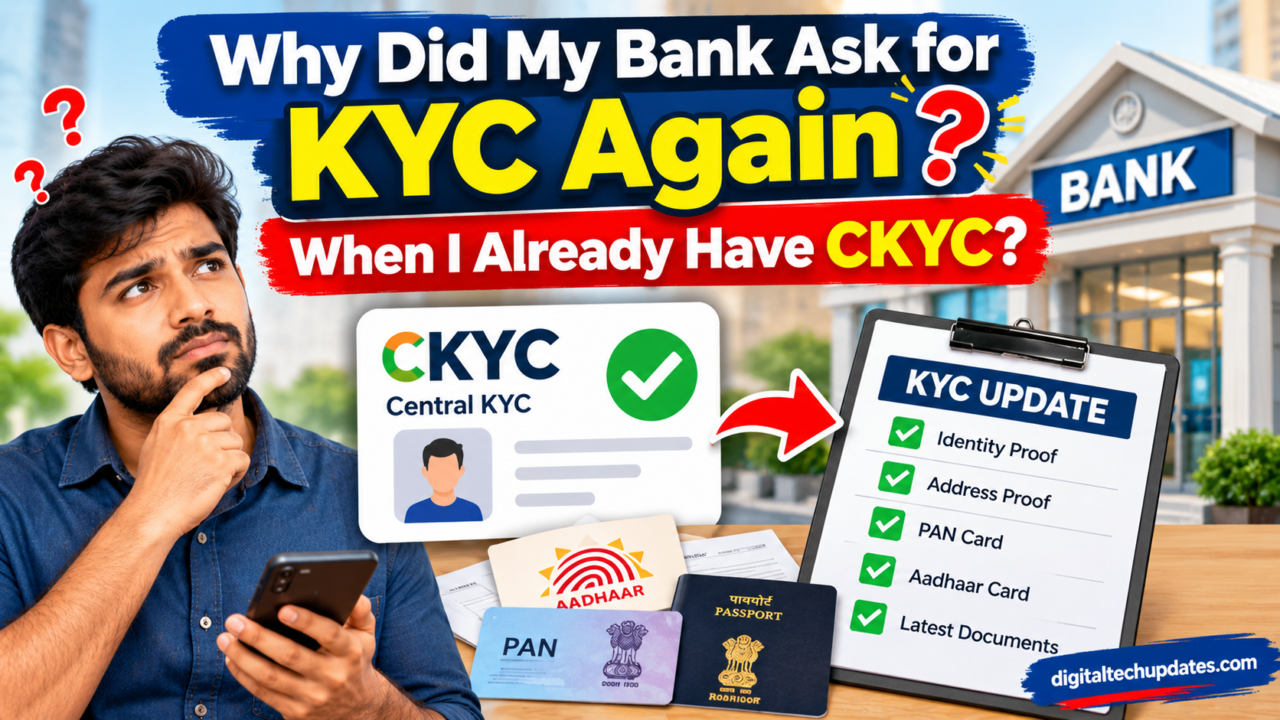
Even if you have already completed your Central KYC (CKYC), your bank may still ask you to submit KYC documents again. This can be confusing, especially when you have already provided your PAN card, Aadhaar details, address proof, and other documents.
The good news is that having a CKYC record does not always mean you can skip every future KYC request. Your bank may need to verify updated information, confirm your identity, complete a periodic review, or meet specific regulatory requirements.
In this guide, we explain why banks ask for KYC again despite CKYC, what you should do if you receive such a request, and how to avoid unnecessary paperwork.
What Is CKYC and How Does It Work?
CKYC stands for Central Know Your Customer. It is a centralized system in India that stores customer KYC records digitally so regulated financial institutions can retrieve them when needed.
The Central KYC Records Registry (CKYCR) is operated by CERSAI, the Central Registry of Securitisation Asset Reconstruction and Security Interest of India.
When you complete KYC with a participating financial institution, your information may be uploaded to the registry and linked to a unique KYC Identifier.
This can make it easier to establish a relationship with another financial institution without submitting the same documents repeatedly.
However, CKYC does not eliminate every KYC verification requirement. Banks must still ensure that the records they use are complete, current, and appropriate for the purpose.
7 Reasons Your Bank May Ask for KYC Again
1. Your Periodic KYC Update Is Due
One of the most common reasons is that your bank’s periodic KYC update is due.
Even if your CKYC record exists, your bank must review customer information at prescribed intervals based on risk classification.
Under the RBI’s KYC directions, the general minimum periodicity is:
| Customer risk category | KYC update interval |
|---|---|
| High risk | At least once every 2 years |
| Medium risk | At least once every 8 years |
| Low risk | At least once every 10 years |
These are general minimum intervals under the applicable framework, not a guarantee that every customer will receive a request only at those intervals. A bank may need to review information earlier when circumstances warrant it.
Example: Suppose you opened your savings account several years ago. Your CKYC number may still exist, but your bank may now need to complete the next periodic review.
2. Your Address or Personal Details Have Changed
Have you moved to a new house, changed your name, or updated other personal details?
Your existing CKYC record may contain information that no longer matches your current circumstances.
Banks may need updated information when details such as these change:
-
Residential or communication address.
-
Name or other identity particulars.
-
Photograph, where an updated photograph is required.
-
Other customer information needed to maintain accurate records.
If your information has changed, inform your bank and ask which specific details need updating. RBI’s KYC framework requires customer information to be kept current and provides for updated information to be recorded in CKYCR.
3. Your CKYC Record Is Incomplete or Outdated
Having a CKYC number does not necessarily mean every detail in the record meets the bank’s current requirements.
Your bank may find that:
-
Some required information is missing.
-
The retrieved record does not meet current KYC standards.
-
A downloaded document’s validity period has expired.
-
Additional verification is needed to establish your identity or current address.
In these circumstances, the bank may need more information or supporting documents.
4. The Bank Cannot Retrieve Your CKYC Record
Sometimes, the issue is not with your identity documents but with retrieving or matching your CKYC information.
For example, the bank may be unable to locate the record using the details provided, or the information in its system may not match the registry.
If this happens, ask the bank whether it can retrieve your record using your CKYC Identifier and what specific problem is preventing verification.
You should not automatically assume that your CKYC record is invalid simply because the bank requests documents.
5. You Need Additional Verification for a Specific Reason
Banks are permitted to seek additional information when necessary to verify identity or address, carry out enhanced due diligence, or establish an appropriate customer risk profile.
For example, the bank may need to understand a discrepancy in your records or obtain information relevant to the nature of your banking relationship.
This does not mean every customer must submit all documents again. The additional request should relate to a legitimate verification need.
6. You Are Applying for a New Financial Product
You might already have CKYC but still encounter a verification request when applying for another product, such as a loan, investment service, or certain financial accounts.
However, there is an important distinction: RBI directions state that an existing KYC-compliant customer generally should not need a fresh customer due diligence exercise merely to open another account or obtain another product from the same regulated entity.
A bank may still need to update information or perform additional checks where an applicable exception exists. Requirements can also differ between institutions and product types.
7. The Bank Needs to Verify Your Current Address or Customer Profile
Even if your identity was verified previously, your bank may need to confirm that your current address and other relevant information are accurate.
This can happen when the information retrieved from CKYCR is insufficient for the bank’s current verification needs or when additional due diligence is justified.
Ask the bank whether a self-declaration, an address update, or a specific supporting document will satisfy the requirement instead of resubmitting every document unnecessarily.
Is Your Bank Allowed to Ask for KYC Again If You Already Have CKYC?
Yes, in certain circumstances. But the bank should not routinely ask you to submit the same information again when it can retrieve an adequate CKYC record and no applicable exception requires additional documents.
RBI’s KYC framework directs regulated entities to seek the customer’s KYC Identifier, or retrieve it if available, and obtain the records from CKYCR.
The directions also identify circumstances in which additional documents or information may be required, including:
-
A change in the information stored in CKYCR.
-
An incomplete record or one that does not meet current requirements.
-
Expired validity of downloaded documents.
-
A legitimate need to verify identity or address, conduct enhanced due diligence, or establish an appropriate risk profile.
In practical terms, you can ask the bank to explain which of these reasons applies to your case.
If your details have not changed and the bank already holds a complete, valid record, ask whether the KYC update can be completed using your existing CKYC details or a self-declaration, where permitted.
What Should You Do If Your Bank Requests KYC Again?
Follow these steps before visiting a branch or submitting documents.
Step 1: Ask why the request was generated
Contact your bank through its official customer care number, verified mobile app, internet banking service, or branch. Ask whether this is periodic KYC, a record mismatch, or additional verification.
Step 2: Locate your CKYC Identifier
Check your previous KYC acknowledgment or relevant financial documents. Share the identifier securely with the bank if requested.
Step 3: Confirm exactly what is required
Ask whether the bank can retrieve your CKYC record and whether a self-declaration, updated address proof, or another specific document is sufficient.
Step 4: Submit the required information securely
Use official banking channels, keep the acknowledgment, and confirm when the update is completed.
Step 5: Escalate unnecessary repeat requests
If the bank cannot explain why the same documents are needed, raise a written complaint through its grievance redressal process and request a specific explanation.
Can You Update KYC Online Without Visiting the Bank?
In many cases, yes. The available options depend on the bank, your customer profile, and the type of update required.
You may be able to use:
-
Mobile banking or internet banking: Check whether your bank provides an online KYC update facility.
-
Self-declaration: If your KYC information has not changed, a declaration may be sufficient in eligible cases.
-
Address update: If only your address has changed, ask whether you can submit a self-declaration with supporting proof, if required.
-
Business Correspondent (BC): RBI’s 2025 amendments permit eligible KYC self-declarations to be obtained through authorized banking correspondents using the prescribed process.
-
Branch visit: This may be necessary when the bank requires further verification or when an online method is unavailable.
RBI’s 2025 amendments strengthened requirements for advance KYC reminders and provided additional options for eligible customers to update their records. The bank remains responsible for ensuring the update is completed correctly.
Check your bank’s official website for its current process before submitting documents.
What Happens If You Ignore a KYC Request?
Ignoring a legitimate KYC request can create problems with your bank account.
Depending on the circumstances and applicable rules, the bank may follow up with reminders or impose restrictions if required KYC obligations remain unresolved. The exact consequences depend on the nature of the non-compliance and applicable regulatory requirements.
If you believe the request is unnecessary, do not simply ignore it. Ask the bank for clarification and resolve the issue through its official channels.
How to Protect Yourself From Fake KYC Messages
Not every SMS, email, or WhatsApp message claiming that your KYC is pending is genuine. Fraudsters sometimes use urgent KYC messages to steal banking credentials.
Follow these precautions:
-
Never share your OTP, PIN, password, or CVV with anyone claiming to update your KYC.
-
Do not install screen-sharing or remote-access applications at the request of an unknown caller.
-
Avoid clicking suspicious links in messages threatening immediate account blocking.
-
Verify the request through your bank’s official app, website, or customer care channel.
-
Submit identity documents only through verified banking channels.
If you receive a suspicious message, contact your bank independently rather than using the contact details in that message.
Frequently Asked Questions (FAQs)
1. If I have a CKYC number, why does my bank need my PAN card again?
Your bank may need to verify a mismatch, update its records, or meet an applicable verification requirement. Ask why the PAN information retrieved from CKYCR is insufficient before submitting it again.
2. Is CKYC valid for all banks in India?
CKYC is a centralized KYC record used by participating regulated financial institutions. However, having a CKYC record does not automatically eliminate every institution’s verification or periodic update requirements.
3. Do I need to complete KYC again when opening another account in the same bank?
Generally, an existing KYC-compliant customer should not need a fresh customer due diligence exercise solely to open another account with the same regulated entity. Additional checks may still be necessary when a recognized exception applies.
4. Can a bank ask for a new photograph even when CKYC is available?
A bank may require an updated photograph in circumstances covered by its applicable KYC policy and regulatory requirements. Ask why a new photograph is necessary in your case.
5. What should I do if my bank insists on the same KYC documents again?
Ask the bank to identify the specific reason and whether it has retrieved your CKYC record. If the explanation is unsatisfactory, raise a written complaint with the bank’s grievance redressal officer.
If the bank does not resolve your complaint satisfactorily, you can consider approaching the RBI Ombudsman through the official Complaint Management System, subject to the scheme’s eligibility requirements and applicable complaint procedure.
6. Can I update CKYC details once and avoid all future KYC requests?
No. Keeping your CKYC record updated can reduce repeated paperwork, but banks may still need periodic updates or additional verification where permitted or required.
Conclusion
Having CKYC can make banking easier, but it does not mean you will never receive another KYC request.
Your bank may be asking for an update because your review is due, your personal details have changed, your record is incomplete, or further verification is necessary.
The best approach is to ask the bank why it needs KYC again, provide your CKYC Identifier, and confirm whether existing records or a simple declaration are sufficient. This can help you avoid unnecessary paperwork while ensuring your bank account remains compliant.

Thalla Lokesh
Thalla Lokesh is a Digital Marketing Strategist and SEO Specialist with over 12 years of experience in helping businesses grow their online presence. Since beginning his career in 2013, he has successfully worked across industries including healthcare, education, technology, and e-commerce. He specializes in search engine optimization (SEO), content marketing, keyword strategy, and link building, with a strong focus on delivering measurable results. Lokesh has helped brands achieve top rankings on Google through data-driven strategies, high-quality content, and ethical SEO practices aligned with search engine guidelines. As the founder of Honey Web Solutions , a Tirupati-based digital marketing company, he actively works with clients to improve organic traffic, lead generation, and online visibility. He also contributes expert insights on digital marketing trends, AI SEO, and content strategies through blogs and industry platforms.