How Technology Is Changing Due Diligence in Citizenship by Investment

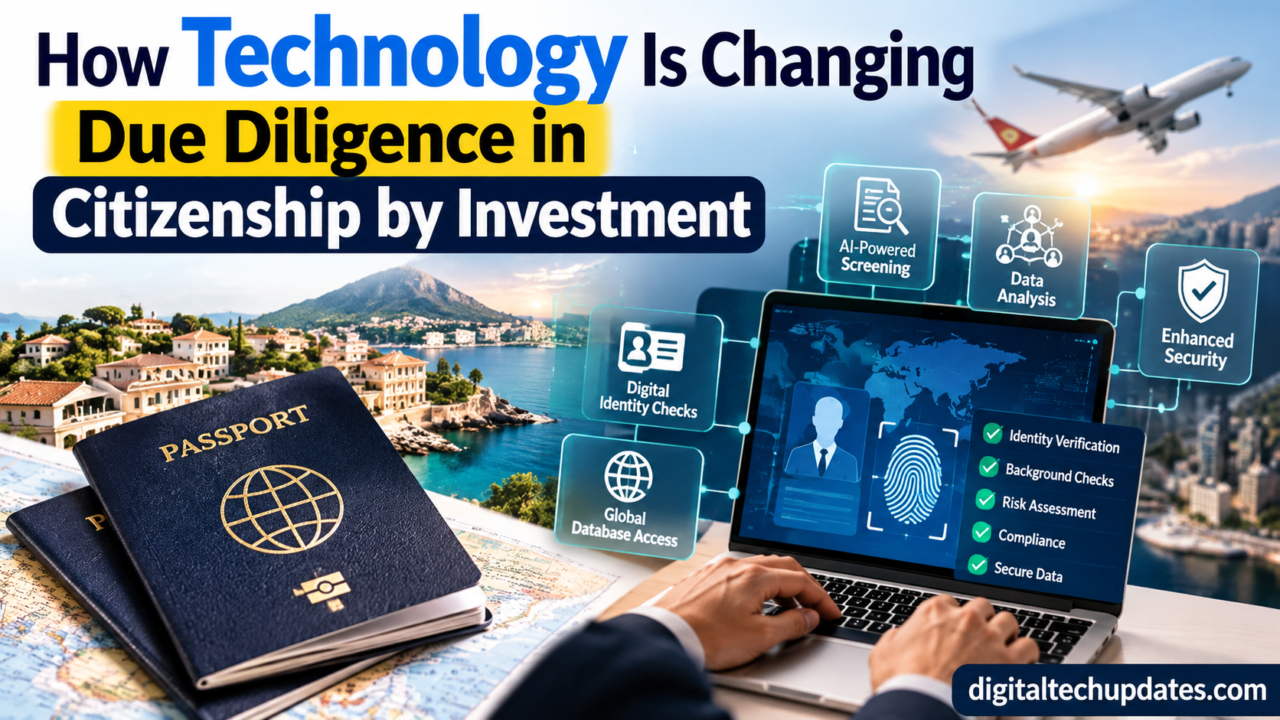
Technology has transformed almost every corner of international finance. Banking relationships can be opened remotely, corporate records can be searched across borders, sanctions databases can be screened in seconds, and sophisticated software can analyze enormous quantities of information that once required days of manual research.
The same transformation is increasingly relevant to citizenship and residence by investment.
These programs sit at an unusual intersection of immigration, international investment, banking, compliance and government administration. An applicant may have businesses, investments, bank accounts and residences spanning several jurisdictions. Determining who that person is, where their wealth originated and whether their background creates legal or reputational concerns therefore requires considerably more than checking a passport.
Technology is making that investigation faster and more scalable. It is not, however, eliminating the need for human judgment.
Understanding that distinction is increasingly important for governments, compliance professionals and investors.
Investment Migration Is Becoming a Data Problem
Citizenship by investment programs generally allow qualified foreign applicants to obtain citizenship after satisfying a country’s legal requirements and making an eligible investment or contribution.
For prospective investors researching citizenship by investment, the financial requirement is only one component of the process. Modern programs can involve identity verification, background investigations, source-of-funds documentation, source-of-wealth analysis and checks against international compliance databases.
The challenge is the amount of information involved.
Consider an entrepreneur who has operated companies in several countries over 20 years.
A proper investigation could involve corporate registries, litigation records, regulatory databases, sanctions lists, news archives, property records, professional history and financial documentation.
Some information may be available digitally. Other records may exist only locally. Names can appear differently across languages and alphabets.
Technology helps investigators organize and screen this information at a scale that would previously have been extremely difficult.
Automated Screening Has Changed the First Layer of Due Diligence
One of technology’s clearest advantages is screening.
Compliance systems can compare applicant information against large databases containing sanctions records, politically exposed persons, regulatory actions and other risk indicators.
Instead of manually searching each database individually, investigators can perform broad initial screening and then examine potential matches.
This matters because names are rarely as simple as they appear.
Two unrelated people can share the same name. One individual can appear under several transliterations. Corporate entities may have similar names across different jurisdictions.
Modern screening systems can use fuzzy matching and other techniques to identify variations that an exact-text search might overlook.
The technology therefore serves an important purpose: identifying where investigators should look more closely.
It does not automatically determine whether a person represents a risk.
A database match is the beginning of an investigation, not necessarily its conclusion.
Open-Source Intelligence Has Become Far More Powerful
Another major development is the growth of open-source intelligence.
An extraordinary amount of potentially relevant information is now publicly accessible online.
Corporate registries may reveal directorships and ownership interests. Court databases may identify litigation. Regulatory agencies publish enforcement actions. News archives can provide years of reporting about companies and individuals.
Investigators can combine information from multiple sources to construct a much more complete picture.
Search technology has also improved the ability to conduct research across languages.
That is especially important in international due diligence.
Searching only English-language sources could miss significant information about an applicant whose principal business activities occurred elsewhere.
Technology-supported multilingual research can broaden the investigation substantially.
But automated research has limitations.
Search results can contain incorrect information, duplicated stories and allegations that were later disproven. Two individuals with similar names can easily be confused.
The more powerful the search technology becomes, the more important verification becomes as well.
Source of Wealth Is Harder to Automate
Some compliance questions cannot be answered simply by searching a database.
Source of wealth is a good example.
Suppose an applicant states that most of his or her wealth came from selling a business.
An investigator may need to understand when the business was established, who owned it, how it grew, whether the transaction actually occurred and whether the resulting proceeds correspond reasonably with the applicant’s financial profile.
Software can help organize documents and identify inconsistencies.
It cannot necessarily determine the complete economic story behind someone’s wealth.
That distinction is important.
Source of funds generally concerns the origin of money being used for a particular transaction. Source of wealth examines the broader process through which an individual accumulated wealth.
Both can require substantial documentation.
Technology can accelerate the analysis, but unusual cases still require professional judgment.
Artificial Intelligence Adds Another Layer
Artificial intelligence introduces additional possibilities.
Large collections of documents can potentially be categorized, summarized and compared much faster than before.
AI systems can help identify discrepancies between forms, flag unusual patterns and assist researchers reviewing large quantities of text.
Imagine an application containing hundreds of pages of corporate, financial and personal documentation.
Software may be able to identify that a company name is spelled differently across several documents, that dates appear inconsistent or that a declared business relationship requires further investigation.
Those capabilities could make investigators more efficient.
Yet AI creates its own risks.
A system can generate false positives. It can misinterpret context. Data used by automated systems may be incomplete or outdated.
High-stakes governmental decisions therefore cannot sensibly be reduced to an algorithmic score.
AI works best as an investigative tool rather than an autonomous decision-maker.
Digital Documents Create Both Efficiency and Risk
Digitization has dramatically improved international applications.
Documents can be transmitted electronically instead of physically transported between countries. Application information can be organized within case-management systems. Different professionals can review files without relying exclusively on paper records.
But digital documents also introduce new verification challenges.
Modern editing software makes documents easier to manipulate, while generative AI is making fabricated digital material increasingly sophisticated.
A PDF that appears professional is not automatically authentic.
Verification increasingly requires examining the underlying source.
Was the document actually issued by the organization identified on it?
Does the issuing institution independently confirm the information?
Does the document correspond with records held elsewhere?
Digital convenience therefore increases the importance of provenance.
The future of compliance will probably involve better ways of establishing where digital documents originated and whether they have been altered.
Cybersecurity Becomes Part of the Equation
Investment migration applications can contain exceptionally sensitive information.
Files may include passports, addresses, banking records, corporate documents, family information and detailed descriptions of an applicant’s finances.
That makes cybersecurity an important part of program administration.
The question is no longer simply whether a government can collect information.
It must also protect it.
Secure portals, encryption, access controls, authentication and internal monitoring become increasingly important when sensitive application information moves through digital systems.
Intermediaries face the same challenge.
Law firms, migration advisers, financial professionals and due-diligence providers may all handle confidential information during an application.
Every additional organization with access to sensitive data creates another potential security point that needs to be managed.
Technology Does Not Replace Local Intelligence
Perhaps the biggest misconception about digital due diligence is that everything important can now be found online.
It cannot.
Some countries have excellent searchable public records. Others have fragmented systems or records that have never been digitized.
Certain information may require contacting institutions directly.
Local investigators can also understand context that software cannot easily recognize.
A company may exist legally but have little genuine commercial activity. A local court matter may not appear in an international database. A business reputation may look very different when examined through local-language sources.
Effective international due diligence therefore increasingly combines two approaches: technology at scale and human investigation at depth.
Neither is sufficient by itself.
Better Technology Can Also Improve the Investor Experience
The benefits are not limited to governments.
Legitimate applicants can benefit from better technology as well.
Clear digital document systems can reduce administrative confusion. Application portals can make it easier to understand which materials remain outstanding. Secure communication platforms can reduce reliance on long email chains containing sensitive attachments.
Technology can also help investors conduct their own preliminary research.
Before choosing a program, applicants can compare government requirements, qualifying investment structures, processing procedures and due-diligence expectations.
That creates a more informed applicant.
It may also discourage people who are unlikely to satisfy compliance requirements from entering the process in the first place.
More Data Does Not Automatically Mean Better Decisions
The central challenge for the next generation of investment-migration technology will not be collecting information.
It will be determining which information matters.
A system that produces thousands of irrelevant alerts can actually make investigations less effective.
The objective should therefore be better risk identification rather than simply more data.
Good technology should help investigators answer specific questions:
- Is this applicant really the person represented in the application?
- Does the financial history make sense?
- Can the stated source of wealth be independently supported?
- Are there sanctions, regulatory, criminal or reputational issues requiring closer investigation?
- Are documents authentic?
- Are different pieces of information consistent with one another?
Technology becomes valuable when it helps humans answer those questions more accurately.
The Future Is Likely to Be Hybrid
Citizenship by investment is sometimes described primarily as an immigration or investment product.
Operationally, however, modern programs increasingly resemble sophisticated international compliance systems.
They must process identity information, financial documentation, corporate records, regulatory data and cross-border risk indicators while protecting highly sensitive personal information.
That makes technology unavoidable.
Automated screening, multilingual search, digital case management, artificial intelligence and better document verification will continue changing how applications are evaluated.
But the strongest systems are unlikely to eliminate human investigators.
They will make those investigators better equipped.
The future of citizenship-by-investment due diligence is therefore not simply digital.
It is hybrid: machines capable of processing enormous amounts of information combined with people capable of understanding what that information actually means.

Thalla Lokesh
Thalla Lokesh is a Digital Marketing Strategist and SEO Specialist with over 12 years of experience in helping businesses grow their online presence. Since beginning his career in 2013, he has successfully worked across industries including healthcare, education, technology, and e-commerce. He specializes in search engine optimization (SEO), content marketing, keyword strategy, and link building, with a strong focus on delivering measurable results. Lokesh has helped brands achieve top rankings on Google through data-driven strategies, high-quality content, and ethical SEO practices aligned with search engine guidelines. As the founder of Honey Web Solutions , a Tirupati-based digital marketing company, he actively works with clients to improve organic traffic, lead generation, and online visibility. He also contributes expert insights on digital marketing trends, AI SEO, and content strategies through blogs and industry platforms.