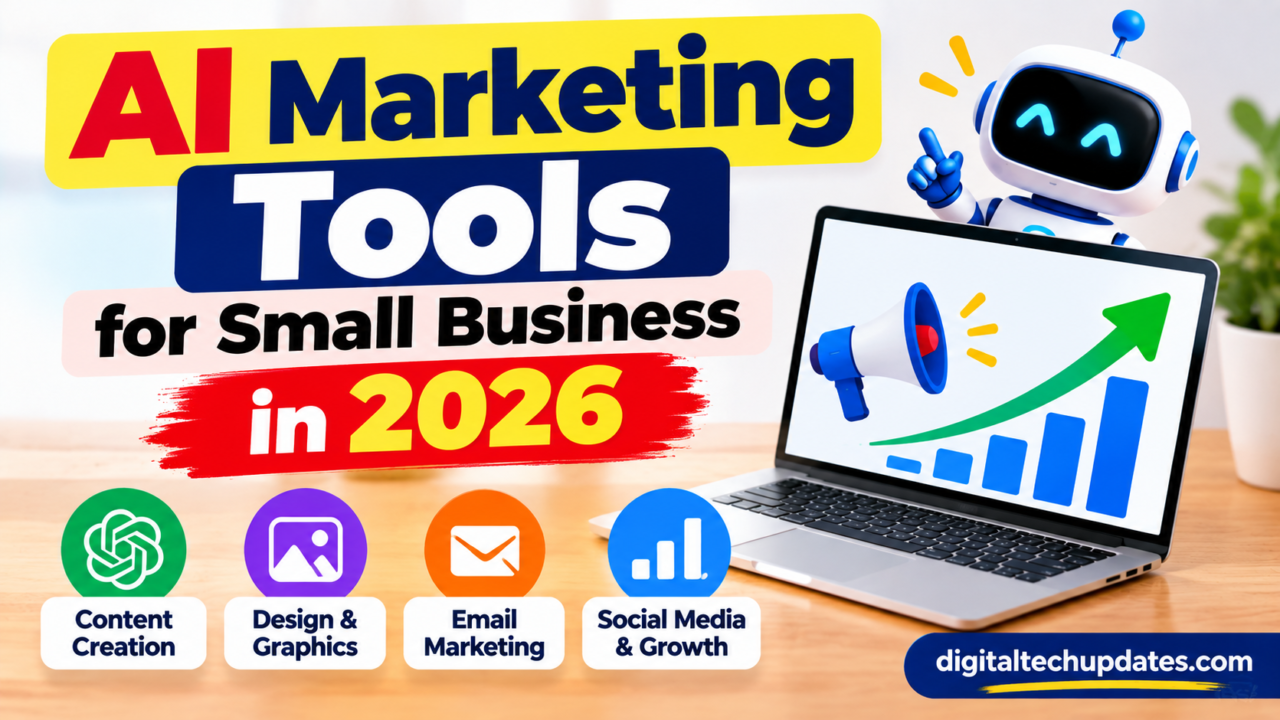
AI Marketing Tools for Small Business: Best Tools to Grow Your Business in 2026

Running a small business often means doing everything yourself.
You may be managing customers in the morning, creating social media posts in the afternoon, answering emails, writing website content and checking advertising performance at night.
Marketing can quickly become one of the most time-consuming parts of running a business.
This is where AI marketing tools for small business can make a real difference.
In 2026, AI marketing software can help small businesses with content creation, social media, email marketing, SEO, advertising, customer communication, lead management and automation.
The important thing, however, is not to use AI for everything.
The best approach is to use AI for repetitive tasks while keeping human judgment, creativity and customer relationships at the center of your marketing strategy.
Recent small-business research and industry coverage show that AI adoption has moved well beyond experimentation, with businesses increasingly using AI for practical marketing and productivity tasks.
In this guide, we’ll look at the best AI marketing tools for small business in 2026, what each tool can do, who should use it and how to build a simple AI marketing stack without wasting money on unnecessary subscriptions.
What Are AI Marketing Tools?
AI marketing tools are software platforms that use artificial intelligence to help businesses plan, create, automate or analyze marketing activities.
Depending on the tool, AI can help with:
- Writing blog posts
- Creating social media captions
- Designing marketing graphics
- Generating advertising ideas
- Researching keywords
- Optimizing content for SEO
- Writing emails
- Segmenting customers
- Automating marketing workflows
- Creating videos
- Answering customer questions
- Analyzing campaign performance
- Generating marketing reports
For a small business, the biggest advantage is usually saving time.
Instead of spending two hours creating a first draft of a social media campaign, for example, you can use AI to create a starting point and then spend your time reviewing and improving it.
Best AI Marketing Tools for Small Business in 2026
Here are some of the most useful AI marketing tools to consider:
| Tool | Best For | Good Choice For |
|---|---|---|
| ChatGPT | Content, ideas and marketing assistance | Almost any small business |
| Canva | Social graphics and marketing designs | Businesses without designers |
| HubSpot Breeze | CRM, marketing and automation | Growing businesses |
| Mailchimp | Email marketing | Email-focused businesses |
| Buffer | Social media management | Small social teams |
| Semrush | SEO and competitor research | Websites and online businesses |
| Jasper | Brand-focused content | Content-heavy businesses |
| Zapier | Marketing automation | Businesses with repetitive workflows |
| Klaviyo | Ecommerce email and customer marketing | Online stores |
| ManyChat | Customer messaging and chat automation | Social-commerce businesses |
The right tool depends on what is slowing down your marketing.
1. ChatGPT – Best General AI Marketing Assistant
OpenAI
ChatGPT can be useful for almost every stage of a small-business marketing workflow.
Instead of thinking of it as simply a writing tool, you can use it as a marketing assistant for brainstorming, research, planning and creating first drafts.
What can you use ChatGPT for?
For example, you can ask it to:
- Generate blog topic ideas
- Create content briefs
- Write social media drafts
- Create email campaigns
- Brainstorm advertising ideas
- Rewrite website copy
- Create product descriptions
- Develop customer personas
- Create FAQs
- Repurpose blog posts into social content
- Analyze marketing ideas
- Create content calendars
The key is to provide useful context.
Instead of asking:
“Write a Facebook post.”
Give it information about your business, target customer, offer, tone and objective.
You’ll generally get a much more useful result.
Best for:
Small businesses that want one flexible AI assistant for multiple marketing tasks.
2. Canva – Best AI Marketing Tool for Visual Content
Canva
Not every small business can afford a full-time graphic designer.
Canva makes it easier to create marketing materials without advanced design skills.
Its AI-powered features can help with creating and editing visual content, while its broader design platform provides templates for social posts, advertisements, presentations, flyers and other marketing assets.
You can use Canva for:
- Instagram posts
- Facebook graphics
- YouTube thumbnails
- Advertisements
- Flyers
- Presentations
- Posters
- Blog graphics
- Product visuals
- Short-form marketing content
Canva is particularly useful for businesses that need to publish visual content regularly.
Best for:
Small businesses that need professional-looking graphics without hiring a designer for every task.
3. HubSpot Breeze – Best for CRM and Marketing Automation
HubSpot
HubSpot combines CRM, marketing, sales and customer-management functionality with its AI layer, Breeze.
This makes it interesting for businesses that want to connect marketing activities with leads and customers instead of using completely separate systems.
HubSpot has continued expanding Breeze throughout 2026. Its current AI capabilities include assistance with content and other marketing workflows, while newer features are designed around connected customer data and marketing operations.
What can it help with?
Depending on your plan and setup, you can use HubSpot for:
- CRM management
- Lead generation
- Email marketing
- Landing pages
- Content creation
- Customer communication
- Marketing automation
- Campaign management
- Reporting
Best for:
Small businesses that are growing beyond basic social media and need better lead and customer management.
4. Mailchimp – Best for AI-Assisted Email Marketing
Mailchimp
Email remains one of the most useful marketing channels for small businesses because you can communicate directly with people who have already shown interest in your business.
Mailchimp combines email marketing with automation, audience management and AI-assisted marketing capabilities.
You can use it to build campaigns such as:
- Welcome emails
- Promotional emails
- Product announcements
- Newsletters
- Abandoned-cart campaigns
- Customer follow-ups
- Re-engagement campaigns
Why is AI useful here?
AI can help you generate subject-line ideas, campaign copy and variations that you can then review before sending.
The goal isn’t to let AI send everything automatically.
It’s to make campaign creation faster.
Best for:
Small businesses that rely heavily on email newsletters and customer communication.
5. Buffer – Best for Social Media Management
Buffer
If you manage multiple social media accounts, posting manually to every platform can become repetitive.
Buffer helps businesses plan and schedule social content, while AI features can assist with creating and adapting posts.
You can use it to:
- Schedule social posts
- Organize content
- Create caption ideas
- Repurpose content
- Manage multiple channels
- Review social performance
For a small business owner, scheduling several posts at once can save a considerable amount of time.
Best for:
Businesses that regularly publish content across multiple social platforms.
6. Semrush – Best AI-Powered SEO Marketing Tool
Semrush
If organic search traffic is important to your business, an SEO platform can become an important part of your marketing stack.
Semrush provides tools for areas such as:
- Keyword research
- Competitor analysis
- Website auditing
- Backlink research
- Content optimization
- Search visibility
- AI-search-related insights
However, Semrush is a relatively advanced platform.
A small business shouldn’t subscribe simply because it is popular.
If you’re running a local service business with a five-page website, you may not need every feature.
Best for:
Businesses that depend on Google traffic and want deeper SEO and competitor research.
7. Jasper – Best for Brand-Focused Content
Jasper
Jasper focuses heavily on marketing content and brand consistency.
It can be useful for businesses that produce large amounts of marketing copy and need consistent messaging across different campaigns.
You might use it for:
- Blog content
- Advertising copy
- Product descriptions
- Email campaigns
- Social content
- Brand messaging
One advantage of specialized marketing AI tools is that they can provide workflows designed specifically around marketing rather than general-purpose conversations.
Best for:
Businesses and marketing teams producing content at scale.
8. Zapier – Best for Marketing Automation
Zapier
Some of the biggest marketing time-wasters are repetitive tasks.
For example:
Someone fills out a website form.
Then you:
- Copy the information.
- Add it to your CRM.
- Send an email.
- Notify someone on your team.
- Add the person to a marketing list.
Automation can connect those steps.
Zapier can connect different applications and automate workflows, with AI features increasingly being incorporated into its automation platform.
Example workflow
A potential customer fills out your website contact form.
The automation could:
Form submission → CRM → Email notification → Welcome email → Follow-up task
That means you don’t have to manually move the information between different systems.
Best for:
Small businesses with repetitive marketing and lead-management tasks.
9. Klaviyo – Best for Ecommerce Marketing
Klaviyo
If you run an online store, your marketing requirements are different from those of a local service business.
You may need to manage:
- Product recommendations
- Customer segments
- Abandoned carts
- Promotional emails
- Customer lifecycle campaigns
- SMS marketing
- Repeat purchases
Klaviyo is designed around ecommerce and customer marketing, making it a stronger fit for many online stores than a basic newsletter platform.
Best for:
Ecommerce businesses that want automated customer and lifecycle marketing.
10. ManyChat – Best for Automated Customer Conversations
ManyChat
Customers increasingly expect businesses to respond quickly.
ManyChat can help businesses automate certain customer conversations across supported messaging and social channels.
For example, you could create an automated flow for:
Customer message → Product question → Information → Website link → Lead collection
This can be especially useful for businesses that receive many inquiries through social media.
Best for:
Businesses that generate leads or sales through messaging and social platforms.
How AI Marketing Tools Help Small Businesses
The biggest benefit isn’t that AI can “do marketing.”
The real benefit is that AI can help you do more marketing with limited time and resources.
Here are some practical examples.
Content Creation
Instead of starting every article from a blank document, AI can help you generate:
- Topic ideas
- Outlines
- Headlines
- FAQs
- Social captions
- Email drafts
You should still fact-check and edit the final content.
Social Media
AI can help turn one piece of content into several posts.
For example:
One blog post
↓
LinkedIn post
↓
Facebook post
↓
Instagram caption
↓
Short-video script
↓
Email newsletter
This is called content repurposing.
Email Marketing
AI can help generate multiple subject lines and email variations.
You can then test which versions produce better results.
SEO
AI can help with:
- Keyword brainstorming
- Search-intent analysis
- Content outlines
- FAQ generation
- Internal-link suggestions
- Content refreshing
But AI should not replace actual SEO research.
Use real search data and customer questions wherever possible.
AI Marketing Tools by Business Type
You don’t need the same tools as every other business.
Local Service Business
For a plumber, salon, consultant, restaurant or local agency:
ChatGPT + Canva + Google Business Profile + email/CRM
may be enough to start.
Ecommerce Business
An online store may benefit from:
ChatGPT + Canva + Klaviyo + SEO software + automation
Freelancer
A freelancer could start with:
ChatGPT + Canva + Buffer
and add specialized tools only when needed.
Small Marketing Agency
An agency may need:
ChatGPT + Canva + Semrush + HubSpot + Zapier
depending on its clients and workflows.
How Much Do AI Marketing Tools Cost?
This is where small businesses need to be careful.
AI tools can look inexpensive individually.
You might think:
- $20 here
- $15 there
- $30 for another tool
- $50 for an SEO platform
Suddenly you’re paying hundreds of dollars every month.
Instead of buying everything, identify your biggest marketing bottleneck.
If writing is the problem
Start with a general AI assistant.
If design is the problem
Try Canva.
If SEO is the problem
Consider an SEO platform.
If leads are being lost
Look at CRM and automation tools.
If email is the main channel
Choose an email marketing platform.
Don’t buy five AI tools to solve one problem.
Are Free AI Marketing Tools Enough for Small Businesses?
For many businesses, yes — at least initially.
A small business can start with free or limited plans and upgrade only when the business actually needs additional features.
For example:
Starting stage
ChatGPT + Canva + free analytics tools
↓
Growing stage
Add email marketing and social scheduling
↓
Established stage
Add CRM, automation and advanced SEO tools
This approach keeps your marketing costs under control.
Current 2026 comparisons also show that many major AI marketing platforms offer free plans or trials, although important limits often apply to usage, contacts, automation or advanced features.
How to Use AI Without Making Your Marketing Sound Robotic
This is one of the biggest problems with AI-generated marketing.
If you simply generate content and publish it without editing, your website and social media accounts can start sounding like everyone else’s.
Instead:
1. Give AI your real business information
Include:
- Your products
- Your customers
- Your location
- Your experience
- Your brand voice
- Your pricing
- Your unique selling points
2. Add real examples
AI can generate general advice.
Your experience makes the content unique.
3. Edit everything before publishing
Check:
- Facts
- Claims
- Statistics
- Tone
- Examples
- Links
- Brand information
4. Don’t let AI replace your personality
Customers still want to hear from real people.
Recent small-business experiences with AI reinforce this point: AI can save time, but business owners still need to provide context, make strategic decisions and maintain authenticity.
Simple AI Marketing Workflow for Small Businesses
If you are just getting started, don’t make things complicated.
Try this workflow:
Step 1: Plan
Use AI to brainstorm content ideas based on your customers’ problems.
Step 2: Research
Check Google search results, competitors, customer questions and industry trends.
Step 3: Create
Use AI to produce a first draft.
Step 4: Add human expertise
Add your own examples, experience, opinions and business information.
Step 5: Design
Use Canva or another design tool to create supporting visuals.
Step 6: Publish
Post the content on your website, email newsletter or social media channels.
Step 7: Automate
Use tools such as Zapier to automate repetitive steps.
Step 8: Measure
Look at traffic, leads, engagement, sales and conversions.
Step 9: Improve
Keep what works and change what doesn’t.
Common Mistakes Small Businesses Make With AI Marketing
Using too many tools
More tools don’t automatically mean better marketing.
Start with two or three tools.
Publishing AI content without checking it
AI can make mistakes.
Always review important claims and information.
Using AI-generated images everywhere
Stock-style AI visuals can make your brand look generic.
Use original photos and authentic business visuals when appropriate.
Focusing only on content
Publishing more blog posts isn’t always the answer.
Marketing should ultimately support business goals such as:
- Leads
- Sales
- Bookings
- Customer retention
- Brand awareness
Expecting instant results
AI can speed up marketing work.
It cannot guarantee instant traffic, rankings or sales.
If you want to keep things simple, here’s a practical starting point:
| Marketing Need | Recommended Starting Tool |
|---|---|
| General marketing help | ChatGPT |
| Social graphics | Canva |
| SEO research | Semrush |
| CRM and automation | HubSpot |
| Email marketing | Mailchimp |
| Social scheduling | Buffer |
| Ecommerce marketing | Klaviyo |
| Workflow automation | Zapier |
| Messaging automation | ManyChat |
You don’t need all nine.
Start with the tools that solve your biggest problem.
Final Thoughts
AI is changing how small businesses approach marketing.
A business that previously needed several people to handle writing, design, social media and repetitive marketing tasks can now use AI to make many of those processes faster.
But AI isn’t a replacement for a marketing strategy.
The most effective approach is:
AI for speed + human expertise + real customer insights + consistent testing.
Start small.
Choose one marketing problem.
Find one AI tool that can help solve it.
Measure the results.
Then expand your AI marketing stack only when there is a genuine reason to do so.
For most small businesses in 2026, the goal shouldn’t be to use the most AI tools.
The goal should be to use the right AI tools to save time, reach more customers and grow revenue.
Frequently Asked Questions
What are the best AI marketing tools for small businesses?
Some of the strongest options include ChatGPT for general marketing assistance, Canva for visual content, HubSpot for CRM and automation, Mailchimp for email marketing, Semrush for SEO, Buffer for social media and Zapier for workflow automation.
What is the best free AI marketing tool for a small business?
A general AI assistant such as ChatGPT can be a strong starting point because it can support many marketing tasks, including brainstorming, content drafting, customer communication and campaign planning. Canva and several other marketing platforms also offer free access with limitations.
Can AI do all of my small-business marketing?
No. AI can automate and accelerate many marketing tasks, but human oversight remains important. Strategy, brand positioning, customer relationships and final decisions should not be completely handed over to AI.
Is AI marketing worth it for a small business?
It can be, particularly when AI is used to reduce repetitive work and improve marketing productivity. The best way to evaluate a tool is to measure whether it saves time, improves campaign performance or helps generate more qualified leads.
How many AI marketing tools does a small business need?
Most small businesses should start with two or three tools rather than subscribing to every AI platform available. Add another tool only when it solves a specific problem that your existing stack cannot handle efficiently.

Thalla Lokesh
Thalla Lokesh is a Digital Marketing Strategist and SEO Specialist with over 12 years of experience in helping businesses grow their online presence. Since beginning his career in 2013, he has successfully worked across industries including healthcare, education, technology, and e-commerce. He specializes in search engine optimization (SEO), content marketing, keyword strategy, and link building, with a strong focus on delivering measurable results. Lokesh has helped brands achieve top rankings on Google through data-driven strategies, high-quality content, and ethical SEO practices aligned with search engine guidelines. As the founder of Honey Web Solutions , a Tirupati-based digital marketing company, he actively works with clients to improve organic traffic, lead generation, and online visibility. He also contributes expert insights on digital marketing trends, AI SEO, and content strategies through blogs and industry platforms.