Anti-Money Laundering Software: Features, Benefits, Types, and How It Works

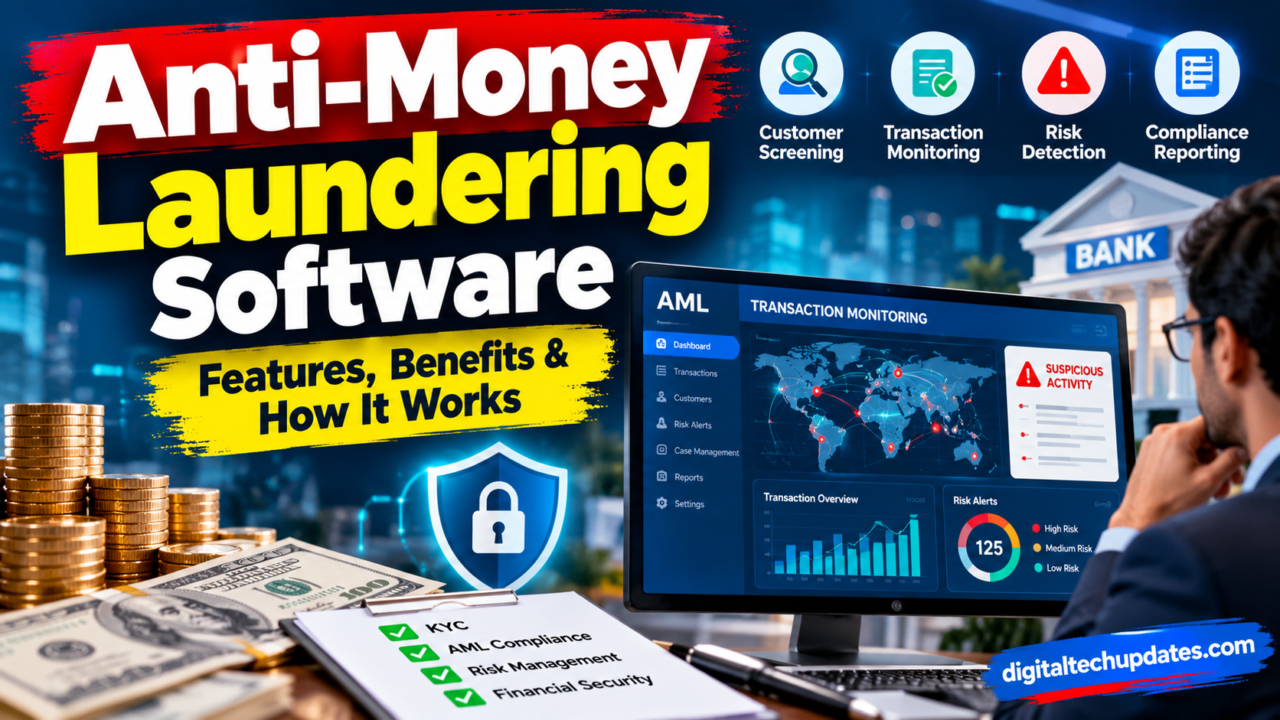
Anti-money laundering software plays an important role in helping banks, financial institutions, fintech companies, and other regulated businesses detect suspicious financial activity and reduce the risk of financial crime.
As digital payments, online banking, and cross-border transactions continue to expand, businesses need effective ways to identify unusual transaction patterns, monitor customer activity, and meet applicable compliance requirements. Traditional manual reviews can struggle to keep pace with large volumes of transactions, making automated monitoring tools increasingly valuable.
But what exactly is anti-money laundering software? How does it work, what features should businesses look for, and how can organizations choose the right solution?
This guide explains the technology in simple terms, including its key features, benefits, common use cases, limitations, and selection criteria.
What Is Anti-Money Laundering Software?
Anti-money laundering (AML) software is a technology solution that helps organizations identify, investigate, and manage activities that may indicate money laundering or related financial crimes.
Money laundering involves disguising the origins of money obtained through illegal activities so that it appears legitimate. Criminals may attempt to move funds through multiple accounts, businesses, transactions, or jurisdictions to hide their source.
AML software helps organizations identify warning signs by analyzing customer information, payment records, transaction histories, and other relevant data.
According to the Financial Action Task Force (FATF), effective AML measures should follow a risk-based approach, meaning that the level of monitoring and due diligence should reflect the risks associated with customers, products, services, and transactions.
In simple terms, AML software helps businesses answer three important questions:
-
Who is the customer, and what is their risk profile?
-
Are their transactions consistent with their expected financial activity?
-
Does any activity require further investigation or reporting?
It supports compliance teams, but it does not automatically prove that a customer has committed a crime.
How Does Anti-Money Laundering Software Work?
AML software generally works through a series of connected processes. The exact workflow depends on the solution, the organization’s risk profile, and applicable regulations.
1. Collect data
Customer details, account information and transaction records
2. Screen customers and transactions
Check relevant watchlists, sanctions lists and risk indicators
3. Detect unusual activity
Apply rules, risk scores, analytics or machine learning
4. Generate alerts for review
Prioritize transactions or customers that need attention
5. Investigate and document
Compliance staff examine evidence and decide on appropriate action
Step 1: Collect Customer and Transaction Data
The software receives information from relevant systems, such as customer onboarding platforms, banking applications, payment gateways, and transaction databases.
Depending on the implementation, data may include:
-
Customer identification and account details.
-
Transaction amounts, dates, and frequency.
-
Sender and recipient information.
-
Geographic information.
-
Business ownership and customer risk details.
The quality of this data is important. Missing records, inconsistent names, and delayed transaction feeds can reduce the effectiveness of AML monitoring.
Step 2: Screen Customers Against Relevant Lists
Customer screening helps organizations identify potential matches against applicable sanctions lists, politically exposed person (PEP) databases, and other relevant watchlists.
Screening may occur when a customer is onboarded and again during the ongoing customer relationship.
Because names can be similar, a potential match requires careful review. A screening alert alone does not establish wrongdoing.
Step 3: Monitor Transactions for Unusual Patterns
Transaction monitoring evaluates whether financial activity appears inconsistent with a customer’s known profile or expected behavior.
For example, the software may flag:
-
Unusually large or frequent transfers.
-
Multiple transactions that appear structured to avoid scrutiny.
-
Rapid movement of funds between accounts.
-
Unusual cross-border transaction patterns.
-
Activity that differs significantly from historical behavior.
These patterns are indicators for investigation, not conclusive evidence of money laundering. FATF guidance emphasizes that unusual activity must be assessed using additional facts and the customer’s risk context.
Step 4: Generate Risk Alerts
When the system identifies activity that meets its configured rules or risk criteria, it generates an alert.
Compliance teams can prioritize alerts based on factors such as severity, customer risk, transaction characteristics, and relevant regulatory obligations.
Effective alert management is important because excessive false positives can overwhelm investigators and delay the review of genuinely concerning activity.
Step 5: Investigate and Take Appropriate Action
Compliance professionals review the alert, examine relevant records, and determine whether further investigation is necessary.
Depending on the findings and applicable law, the organization may document its decision, request additional information, escalate the case, or submit a suspicious transaction report to the relevant authority when required.
The software supports this process; the organization’s authorized personnel remain responsible for appropriate decisions and compliance.
Key Features of Anti-Money Laundering Software
Not every AML platform includes the same features. The following capabilities are common in solutions designed for financial institutions and regulated businesses.
| Feature | What it does |
|---|---|
| Transaction monitoring | Identifies potentially suspicious transaction patterns. |
| Customer due diligence | Supports identity verification and customer risk assessment. |
| Sanctions screening | Checks relevant names and transactions against applicable sanctions lists. |
| PEP screening | Helps identify politically exposed persons for appropriate risk assessment. |
| Risk scoring | Assigns risk levels based on configured criteria and available data. |
| Case management | Organizes alerts, investigations, evidence, and decisions. |
| Regulatory reporting support | Helps prepare and document required reports. |
| Audit trails | Records relevant actions and investigation history. |
| Analytics and machine learning | Helps identify patterns and prioritize potential risks. |
| Ongoing monitoring | Supports repeated screening and monitoring as customer information or risks change. |
Some platforms also provide data integration, configurable workflows, dashboards, and reporting tools. For example, SAS describes capabilities for integrating transaction, customer, geographic, and third-party data to support AML analytics.
Types of Anti-Money Laundering Software
AML software is not a single product category with identical functionality. Organizations may choose specialized tools or integrated platforms depending on their business needs.

1. Transaction monitoring software
Analyzes transactions to identify unusual amounts, frequencies, relationships, and movement of funds. It is commonly used by banks, payment providers, and other financial institutions.

2. Customer due diligence (CDD) software
Supports customer identification, verification, risk classification, and ongoing due diligence. It may integrate with KYC platforms and business ownership databases.

3. Sanctions and watchlist screening software
Checks customer names, counterparties, and relevant transactions against applicable lists. Matching tools help investigators assess possible name matches.

4. AML investigation and case management software
Helps compliance teams manage alerts, gather evidence, assign cases, document decisions, and track investigation progress.

5. AI-powered AML analytics software
Uses statistical models, machine learning, or network analysis to help identify complex patterns and prioritize alerts. Its effectiveness depends on data quality, model design, testing, and oversight.
Some organizations purchase separate tools for these functions, while others use an integrated AML compliance platform.
Benefits of Anti-Money Laundering Software
Investing in appropriate AML software can help organizations strengthen financial crime controls and improve compliance operations.
1. Faster Detection of Suspicious Activity
Automated monitoring can analyze large volumes of transaction data more consistently than a process relying entirely on manual reviews. This helps compliance teams identify activity that deserves closer attention.
2. More Efficient Compliance Workflows
AML software can automate repetitive screening, alert generation, case assignment, and documentation tasks. This allows investigators to spend more time reviewing higher-priority cases.
3. Better Risk Assessment
By combining customer information, transaction history, and relevant risk indicators, the software can help organizations develop a more informed view of customer risk.
4. Improved Audit Readiness
Centralized case records and audit trails can help organizations demonstrate how alerts were reviewed, what evidence was considered, and why decisions were made.
5. Support for Regulatory Compliance
AML tools can support customer due diligence, transaction monitoring, recordkeeping, and suspicious transaction reporting processes. However, purchasing software alone does not guarantee regulatory compliance. Organizations must configure, operate, test, and oversee their controls appropriately.
6. Scalability as Transaction Volumes Grow
As a business expands into new markets, payment methods, or customer segments, an appropriately designed platform can help manage increasing data volumes and monitoring demands.
Who Uses Anti-Money Laundering Software?
AML software is used across several industries where financial crime risks and regulatory obligations are relevant.
| Industry | Typical use case |
|---|---|
| Banks and credit unions | Monitoring account activity and transfers. |
| Fintech companies | Screening customers and monitoring digital payments. |
| Payment service providers | Identifying unusual payment patterns. |
| Insurance companies | Supporting customer checks and identifying suspicious financial activity. |
| Investment firms | Screening clients and monitoring relevant transactions. |
| Cryptocurrency businesses | Monitoring blockchain activity and customer transactions. |
| Money transfer businesses | Identifying suspicious remittances and transaction patterns. |
| Other regulated businesses | Supporting applicable AML and customer due diligence obligations. |
The specific requirements vary by jurisdiction and business type. FATF standards provide an international framework, while national laws and regulators determine the obligations that apply to individual organizations.
How to Choose the Right AML Software
Selecting anti-money laundering software requires more than comparing features or subscription prices. The best solution is one that fits the organization’s risk profile, transaction volume, operational processes, and regulatory environment.
Consider the following factors before making a decision.
1. Identify your compliance requirements
Determine which AML, sanctions screening, recordkeeping, and reporting obligations apply to your organization and the jurisdictions in which it operates.
2. Check data integration capabilities
Confirm that the platform can connect to your existing banking, payment, customer onboarding, and data management systems.
3. Evaluate monitoring flexibility
Look for configurable rules, customer risk models, relevant screening lists, and the ability to adapt monitoring to your actual risks.
4. Assess AI and analytics carefully
Ask how models are validated, how false positives are measured, how decisions can be explained, and how model performance is monitored.
5. Review security and data privacy
Examine access controls, encryption, data retention, audit logs, hosting arrangements, and compliance with applicable data protection requirements.
6. Calculate the total cost of ownership
Consider licensing, implementation, integration, data feeds, staff training, maintenance, and ongoing model validation—not just the initial subscription.
Before purchasing, request a demonstration using representative scenarios and assess how the vendor measures detection effectiveness, alert quality, investigation time, and system reliability.
Popular Anti-Money Laundering Software Solutions
Organizations can evaluate specialist AML vendors and broader financial crime compliance platforms. The following examples are starting points for research, not a ranking or endorsement.

SAS Anti-Money Laundering
Provides AML analytics and data management capabilities for financial crime monitoring.
Official website: SAS AML

NICE Actimize
Offers financial crime risk management technologies, including AML-related monitoring and investigation capabilities.
Official website: NICE Actimize
ComplyAdvantage
Provides compliance tools covering risk intelligence, sanctions screening, and transaction monitoring.
Official website: ComplyAdvantage

Oracle Financial Services
Offers financial services technology that includes risk management and financial crime compliance capabilities.
Official website: Oracle Financial Services
Feature availability, implementation requirements, pricing, and geographic coverage vary. Contact vendors for current product details and determine whether their solutions meet your specific compliance needs.
Challenges and Limitations of AML Software
Although AML software can improve monitoring, it cannot eliminate financial crime or replace sound compliance practices.
Common challenges include:
-
False positives: Legitimate transactions may trigger alerts, increasing investigation workloads.
-
Data quality issues: Incomplete or inconsistent records can undermine detection.
-
Evolving criminal methods: Criminals continually change their techniques, requiring monitoring rules and models to be reviewed.
-
Implementation costs: Integration, customization, training, and ongoing maintenance can be expensive.
-
Model risks: Poorly designed or inadequately tested models may miss suspicious activity or generate excessive alerts.
-
Privacy and security concerns: Sensitive customer and transaction data must be handled appropriately.
Organizations should regularly evaluate their monitoring systems, document decisions, test controls, and ensure that qualified personnel review significant alerts. Technology is most effective when combined with risk-based policies, trained investigators, and appropriate governance.
Frequently Asked Questions
1. What is anti-money laundering software used for?
Anti-money laundering software helps organizations monitor transactions, screen customers, assess financial crime risks, investigate suspicious activity, and support regulatory reporting processes.
2. How does AML software detect suspicious transactions?
It analyzes transaction data using predefined rules, risk indicators, statistical methods, and sometimes machine learning. Transactions that meet certain criteria are flagged for review by compliance professionals.
3. Is AML software mandatory for every business?
Requirements depend on the jurisdiction, industry, and legal status of the business. Many regulated financial institutions have specific AML obligations, while other businesses may be subject to different requirements. Organizations should check the rules applicable to their activities.
4. What is the difference between AML software and KYC software?
KYC software focuses primarily on establishing and verifying customer identity and collecting customer information. AML software covers a broader set of financial crime controls, including transaction monitoring, sanctions screening, risk assessment, and investigation workflows. The two categories often overlap or integrate.
5. Can AI improve anti-money laundering detection?
AI can help identify complex patterns, prioritize alerts, and analyze large volumes of data. However, its performance depends on data quality, appropriate testing, model governance, and human oversight. AI does not guarantee accurate detection.
6. How much does AML software cost?
Pricing varies considerably depending on transaction volumes, customer numbers, required features, integrations, deployment model, and support arrangements. Some vendors offer usage-based or subscription pricing, while larger implementations may require customized contracts. Request a tailored quote rather than relying on a generic price estimate.
Conclusion
Anti-money laundering software is an important tool for organizations seeking to detect suspicious financial activity, strengthen compliance processes, and manage financial crime risks.
From transaction monitoring and sanctions screening to customer risk assessment and investigation management, these solutions can help teams process information more efficiently and focus on activity that requires closer review.
However, choosing the right platform requires careful consideration of regulatory obligations, data quality, integration, security, cost, and the effectiveness of its monitoring capabilities.
The best AML software is not simply the one with the most features. It is the one that helps your organization identify relevant risks, investigate alerts effectively, and maintain reliable, well-documented compliance controls.

Thalla Lokesh
Thalla Lokesh is a Digital Marketing Strategist and SEO Specialist with over 12 years of experience in helping businesses grow their online presence. Since beginning his career in 2013, he has successfully worked across industries including healthcare, education, technology, and e-commerce. He specializes in search engine optimization (SEO), content marketing, keyword strategy, and link building, with a strong focus on delivering measurable results. Lokesh has helped brands achieve top rankings on Google through data-driven strategies, high-quality content, and ethical SEO practices aligned with search engine guidelines. As the founder of Honey Web Solutions , a Tirupati-based digital marketing company, he actively works with clients to improve organic traffic, lead generation, and online visibility. He also contributes expert insights on digital marketing trends, AI SEO, and content strategies through blogs and industry platforms.