How to Stay Human in an AI World: 7 Skills That Matter More Than Ever

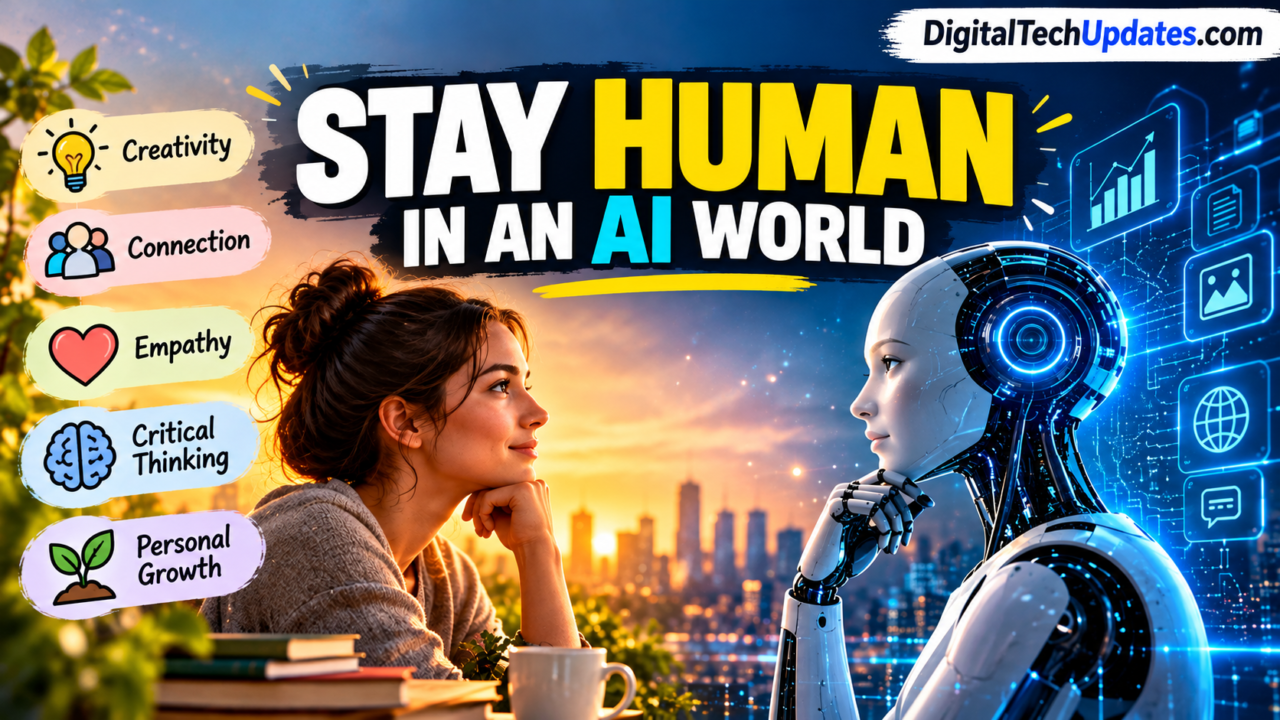
Artificial intelligence is changing the way we work, communicate, learn, and create. From writing emails and generating images to answering questions and solving complex problems, AI tools can now complete tasks that once required hours of human effort.
But as technology becomes more capable, an important question deserves our attention: Are we becoming more productive while slowly losing the skills that make us human?
Think about the last time you wrote an email, searched for an answer, or made an important decision. Did you think it through yourself, or did you immediately ask an AI tool to do the work for you?
There is nothing wrong with using AI. In fact, learning to use it effectively can save time and open up new opportunities. The challenge begins when convenience replaces independent thinking, automated messages replace genuine communication, and AI-generated ideas become a substitute for our own creativity.
The goal is not to avoid artificial intelligence. It is to use technology without losing our individuality, curiosity, empathy, and ability to think independently.
In this guide, we will explore seven practical ways to stay human in an AI-driven world while making the most of modern technology.
1. Think for Yourself Before Asking AI
One of the biggest advantages of AI is its ability to provide quick answers. However, getting an answer instantly does not always mean understanding the problem.
Imagine you are writing an article for your website. You could ask AI to generate the entire article, accept the result, and publish it immediately. The task might be finished quickly, but you may miss the opportunity to research the subject, develop your own perspective, and improve your writing skills.
Over time, relying on AI for every small decision can make independent thinking feel unnecessary.
A better approach is to spend a few minutes thinking about the problem before opening an AI tool. Write down your initial ideas, identify what you already know, and consider possible solutions. Then use AI to explore alternatives, identify gaps, or challenge your assumptions.
Research discussed by the American Psychological Association in 2026 highlights an important distinction: AI use can support performance, but passive dependence may weaken certain thinking skills. How people interact with these tools matters.
Try this: Before asking AI for an answer, write down your own first attempt. Compare it with the AI’s response and decide what genuinely improves your understanding.
AI should help you think more clearly, not decide what you should think.
2. Protect Your Creativity Instead of Outsourcing It
Creativity is not limited to painting, photography, music, or writing. It also involves finding better ways to solve problems, connecting seemingly unrelated ideas, and looking at familiar situations from a different perspective.
AI can help generate headlines, suggest designs, brainstorm business ideas, and create content. These capabilities are useful, especially when you feel stuck.
However, if you always accept the first suggestion, your work can begin to look and sound like everyone else’s.
Consider two content creators. The first asks AI for ten article ideas and chooses one without further research. The second studies the audience, identifies a real problem, draws on personal observations, and then uses AI to explore possible angles.
Both use the same technology, but the second creator brings more independent thought and purpose to the process.
To protect your creativity:
- Write down your own ideas before requesting AI suggestions.
- Explore unusual approaches rather than accepting the most obvious answer.
- Include original examples, observations, and experiences where appropriate.
- Experiment with different solutions before choosing one.
- Use AI-generated ideas as starting points, not finished creative decisions.
Remember: AI can help you produce more ideas. Your judgment determines which ideas are worth pursuing.
3. Make Real Human Connections a Priority
Digital communication has made it easier than ever to stay in touch. We can send messages, attend virtual meetings, and communicate across continents in seconds.
Yet convenience does not automatically create meaningful relationships.
An automatically generated birthday message may be grammatically perfect, but a short personal message recalling a shared memory can feel much more meaningful. Similarly, an AI-assisted work email may be professional, but genuine listening and thoughtful conversation are what help build trust between colleagues.
Human connection involves more than exchanging information. It includes paying attention, understanding context, noticing emotions, and responding with care.
You can strengthen these connections through a few simple habits:
- Call a friend or family member instead of always sending a quick message.
- Listen without checking your phone during conversations.
- Remember important details about the people around you.
- Give honest, personal responses rather than relying on automated phrases.
- Make time for face-to-face conversations whenever possible.
AI can help you communicate more clearly, but it should not become a replacement for the relationships that give communication its meaning.
4. Develop Emotional Intelligence and Empathy
AI tools can recognize emotional language and generate responses that sound sympathetic. But producing an empathetic sentence is not the same as having a human relationship or sharing another person’s lived experience.
Emotional intelligence involves recognizing emotions, understanding different perspectives, managing your reactions, and responding appropriately.
For example, imagine a colleague has made a mistake on an important project. You could immediately criticize the person or send a formal message generated by AI. A more thoughtful response would consider what happened, ask questions, understand the circumstances, and work together on a solution.
This ability to balance honesty with compassion is valuable at work, at home, and in everyday life.
Here are some ways to improve it:
- Listen carefully before offering advice.
- Ask questions instead of making assumptions.
- Try to understand why someone may feel differently from you.
- Learn to disagree respectfully.
- Recognize when a person needs support rather than an immediate solution.
These habits matter even when AI tools become increasingly convincing conversational partners. Human relationships still depend on trust, mutual understanding, and responsibility.
5. Keep Your Own Voice in an Age of AI-Generated Content
AI can produce polished emails, blog posts, social media captions, presentations, and reports in seconds. But polished writing is not always memorable writing.
People connect with communication that feels relevant, specific, and genuine. They want useful insights, clear explanations, and perspectives that reflect an understanding of their needs.
If every article uses the same introductions, every email sounds overly formal, and every social media post follows the same formula, the result can feel repetitive and impersonal.
This is especially important for bloggers, business owners, marketers, and content creators.
To keep your voice authentic:
Start with your audience. Understand what readers need to know and what problems they want to solve.
Add original insight. Include relevant examples, firsthand experience, expert input, or carefully verified information.
Edit the AI’s output. Remove unnecessary phrases, exaggerated claims, repetitive explanations, and language that does not sound natural.
Be specific. Replace vague advice with concrete examples and practical steps.
Take responsibility. Verify facts, respect copyright, and make sure the final content reflects your standards.
For example, instead of publishing a generic statement such as “AI is transforming the world,” explain how a particular AI feature helps a small business save time, where it falls short, and what a person should check before relying on it.
The difference is useful detail and independent judgment.
6. Question AI Answers Instead of Trusting Them Automatically
AI tools can produce convincing answers that contain errors, outdated information, unsupported claims, or missing context. A confident tone does not guarantee accuracy.
This is particularly important when researching technology updates, financial information, government announcements, health topics, or other subjects where mistakes can have serious consequences.
Suppose an AI tool tells you that a new smartphone update is available. Before publishing a news article, check the manufacturer’s official website, release notes, or a reliable report. If the information cannot be verified, do not present it as confirmed.
Build the habit of asking three questions:
- Is it accurate? Can I verify the important claims using trustworthy sources?
- Is it relevant? Does the answer address the actual question or situation?
- Is it reasonable? Are there missing details, conflicting facts, or alternative explanations?
For important decisions, seek reliable evidence and appropriate professional advice rather than treating an AI response as the final authority.
Critical thinking does not mean rejecting everything AI says. It means knowing when to trust a result, when to investigate further, and when to disagree.
7. Use AI to Save Time, Not to Avoid Learning
Automation is most useful when it removes repetitive work and gives people more time to focus on valuable activities.
For example, a business owner might use AI to organize notes, summarize a long document, or draft a routine email. That frees up time for customer conversations, strategic decisions, and improving the business.
A student, meanwhile, can use AI to explain a difficult concept, generate practice questions, or identify mistakes in an attempted solution. Simply copying an answer may finish the assignment, but working through the explanation builds understanding.
The key is to distinguish between tasks that benefit from automation and skills you still need to develop yourself.
| Use AI to help with | Stay personally involved in |
|---|---|
| Organizing information | Deciding what matters |
| Generating initial ideas | Developing original perspectives |
| Drafting routine messages | Building meaningful relationships |
| Explaining difficult concepts | Practising and testing your knowledge |
| Summarizing documents | Verifying important facts |
| Exploring possible solutions | Making accountable decisions |
A useful rule is to automate repetitive tasks while remaining actively involved in learning, judgment, creativity, and decisions that affect other people.
The objective is not to do everything manually. It is to make sure convenience does not come at the expense of competence.
How to Build a Healthier Relationship With AI Every Day
You do not need to make dramatic changes to become more intentional about technology. Start with a few small habits and practise them consistently.
In the morning: Decide which tasks genuinely need AI assistance and which are better handled through your own thinking.
While working: Try to solve a problem independently before using AI to improve your approach. Verify important facts before acting on them.
During conversations: Put distractions aside and give people your full attention.
While learning: Ask AI to explain concepts and test your understanding instead of simply providing finished answers.
At the end of the day: Reflect on what you learned, which decisions you made independently, and whether technology helped you do meaningful work.
These steps can help you benefit from AI without turning every activity into an automated process.
The Future Belongs to People Who Combine Technology With Human Judgment
Artificial intelligence will continue to influence how people learn, work, communicate, and create. Avoiding it completely is unlikely to be practical for many people, but using it without thought is not a good long-term strategy either.
The American Psychological Association’s 2026 analysis of AI and thinking skills emphasizes that the effects of AI depend partly on how people use it. Deliberate engagement can support better outcomes, while passive reliance can create risks for independent thinking.
This offers a useful way to approach the future: learn the tools, understand their limitations, and keep developing the abilities that help you use them wisely.
A writer still needs to understand readers. A business owner still needs to understand customers. A student still needs to learn. A leader still needs to make difficult decisions and take responsibility for the consequences.
Technology can support these responsibilities, but it does not remove the need for human judgment.
Final Thoughts
Being more human in an AI world does not mean rejecting technology or refusing to use modern tools. It means protecting the qualities that make technology useful in the first place: curiosity, creativity, independent thought, empathy, and the ability to connect with others.
Use AI to explore new possibilities, but make your own judgments. Let it help you communicate, but keep your voice. Use it to learn faster, but do not stop learning for yourself.
The real advantage is not being able to produce the most content in the shortest time. It is knowing how to combine the speed of technology with the depth of human understanding.
Let AI make your work easier, not your thinking weaker.

Thalla Lokesh
Thalla Lokesh is a Digital Marketing Strategist and SEO Specialist with over 12 years of experience in helping businesses grow their online presence. Since beginning his career in 2013, he has successfully worked across industries including healthcare, education, technology, and e-commerce. He specializes in search engine optimization (SEO), content marketing, keyword strategy, and link building, with a strong focus on delivering measurable results. Lokesh has helped brands achieve top rankings on Google through data-driven strategies, high-quality content, and ethical SEO practices aligned with search engine guidelines. As the founder of Honey Web Solutions , a Tirupati-based digital marketing company, he actively works with clients to improve organic traffic, lead generation, and online visibility. He also contributes expert insights on digital marketing trends, AI SEO, and content strategies through blogs and industry platforms.