Trademark Search in India: How to Check a Brand Name Before Registration

Planning to start a business, launch a new product, or build your own brand? Before investing in a name or logo, conducting a trademark search is an important step. It helps you identify existing trademarks that may conflict with the name you want to use.
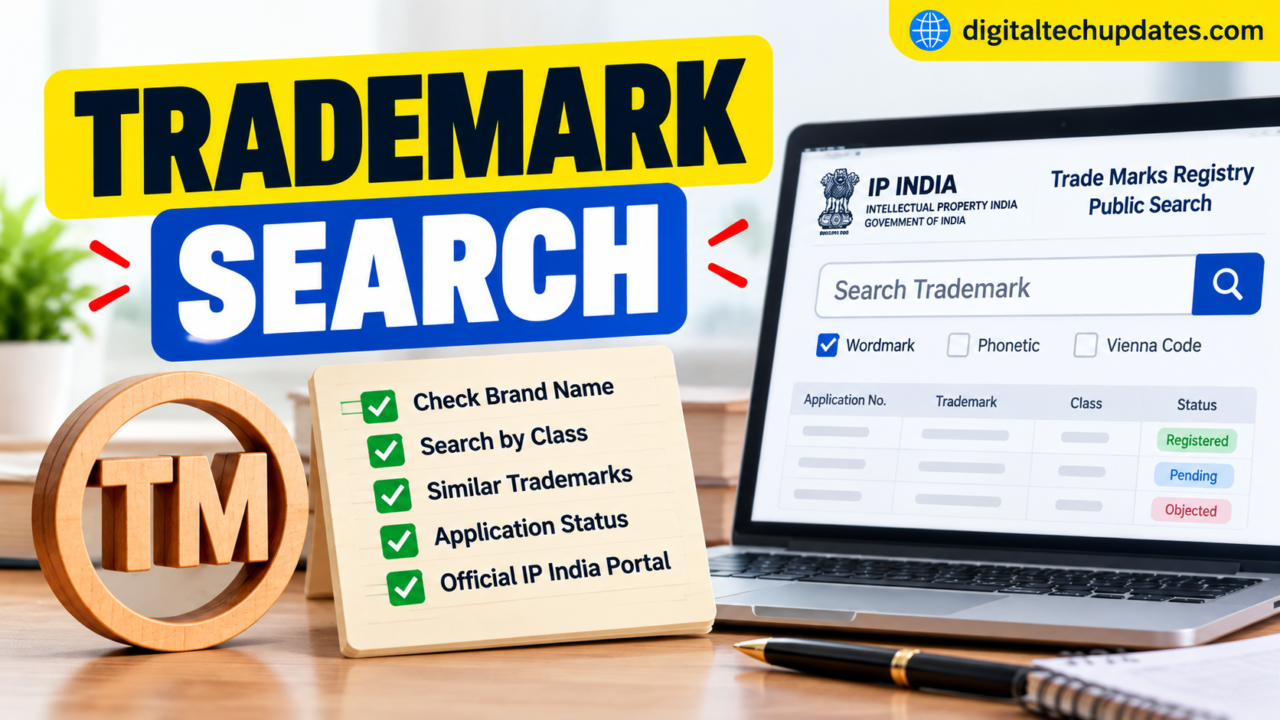
A trademark search allows you to check whether an identical or similar brand name has already been registered or applied for in a particular category of goods or services. In India, you can begin this process using the official IP India trademark search portal.
Whether you are a startup founder, small business owner, entrepreneur, or freelancer, understanding how to search trademarks can help you make better branding decisions and identify potential legal risks before filing an application.
In this guide, you will learn how to conduct a trademark search in India, use the official government portal, check trademark availability, understand trademark classes, and interpret search results.
What Is a Trademark Search?
A trademark search is the process of checking existing trademark records to identify names, logos, symbols, or other marks that may be identical or similar to the one you want to use.
A trademark can help distinguish one business’s goods or services from those of another business. Depending on the applicable law and circumstances, it may protect a brand name, logo, word, or other distinctive sign.
For example, suppose you plan to launch a skincare brand called “GlowNest.” Before printing packaging, purchasing a domain, or investing in advertising, you should search for identical and similar names used for related products.
If a conflicting mark already exists, you may need to reconsider the name or seek professional advice before proceeding.
A trademark search is an initial screening exercise. It does not automatically establish that a name is legally available or guarantee that a trademark application will be approved.
How to Conduct a Trademark Search in India
You can begin your search through the official website of the Indian Trade Marks Registry.
Official trademark search portal: https://tmrsearch.ipindia.gov.in/tmrpublicsearch/
The IP India website also provides access to standard and AI/ML-based trademark search tools.
Follow these steps to conduct a preliminary trademark search.
Step 1: Open the Official IP India Website
Visit the official IP India website and navigate to the Trade Marks section.
Open the option for searching existing trademarks. Alternatively, visit the official public search portal using the link provided above.
Make sure you are using the government website rather than a third-party website that may display trademark information differently.
Step 2: Choose the Appropriate Search Type
Depending on the available options in the portal, you can conduct different types of searches.
Wordmark search: Use this to search for a brand name or words you intend to use.
Phonetic search: Use this to identify names that sound similar, even if their spelling differs.
Vienna Code search: This can help search figurative elements in logos using the relevant visual classification codes.
For example, if your proposed brand is “GlowNest,” do not search only for that exact spelling. Also consider names such as “Glow Nest,” “Glownest,” or other similar-sounding names that could be relevant to your products or services.
Step 3: Enter Your Proposed Brand Name
Enter the name you want to investigate and select the relevant search options.
Where the portal offers different matching methods, consider using broader matching options in addition to an exact-name search.
Search for:
- The complete brand name.
- Names without spaces.
- Important individual words.
- Common spelling variations.
- Similar-sounding names.
- Abbreviations or shortened versions, where relevant.
The purpose is to identify potential conflicts that an exact-match search might miss.
Step 4: Select the Relevant Trademark Class
Trademark applications are classified according to the goods and services associated with the mark. India follows the international Nice Classification system, which has 45 classes.
Classes 1–34 generally cover goods, while Classes 35–45 generally cover services.
Examples include:
| Class | General Category |
|---|---|
| Class 3 | Cosmetics and certain personal-care products |
| Class 9 | Certain electronic products and software |
| Class 25 | Clothing, footwear, and headwear |
| Class 35 | Advertising, business management, and certain retail-related services |
| Class 41 | Education and entertainment services |
| Class 42 | Technology, software development, and certain technical services |
These are broad examples, not a complete classification guide. The correct class depends on the specific goods or services you intend to offer.
A business may need to search more than one class. Also consider related classes where similar marks could create a conflict.
Step 5: Review the Search Results
After submitting your search, review the matching records carefully.
Depending on the portal and record, useful details may include:
- Trademark name or representation.
- Application number.
- Applicant or proprietor.
- Relevant class.
- Application or filing date.
- Current application status.
- Description of goods or services.
Do not assume that every result is a direct conflict. Compare the marks themselves, their commercial context, the goods or services covered, and the status of each record.
An identical name used for unrelated goods may present a different situation from a highly similar name used for competing products. However, well-known marks and other legal considerations can complicate this assessment.
Step 6: Check the Trademark Application Status
If you find a potentially relevant mark, investigate its current status.
A trademark may be registered, pending examination, objected to, opposed, abandoned, or in another procedural state. The legal implications vary depending on the circumstances.
You can access trademark status services through the official IP India website.
Review the complete record where available instead of relying only on the status label displayed in a search result.
Step 7: Search Similar Names Before Making a Decision
Once you have reviewed exact matches, expand your search to include similar names and related goods or services.
For instance, a proposed brand called “TechNova” may warrant searches for “TekNova,” “Tech Nova,” or other names with similar pronunciation or commercial impression.
The examples are illustrative and do not represent actual trademark clearance results.
If you identify a potentially conflicting mark, consider consulting a registered trademark professional before committing to the proposed name.
Trademark Search Online: What Should You Check?
When conducting a trademark search online, look beyond the name itself.
Identical and Similar Trademarks
A name does not necessarily need to be identical to raise a concern. Similar spelling, pronunciation, appearance, or commercial impression may also be relevant.
Goods and Services
Check the products or services covered by the existing application or registration. The relationship between the businesses can affect the risk of confusion.
Applicant and Ownership Details
Review the applicant or proprietor information shown in the official record. This helps you understand who filed the mark and whether additional investigation is needed.
Filing Date and Status
The filing date and current status can provide important context. A pending application may still be relevant to your assessment.
Logo and Figurative Elements
If you plan to use a logo, consider searching its word elements as well as relevant figurative elements. A logo search alone may not identify conflicts involving similar brand names.
Is a Trademark Search Free in India?
The official IP India public search portal provides a way to inspect trademark records without purchasing a commercial search report.
However, a free database search is not the same as a comprehensive legal clearance opinion. Search results may require interpretation, and the database may not reveal every relevant commercial use or legal issue.
Third-party trademark professionals may charge for broader searches, risk assessments, or legal advice.
Before paying for a private service, understand exactly what it includes and whether it covers relevant classes, phonetic variations, pending applications, and similar marks.
How to Check Trademark Availability Before Registering a Brand
Finding no exact match is encouraging, but it is not enough to establish that your brand is available.
Before proceeding, consider the following checklist:
- Search the exact proposed name.
- Search spelling and phonetic variations.
- Check the relevant goods and services classes.
- Review similar marks in related classes.
- Examine potentially conflicting application records.
- Consider relevant unregistered brand use and other legal rights.
- Assess whether the proposed name is distinctive and registrable.
- Obtain professional advice if you identify a possible conflict.
A trademark search can reduce avoidable risks, but it cannot eliminate them entirely.
What Happens After a Trademark Search?
If your preliminary search does not reveal an obvious conflict, the next step is to evaluate the proposed mark and determine the appropriate filing strategy.
Choose a Distinctive Brand Name
Names that clearly distinguish your products or services may be easier to protect than names that merely describe the goods or their characteristics.
The registrability of a particular name depends on the applicable legal requirements and the facts of the case.
Identify the Correct Class
Prepare a clear description of the goods or services for which you want protection. Selecting the correct class and description is an important part of the application process.
Prepare the Application
Trademark applications in India are generally submitted using the applicable prescribed form and procedure. Check the current official filing requirements, fees, and documentation before applying.
Monitor the Application
After filing, track the application and respond to examination reports or other procedural requirements within the applicable time limits.
A successful search does not guarantee registration. The Trade Marks Registry will assess the application under the applicable legal provisions.
Common Trademark Search Mistakes to Avoid
Searching only the exact name: Similar-sounding or visually similar marks may also be relevant.
Ignoring trademark classes: A search in only one class may miss relevant records in another class.
Assuming a pending application is irrelevant: Pending applications can still matter when assessing a proposed brand.
Relying only on a third-party website: Use official records to verify important details.
Confusing domain availability with trademark availability: An available domain name does not establish that the corresponding brand can be registered or safely used.
Treating no results as legal clearance: A preliminary database search cannot establish the absence of all potential conflicts.
Waiting until after launch: Discovering a serious conflict after investing in packaging, marketing, or signage can be costly.
Frequently Asked Questions About Trademark Search
1. How do I search for a trademark in India?
Visit the official IP India trademark public search portal, enter your proposed name, select the relevant search type and class, and review the matching records. Search similar spellings and pronunciations as well.
2. Can I check trademark availability online for free?
You can use the official public search portal to inspect trademark records. However, the absence of an exact match does not guarantee legal availability or successful registration.
3. What is the official trademark search website in India?
The official Trade Marks Registry public search portal is available at https://tmrsearch.ipindia.gov.in/tmrpublicsearch/. You can also access trademark search services through https://www.ipindia.gov.in/.
4. What is the difference between a wordmark and a logo search?
A wordmark search focuses on the textual elements of a mark. A logo search may involve figurative elements and relevant visual classification codes. Depending on the brand, both searches may be useful.
5. Can I register a trademark if a similar name already exists?
It depends on the similarity of the marks, the goods and services involved, existing rights, and other legal considerations. A similar result does not automatically determine the outcome, but it should be investigated before filing.
6. How many trademark classes are there in India?
India follows the Nice Classification system, which contains 45 classes: 34 for goods and 11 for services. The appropriate class depends on what the business offers.
7. Does an available domain name mean the trademark is available?
No. Domain registration and trademark rights are separate. A domain may be available even when a similar trademark exists, and registering a domain does not automatically give you trademark rights.
8. Should I conduct a trademark search before launching a business?
Yes. Conducting a preliminary search before investing in branding can help identify potential conflicts early. For important commercial decisions, consider professional trademark clearance advice.
Conclusion
A trademark search is an important step when choosing a brand name, launching a product, or preparing to register a trademark in India.
Start with the official IP India portal, check exact and similar names, review the relevant classes, and examine the status and details of potentially conflicting marks.
Most importantly, remember that a preliminary search is not a guarantee of legal clearance. If your proposed brand is central to your business, a careful professional assessment can help you make a more informed decision before investing in its launch.

Thalla Lokesh
Thalla Lokesh is a Digital Marketing Strategist and SEO Specialist with over 12 years of experience in helping businesses grow their online presence. Since beginning his career in 2013, he has successfully worked across industries including healthcare, education, technology, and e-commerce. He specializes in search engine optimization (SEO), content marketing, keyword strategy, and link building, with a strong focus on delivering measurable results. Lokesh has helped brands achieve top rankings on Google through data-driven strategies, high-quality content, and ethical SEO practices aligned with search engine guidelines. As the founder of Honey Web Solutions , a Tirupati-based digital marketing company, he actively works with clients to improve organic traffic, lead generation, and online visibility. He also contributes expert insights on digital marketing trends, AI SEO, and content strategies through blogs and industry platforms.