White Label Website Builder: How It Works, Benefits, and What to Look For

Building websites for clients traditionally requires a combination of design skills, development resources, hosting, maintenance, and ongoing technical support. For agencies and freelancers managing multiple clients, handling all of these tasks from scratch can quickly become time-consuming.
A white label website builder offers another approach. It allows an agency, freelancer, reseller, or other business to create and manage websites using an existing platform while presenting the service under its own brand.
Instead of asking clients to work directly with the underlying technology provider, the business can provide the website service as its own offering.
But how exactly does white labelling work, and what should you consider before choosing a platform?
Let’s take a closer look.
What Is a White Label Website Builder?
A white label website builder is a website creation platform that allows another business to offer website-building services under its own brand.
The technology provider supplies the underlying infrastructure, tools, hosting, or website editor. The agency or reseller can then customize the customer-facing experience with its own branding, domain, logo, and service structure, depending on the platform’s capabilities and licensing.
For example, imagine a digital marketing agency that wants to offer websites to local businesses.
Instead of developing its own website builder, the agency could use a white label platform to:
- Create websites for customers
- Apply its own branding
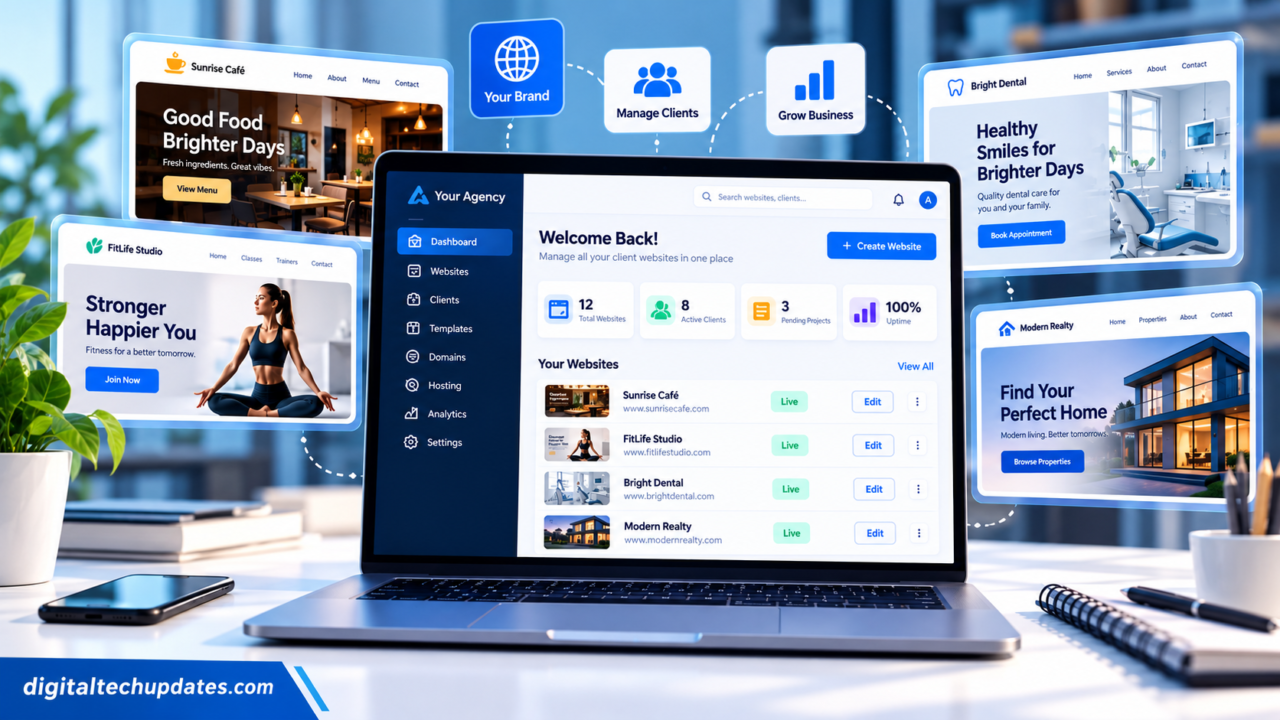
- Manage multiple client websites
- Provide clients with website access
- Offer hosting and maintenance
- Package website services with SEO or marketing
- Charge clients directly
The customer primarily interacts with the agency rather than the underlying software provider.
This is the basic idea behind white labeling.
How Does a White Label Website Builder Work?
The exact process depends on the platform, but a typical workflow looks like this:
1. Choose a White Label Platform
The agency selects a website builder that supports white-label functionality.
Important considerations can include branding controls, client management, hosting, SEO features, pricing, integrations, and scalability.
2. Configure Your Brand
Depending on the platform, you may be able to add your:
- Business name
- Logo
- Brand colors
- Custom domain
- Support information
- Client portal branding
Some platforms provide considerably more customization than others.
3. Build the Client Website
The agency uses the website builder to create a website using templates, visual editors, components, or other available tools.
4. Connect the Client’s Domain
The customer’s domain can be connected to the completed website, depending on the hosting and domain setup.
5. Deliver the Website
Once the website is ready, the agency can launch it and provide the customer with the appropriate level of access.
6. Provide Ongoing Services
The agency can continue offering services such as:
- Website maintenance
- Hosting
- Content updates
- SEO
- Analytics
- Technical support
This can turn a one-time website project into an ongoing client relationship.
Who Can Benefit From a White Label Website Builder?
White-label platforms aren’t limited to traditional web development companies.
Web Design Agencies
Agencies managing several website projects can use a platform to standardize their workflow and reduce repetitive development work.
Digital Marketing Agencies
Marketing agencies can add website development to existing SEO, advertising, social media, or content services.
Freelancers
Independent designers and developers can use white-label tools when they want to deliver websites without maintaining their own website-building infrastructure.
Hosting Companies
Hosting businesses can potentially bundle website creation with domain registration, hosting, maintenance, and support.
SaaS Businesses
Software companies can incorporate website-building capabilities into their own product or service offering when the underlying platform supports the required licensing model.
Entrepreneurs and Resellers
A person starting a website service business can use a white-label solution rather than developing a complete website platform from the ground up.
Key Features to Look for in a White Label Website Builder
Not every platform offering “white label” functionality provides the same capabilities. Before choosing one, examine the actual features included in the plan.
Custom Branding
Branding is one of the most important parts of a white-label service.
Look for options to customize elements such as:
- Logo
- Colors
- Domain
- Client dashboard
- Emails
- Login pages
The amount of available branding can vary significantly between providers.
Custom Domain
A custom domain can make the service feel more integrated with your business.
Check whether the platform allows custom domains for your agency portal, client websites, or both.
Client Management
If you’re managing multiple websites, client management becomes increasingly important.
Useful functionality may include:
- Separate client accounts
- User permissions
- Website access controls
- Project organization
- Billing management
- Client dashboards
Drag-and-Drop Editor
A visual editor can make website creation faster, especially when the agency handles smaller business websites.
However, don’t evaluate an editor solely on how easy it is to use. Check whether it provides enough flexibility for your typical projects.
Templates and Design Components
A good template library can reduce the amount of time required to build common website types.
Look for templates suitable for your target customers, such as:
- Restaurants
- Clinics
- Professional services
- Real estate
- Retail
- Local businesses
- Consultants
Responsive Design
Websites should work properly across desktops, tablets, and smartphones.
Check how the platform handles responsive layouts and whether you can manually adjust mobile designs when necessary.
SEO Controls
A website builder should provide the basic controls needed for search optimization.
Depending on the platform, these can include:
- Page titles
- Meta descriptions
- URL customization
- Image alt text
- Heading controls
- XML sitemap functionality
- Canonical settings
- Redirects
- Schema options
SEO capabilities can vary, so verify them before committing to a platform.
Hosting and SSL
Some white-label website builders include hosting and SSL certificates.
If hosting is included, understand the limits, storage, traffic policies, backups, uptime commitments, and other terms.
Integrations
Integrations can become important as your agency grows.
Depending on your clients’ needs, you may want integrations with:
- Analytics platforms
- CRM systems
- Email marketing tools
- Payment services
- Forms
- Social media
- Marketing automation tools
Benefits of Using a White Label Website Builder
A white-label platform can provide several practical benefits for agencies and service providers.
Faster Website Production
Starting with an existing platform can eliminate some of the repetitive technical work involved in building websites from scratch.
This can allow teams to concentrate more on:
- Design
- Content
- User experience
- Branding
- Marketing strategy
Consistent Branding
White-label functionality allows agencies to present the website service as part of their own business.
This can create a more consistent customer experience.
Reduced Development Work
Developing a complete website-building platform requires significant resources.
A white-label solution lets businesses use an existing technical foundation instead.
Easier Client Management
Platforms designed for agencies may provide tools for managing multiple websites and customers from a centralized environment.
Additional Revenue Opportunities
Agencies can combine website development with recurring services such as:
- Hosting
- Maintenance
- SEO
- Content updates
- Analytics reporting
- Technical support
The exact business model depends on the agency and the platform’s licensing terms.
Easier Scaling
If an agency moves from managing five websites to dozens or hundreds, having a standardized platform can make processes easier to organize.
However, scalability should always be tested rather than assumed.
Are There Any Disadvantages?
White-label website builders can simplify website delivery, but they aren’t suitable for every project.
Platform Dependency
Your service may depend heavily on the underlying provider.
If the provider changes its pricing, features, policies, or infrastructure, those changes may affect your business.
Limited Customization
Some platforms provide extensive customization, while others restrict what users can modify.
Highly customized projects may require traditional development instead.
Subscription Costs
White-label platforms typically involve ongoing costs.
Before signing up, calculate your total operating cost rather than looking only at the advertised monthly price.
Migration Restrictions
Moving websites from one platform to another isn’t always straightforward.
Check whether websites can be exported and what happens to client data if you decide to leave.
Vendor Lock-In
The more of your business workflow you build around one platform, the harder switching providers can become.
For this reason, migration options and contractual terms deserve attention before you commit.
White Label Website Builder vs. Traditional Website Development
| Factor | White Label Website Builder | Traditional Development |
|---|---|---|
| Development time | Usually faster | Can take longer |
| Technical expertise | Often lower | Usually higher |
| Customization | Depends on platform | Potentially extensive |
| Branding | White-label options available | Fully controlled |
| Maintenance | Often platform-supported | Usually handled by developer/team |
| Hosting | May be included | Usually arranged separately |
| Scalability | Depends on provider | Depends on infrastructure |
| Initial development | Lower technical workload | Higher technical workload |
Neither approach is automatically suitable for every project. The right choice depends on the complexity of the website, budget, technical requirements, and long-term business model.
White Label Website Builder vs. Regular Website Builder
A regular website builder is generally designed for the person or business creating its own website.
A white-label website builder adds functionality intended for businesses that want to provide website services to their own customers.
For example, a regular website builder may primarily focus on:
“Build your own business website.”
A white-label platform may focus more on:
“Build and manage websites for your customers under your own business.”
Features such as client management, branding controls, reseller capabilities, and agency dashboards can therefore become particularly important.
How to Choose the Right White Label Website Builder
Before selecting a platform, create a checklist based on your actual business requirements.
Check the Branding Options
Find out exactly what can be branded and what remains associated with the platform provider.
Compare Pricing
Calculate the expected cost based on your number of websites and clients.
Consider:
- Monthly fees
- Annual fees
- Per-site charges
- User fees
- Hosting charges
- Additional features
- White-label fees
Test the Website Editor
Build a small test website before purchasing a long-term plan.
See whether the editor is intuitive and flexible enough for your projects.
Review SEO Features
If your agency provides SEO services, make sure the platform provides the controls your team needs.
Examine Client Permissions
Determine what customers can see and modify.
You may want clients to update content while preventing them from accidentally changing important website settings.
Check Support
Technical issues can affect your clients, so understand how support works before relying on the platform for production websites.
Review Migration Policies
Read the terms regarding website ownership, data, exports, backups, and migration.
Think About Scalability
A platform that works for ten websites may not necessarily be the right choice for 500.
Consider your expected client volume before choosing.
How Much Does a White Label Website Builder Cost?
There isn’t one standard price for a white-label website builder.
Platforms can use different pricing models, including:
- Monthly subscriptions
- Annual subscriptions
- Per-website pricing
- Per-client pricing
- Agency plans
- Enterprise plans
- Usage-based pricing
Some providers may charge separately for white-label functionality.
Instead of comparing only the headline subscription price, calculate the total cost per client.
For example:
Total monthly platform costs ÷ number of active client websites = approximate platform cost per website
This can give you a clearer picture of whether the platform fits your business model.
How Agencies Can Make Money With a White Label Website Builder
A white-label platform can become part of a broader service business.
Website Packages
An agency can create packages containing:
- Website design
- Hosting
- Basic SEO
- Contact forms
- Analytics setup
Monthly Website Management
Instead of treating the website as a one-time project, an agency can offer ongoing maintenance and updates.
Website + SEO Packages
Website development can be combined with search engine optimization services.
Hosting and Maintenance
Agencies can potentially create recurring service packages that include hosting, security monitoring, backups, and content changes, depending on the platform.
Marketing Bundles
A website can also become part of a broader package involving:
- SEO
- Social media
- Content marketing
- Email marketing
- Paid advertising
The important point is to clearly define what is included in each package and what the platform actually supports.
How to Start a White Label Website Business
If you’re considering building a business around white-label websites, a practical starting process is:
Step 1: Choose a Target Market
Instead of trying to serve everyone, consider focusing on a specific market.
For example:
- Local restaurants
- Real estate businesses
- Clinics
- Small professional firms
- Local retailers
Step 2: Select Your Platform
Compare platforms based on features, pricing, branding, support, scalability, and migration options.
Step 3: Create Your Service Packages
Decide what your customers will receive.
Step 4: Build Demonstration Websites
Create several sample websites that demonstrate your design capabilities.
Step 5: Establish Your Brand
Create your agency website, branding, portfolio, and sales materials.
Step 6: Define Your Pricing
Consider both one-time project fees and recurring services.
Step 7: Create a Client Onboarding Process
Determine what information you need from customers, such as:
- Business details
- Logo
- Images
- Contact information
- Services
- Social media accounts
- Domain information
Step 8: Build and Launch Websites
Use a repeatable workflow to reduce delays.
Step 9: Offer Ongoing Support
Maintenance and support can become an important part of long-term client relationships.
Common Mistakes to Avoid
Before choosing a white-label platform, avoid these common mistakes:
Choosing based only on price: A cheaper platform may lack features you need later.
Ignoring migration: Understand what happens if you eventually move to another provider.
Not testing client access: Make sure the permission system works for your workflow.
Overlooking SEO: Website design alone doesn’t guarantee search visibility.
Ignoring licensing: Understand whether your plan permits the number and type of websites you intend to create.
Not testing support: Try the support system before putting client websites on the platform.
Promising unsupported features: Clearly understand the platform’s capabilities before selling them to customers.
Frequently Asked Questions
What is a white label website builder?
A white label website builder is a platform that allows agencies, freelancers, and other businesses to create websites for customers while presenting the service under their own brand.
How does white labeling work for websites?
The underlying provider supplies the website-building technology, while the reseller or agency manages the customer-facing service using its own branding and business model.
Can I sell websites under my own brand?
Many white-label platforms are designed for this purpose, but the exact branding and resale rights depend on the provider’s plan and licensing terms.
Is a white label website builder suitable for freelancers?
It can be useful for freelancers who manage multiple client websites and want to reduce repetitive development and maintenance work.
Can agencies use white label website builders?
Yes. Agencies are one of the common use cases because they can manage multiple websites and potentially combine website services with other digital marketing services.
Do white label website builders include hosting?
Some do, while others require separate hosting. Always check the specific platform and plan.
Are white label website builders SEO-friendly?
Some provide extensive SEO controls, while others have limitations. Review features such as metadata, URLs, redirects, structured data, sitemaps, and page performance before choosing.
How much does a white label website builder cost?
Pricing varies by provider and plan. Costs can be based on websites, users, clients, features, or subscription tiers.
Final Thoughts
A white label website builder can provide a practical way for agencies, freelancers, resellers, and other businesses to offer website services without developing an entire website-building platform themselves.
The biggest advantages can include faster production, centralized management, branding options, and opportunities to create recurring services.
However, the platform you choose matters. Before committing, examine its customization options, SEO capabilities, client management, pricing, licensing, support, scalability, and migration policies.
The goal isn’t simply to find a platform that can create websites. It’s to find one that fits the way your business actually sells, builds, manages, and supports websites.

Thalla Lokesh
Thalla Lokesh is a Digital Marketing Strategist and SEO Specialist with over 12 years of experience in helping businesses grow their online presence. Since beginning his career in 2013, he has successfully worked across industries including healthcare, education, technology, and e-commerce. He specializes in search engine optimization (SEO), content marketing, keyword strategy, and link building, with a strong focus on delivering measurable results. Lokesh has helped brands achieve top rankings on Google through data-driven strategies, high-quality content, and ethical SEO practices aligned with search engine guidelines. As the founder of Honey Web Solutions , a Tirupati-based digital marketing company, he actively works with clients to improve organic traffic, lead generation, and online visibility. He also contributes expert insights on digital marketing trends, AI SEO, and content strategies through blogs and industry platforms.