Why AI Coding Assistants Are Becoming a Software Supply-Chain Security Risk

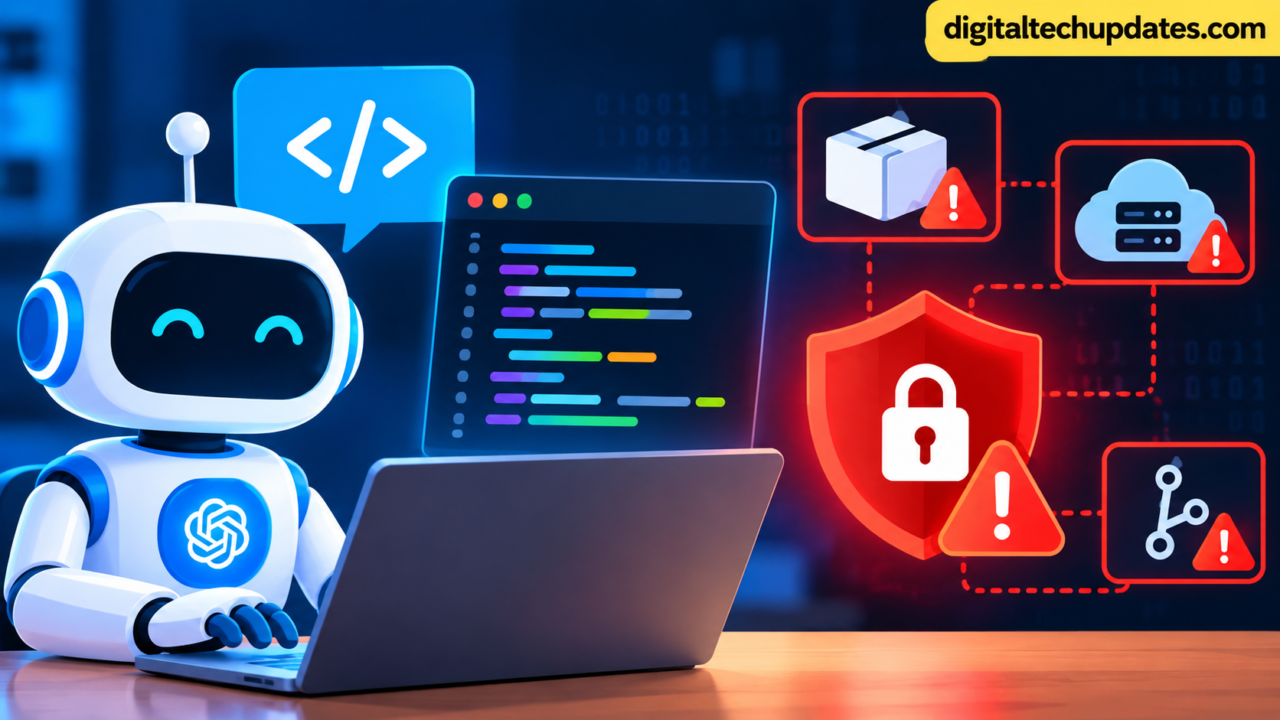
AI coding assistants are changing how software is built. Developers can now generate functions, create application components, write tests, configure development environments, and automate repetitive tasks with a few natural-language instructions. This makes software development faster, but it also introduces security risks that many teams are still learning to manage.
The concern goes beyond whether AI-generated code contains bugs. Modern coding assistants can suggest third-party packages, modify project configuration files, generate build scripts, and, when connected to tools, perform actions inside development environments. An unsafe recommendation or an insufficiently reviewed change can therefore affect more than a single application function.
This is why AI coding assistants are becoming an important software supply-chain security concern. The risk emerges when generated code, external dependencies, automated tools, and trusted development workflows interact without adequate verification.
For development teams, the challenge is not to abandon AI coding tools. It is to make sure that the speed they provide does not come at the expense of software integrity, data protection, and secure deployment.
What Is a Software Supply-Chain Security Risk?
A software supply chain includes all the components, tools, services, and processes involved in building and delivering an application.
It can include:
- Source code written by developers or generated with AI.
- Third-party libraries and open-source packages.
- Build tools, plugins, and development extensions.
- Source-code repositories and version-control systems.
- Continuous integration and continuous deployment (CI/CD) pipelines.
- Container images, deployment scripts, and cloud infrastructure.
- Credentials, access permissions, and software distribution systems.
A supply-chain attack occurs when an attacker compromises one of these trusted elements to affect software or the systems that build, distribute, or run it.
AI coding assistants add another layer to this environment. They can recommend dependencies, generate code that interacts with external services, or modify files that execute automatically during installation and deployment.
The result is a larger set of changes that developers must verify before trusting an application.
The OWASP GenAI Security Project identifies supply-chain vulnerabilities as a significant risk category for AI systems, including risks involving third-party components, compromised models, and the integrity of development resources.
Why AI Coding Assistants Are Increasing Security Concerns
1. AI Can Recommend Vulnerable or Unverified Dependencies
Most modern applications rely on external libraries rather than implementing every feature from scratch. These packages can save development time, but they also introduce dependencies that must be maintained and secured.
When asked to implement a feature, an AI coding assistant may recommend a package that appears suitable for the task. However, the recommendation may be outdated, poorly maintained, vulnerable, or simply inappropriate for the project.
In some cases, an AI system may suggest a package name that does not correspond to a legitimate library. If a developer installs it without checking its authenticity, the project could be exposed to a malicious package.
Consider a developer who asks an AI assistant to add a date-formatting feature. The assistant suggests an unfamiliar package and generates an installation command. The developer runs the command immediately, assuming the recommendation has already been verified.
If the package is malicious or compromised, the consequences could extend beyond the original feature.
The security lesson: AI-generated dependency recommendations should be treated as suggestions, not trusted endorsements.
Developers should verify package names, maintainers, repository activity, release history, dependency trees, and known vulnerabilities before adding new dependencies.
2. AI-Generated Code Can Introduce Hidden Vulnerabilities
AI coding assistants learn patterns from large collections of code and can produce useful solutions quickly. However, code that looks correct is not necessarily secure.
A generated function might contain:
- Weak input validation.
- Improper authentication or authorization checks.
- Insecure handling of passwords or API keys.
- Unsafe database queries.
- Inadequate error handling.
- Incorrect permission settings.
- Vulnerable file-handling or network operations.
These weaknesses can be difficult to recognize when a developer focuses primarily on whether the feature works.
For example, an AI assistant might generate an API endpoint that returns a user’s account information. If the implementation checks whether a user is logged in but fails to verify that the user is authorized to access the requested account, it may expose information belonging to other users.
The application could pass basic functionality tests while still containing an access-control vulnerability.
This is especially concerning when generated code is accepted without a thorough review or meaningful security testing.
3. Automated Changes to Build Scripts Can Create a Larger Attack Surface
The risk becomes more serious when coding assistants can edit files beyond ordinary application source code.
Development projects often contain files that control how software is installed, tested, packaged, and deployed. Examples include:
package.json.github/workflows/*.ymlDockerfiledocker-compose.ymlMakefilepyproject.toml
Changes to these files can influence which commands run, what software gets downloaded, which secrets become available, and how code reaches production.
An AI assistant might generate a build step that downloads an external resource or executes a shell command. That change may be legitimate, but it could also introduce an unsafe operation into a trusted workflow.
If the workflow has access to deployment credentials or other sensitive secrets, a compromise could have consequences well beyond a developer’s local machine.
OWASP’s Secure Coding with AI guidance specifically highlights the need to review AI-generated changes to build configurations, package scripts, and CI/CD workflows with additional scrutiny.
Development teams should therefore treat changes to these files as security-sensitive rather than ordinary code edits.
4. AI Agents May Have More Access Than They Need
Some coding assistants do more than suggest code. Depending on their configuration, they can read files, run commands, modify repositories, access external services, and interact with development tools.
These capabilities can make them powerful productivity tools. They can also create opportunities for mistakes or abuse if their permissions are too broad.
For example, an assistant that only needs to edit a frontend component may not need access to production credentials, private cloud resources, or unrestricted terminal commands.
If the assistant operates with those privileges, an unsafe action or compromised workflow could expose systems that are unrelated to the original task.
The principle of least privilege is essential here: give AI tools only the permissions required to complete their assigned work.
Use sandboxed execution environments, restrict network access where practical, and require human approval for sensitive actions such as modifying deployment configurations, accessing secrets, or publishing releases.
5. Untrusted Project Files Can Influence AI-Assisted Workflows
AI coding tools often analyze project documentation, code comments, issue descriptions, dependency information, and other repository content.
That content should not automatically be considered trustworthy.
An attacker could attempt to place malicious instructions in an issue, a documentation file, a code comment, or another resource that an AI assistant may read. In some tool-enabled workflows, this can contribute to prompt-injection attacks, where untrusted content attempts to influence the assistant’s behavior.
The potential impact depends on the tool’s design, available permissions, and safeguards. Reading a malicious instruction does not automatically mean the assistant will execute it.
However, if an assistant can act on its own interpretation of untrusted content, the risk increases.
For example, a repository file might contain instructions encouraging the assistant to run an unfamiliar script or reveal information from its environment. A secure workflow should prevent repository content from overriding trusted instructions or authorizing sensitive actions.
Developers should treat external content as data to inspect, not as permission to execute commands.
6. Developers May Trust AI-Generated Code Too Quickly
AI coding assistants can produce convincing explanations and code that appears professionally written. This can encourage developers to accept recommendations without checking the underlying assumptions.
The problem is not limited to inexperienced programmers. Even experienced developers may find it difficult to review large volumes of generated code under delivery pressure.
A generated implementation might pass a basic test suite while missing security requirements that the tests do not cover.
For example, a test may confirm that a login function accepts valid credentials. It may not test account enumeration, rate limiting, session invalidation, or authorization failures.
This creates a gap between functional correctness and security assurance.
AI-generated code should undergo the same review standards as code written manually. In high-risk applications, additional threat modeling, security testing, and independent review may be necessary.
How AI Coding Assistants Can Affect the Software Supply Chain
The following table summarizes the main risks and practical responses.
| Risk area | Potential consequence | Recommended control |
|---|---|---|
| Unverified dependencies | Malicious or vulnerable packages enter a project | Verify packages and scan dependencies |
| Insecure generated code | Application vulnerabilities reach production | Code review and security testing |
| Build-script changes | Unsafe commands execute during trusted workflows | Review configuration changes and restrict permissions |
| Excessive tool permissions | Sensitive files or credentials become exposed | Least-privilege access and sandboxing |
| Untrusted repository content | Prompt injection influences tool behavior | Treat external content as untrusted input |
| Weak testing | Security flaws remain undetected | Add security-focused tests and independent checks |
| Uncontrolled releases | Unreviewed changes reach production | Require approvals and protect release pipelines |
These risks are related, but they are not identical. A vulnerable dependency, an insecure application function, and a compromised CI/CD pipeline require different detection and response measures.
Effective protection combines dependency management, secure coding practices, access controls, testing, and software release governance.
Real Security Guidance: What OWASP Recommends
OWASP has published guidance specifically addressing secure coding with AI. Its recommendations emphasize that AI-generated code and configuration changes must be reviewed rather than trusted automatically.
The guidance also highlights risks involving dependencies, automated development tools, and changes to files that control software builds and deployments.
The broader OWASP GenAI Security Project identifies supply-chain security, improper output handling, prompt injection, and excessive agency among the areas developers should consider when securing AI-enabled systems.
These recommendations reflect an important distinction: securing an AI coding assistant is not enough on its own. Organizations must also secure the software development processes in which the assistant operates.
A coding assistant can follow its intended behavior and still produce insecure code. Similarly, a developer can use a legitimate AI service while accidentally introducing an untrusted dependency into a project.
Security controls must therefore apply to the final code, its dependencies, the development environment, and the release process.
How Development Teams Can Reduce AI Coding Supply-Chain Risks
1. Review Every Important AI-Generated Change
Do not merge generated code simply because it compiles or passes basic tests.
Review changes for authentication, authorization, input validation, data exposure, cryptographic operations, file handling, and network access.
Pay particular attention to code that handles sensitive information or controls access to important resources.
2. Scan Dependencies Before They Reach Production
Use software composition analysis (SCA) tools to identify vulnerable and outdated third-party components.
Maintain dependency lockfiles where appropriate, review transitive dependencies, and generate a software bill of materials (SBOM) when useful for inventory and compliance.
An SBOM helps teams understand which components are present in an application. It does not prove that those components are safe, so it should be combined with vulnerability monitoring and package verification.
3. Protect Build and Deployment Pipelines
Require additional review for changes to package lifecycle scripts, CI/CD workflows, container definitions, and deployment configuration.
Restrict which workflows can access production secrets. Use short-lived credentials where possible, protect sensitive branches, and require approval for high-impact deployment actions.
Avoid giving a coding assistant unrestricted access to the same environment that publishes production software.
4. Apply Least-Privilege Permissions
Configure coding tools so they receive only the access needed for the current task.
For example, a tool working on a documentation change should not automatically have permission to publish releases or modify cloud infrastructure.
Where supported, use sandboxing, command restrictions, controlled network access, and explicit approval for potentially destructive actions.
5. Add Security Tests to the Development Workflow
Use static application security testing (SAST), dependency scanning, secret detection, and appropriate dynamic testing as part of the software delivery process.
Write tests for authorization boundaries, malformed input, error handling, and other security requirements—not just successful user journeys.
Automated checks are valuable, but they cannot identify every vulnerability. High-risk changes may require manual security review or penetration testing.
6. Verify Package Sources and Software Integrity
Before installing a new dependency, confirm that the package comes from the intended publisher and repository.
Use trusted registries, pinned versions or lockfiles where appropriate, and integrity verification mechanisms supported by the ecosystem.
For critical software, evaluate package provenance and signed artifacts where available. Investigate unexpected dependency changes rather than automatically accepting them.
7. Establish Clear Rules for AI Tool Use
Organizations should define which coding assistants are approved, what information employees may share with them, and which actions require human authorization.
Policies should cover source-code confidentiality, secret handling, repository access, package installation, testing, and deployment.
Developers also need training to recognize insecure suggestions and understand that AI-generated explanations are not proof of security.
What Developers Should Check Before Accepting AI-Generated Code
Use this practical checklist during code review:
-
Does the code meet the actual functional and security requirements?
-
Have authentication and authorization rules been verified?
-
Are inputs validated and outputs handled safely?
-
Are new dependencies legitimate, maintained, and necessary?
-
Have vulnerable or unexpected transitive dependencies been checked?
-
Were build scripts, package files, or CI/CD configurations modified?
-
Does the change introduce network calls, shell commands, or external downloads?
-
Could secrets, personal information, or internal source code be exposed?
-
Have security-focused tests and automated scans been run?
-
Are required approvals in place before merging or deploying?
Not every change requires the same level of scrutiny. A documentation edit and a modification to authentication logic have very different risk profiles. Review effort should reflect the potential impact of the change.
Are AI Coding Assistants Safe to Use?
AI coding assistants can be used responsibly when they operate within a well-designed development process.
They can help developers understand unfamiliar code, draft tests, explain vulnerabilities, and identify potential improvements. These benefits do not eliminate the need for secure engineering practices.
The important question is not whether AI-generated code is inherently safe or unsafe. It is whether the organization can verify the code, control the assistant’s permissions, manage dependencies, and detect problems before software reaches production.
Teams that combine AI-assisted development with established security controls can benefit from faster workflows without treating generated output as automatically trustworthy.
By contrast, teams that allow assistants to install packages, modify deployment workflows, access sensitive credentials, and publish code without appropriate checks create unnecessary exposure.
The Future of AI-Assisted Software Supply-Chain Security
As coding assistants become more integrated with repositories, terminals, cloud services, and deployment systems, software security will increasingly depend on how these tools are governed.
Security teams will need visibility into AI-assisted changes, reliable dependency inventories, protected development credentials, and clear approval processes for sensitive actions.
Organizations should also monitor changes in AI tool capabilities and update their controls accordingly. A tool that initially offers code suggestions may later gain permission to execute commands or interact with external systems, changing its risk profile.
The goal should be to make security checks part of the normal development workflow rather than a final obstacle before release.
AI-assisted development is likely to remain an important part of software engineering. Building trust in it will require transparency, verification, and accountability at every stage of the software supply chain.
Frequently Asked Questions
Why are AI coding assistants a software supply-chain security risk?
They can introduce insecure code, recommend unverified dependencies, modify build configurations, and interact with development tools. Without adequate review and access controls, these actions can expose applications and software delivery systems to security threats.
Can AI-generated code contain security vulnerabilities?
Yes. AI-generated code can contain vulnerabilities involving authentication, authorization, input validation, data handling, and other areas. It should be reviewed and tested using the same security standards applied to manually written code.
What is the biggest supply-chain risk associated with AI coding tools?
There is no single risk that is always the biggest. Unverified dependencies, insecure build scripts, excessive tool permissions, and insufficient code review can each create serious problems depending on the application and development environment.
How can developers secure AI-generated code?
Developers should review generated changes, scan dependencies, run security tests, protect secrets, restrict tool permissions, and require appropriate approval for sensitive changes. Security controls should cover both application code and development infrastructure.
Does using an AI coding assistant automatically make software insecure?
No. AI coding assistants do not automatically make software insecure. The risk depends on the generated changes, the permissions granted to the tool, the quality of verification, and the security controls surrounding the development process.
What is the role of OWASP in AI coding security?
OWASP publishes security guidance for AI-enabled applications and secure coding with AI. Its resources help development teams understand risks involving generated code, software dependencies, prompt injection, and automated actions, and identify practical ways to reduce them.
Conclusion
AI coding assistants are transforming software development, but faster coding does not automatically mean safer software. Generated code, package recommendations, build configurations, and tool permissions can all influence the security of the software supply chain.
The most effective response is not to reject AI-assisted development. It is to verify generated changes, control access, monitor dependencies, protect build pipelines, and make security testing a routine part of software delivery.
AI should accelerate software development—not replace the security checks that make software trustworthy.

Thalla Lokesh
Thalla Lokesh is a Digital Marketing Strategist and SEO Specialist with over 12 years of experience in helping businesses grow their online presence. Since beginning his career in 2013, he has successfully worked across industries including healthcare, education, technology, and e-commerce. He specializes in search engine optimization (SEO), content marketing, keyword strategy, and link building, with a strong focus on delivering measurable results. Lokesh has helped brands achieve top rankings on Google through data-driven strategies, high-quality content, and ethical SEO practices aligned with search engine guidelines. As the founder of Honey Web Solutions , a Tirupati-based digital marketing company, he actively works with clients to improve organic traffic, lead generation, and online visibility. He also contributes expert insights on digital marketing trends, AI SEO, and content strategies through blogs and industry platforms.