Best Term Insurance Plan India 2026

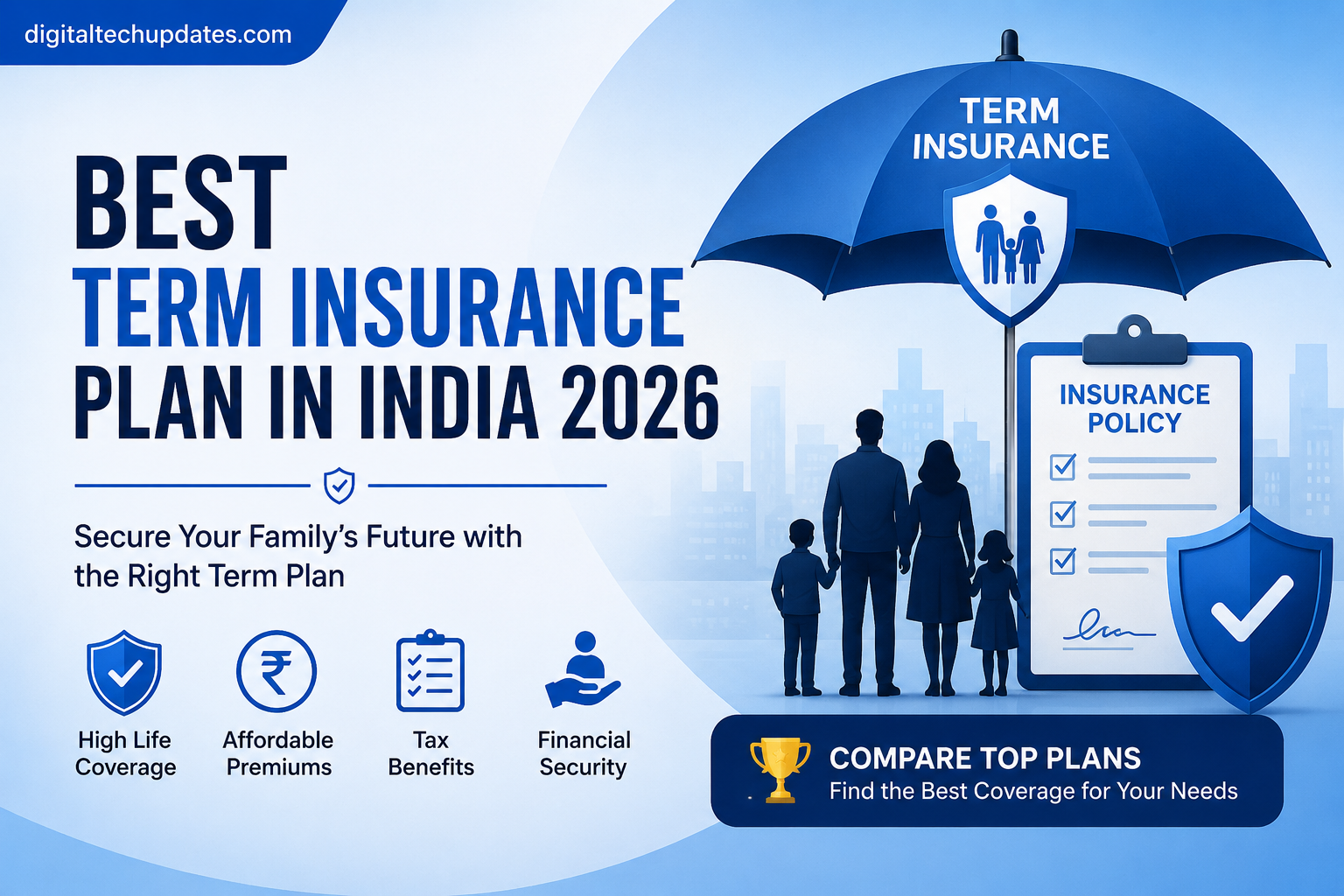
Best Term Insurance Plan in India 2026: Top 10 Picks Compared (Honest Review)
If there is one financial decision that can protect your family from a lifetime of financial struggle, it is buying the right term insurance plan — and buying it early.
In 2026, with rising living costs, home loan EMIs, and education expenses, having a solid life cover has never been more important. The good news? Term insurance in India has become more affordable, more flexible, and easier to buy than ever before.
But with dozens of plans from HDFC Life, ICICI Prudential, LIC, Bajaj Allianz, Tata AIA, and others competing for your attention, how do you pick the right one?
This guide cuts through all the noise and gives you a plain-language breakdown of the best term insurance plans in India for 2026 — what they offer, who they are right for, and what you should watch out for before you sign.
What is Term Insurance and Why Does It Matter?
Term insurance is the simplest form of life insurance. You pay a small annual premium, and in exchange, your family receives a large lump sum (called the sum assured) if you pass away during the policy term.
Unlike ULIPs or endowment plans, there is no investment component. That is actually a feature, not a bug — because it means your premium goes entirely toward protection, making term insurance 5 to 10 times cheaper than other life insurance products for the same coverage amount.
A 28-year-old non-smoker can get ₹1 crore of life cover for as low as ₹400 to ₹600 per month. That is roughly the cost of two cups of coffee per day to ensure your family never faces financial hardship if the worst happens.
How Much Coverage Do You Actually Need?
Before comparing plans, figure out the right sum assured for your situation. A simple rule of thumb is to aim for 10 to 15 times your current annual income plus all outstanding liabilities (home loan, car loan, personal loan).
If your annual income is ₹8 lakh and you have a ₹20 lakh home loan, you need roughly ₹1 crore to ₹1.4 crore in coverage. Always round up, not down — it is better to be slightly over-insured than to leave your family short.
Top 10 Best Term Insurance Plans in India for 2026
Here is a detailed comparison of the plans consistently rated highest for claim settlement, features, and value for money.
1. LIC Tech Term Plan
- Claim Settlement Ratio: 98.8%
- Coverage: ₹50 lakh to unlimited
- Key Feature: The name LIC carries unmatched trust in India. Best for people who prioritize claim certainty over bells and whistles.
- Best For: Conservative buyers, government employees, rural policyholders
2. HDFC Life Click 2 Protect Super
- Claim Settlement Ratio: 98.6%
- Coverage: Up to ₹20 crore
- Key Feature: Life-stage protection — your cover automatically increases when you get married or have a child. Also offers a return of premium option.
- Best For: Young professionals planning life milestones
3. ICICI Prudential iProtect Smart
- Claim Settlement Ratio: 97.9%
- Coverage: ₹25 lakh to ₹10 crore
- Key Feature: Covers 34 critical illnesses and offers an accidental death benefit. Terminal illness payout comes in advance.
- Best For: People wanting health riders alongside life cover
4. Tata AIA Sampoorna Raksha Promise
- Claim Settlement Ratio: 99.1%
- Coverage: ₹50 lakh to ₹5 crore
- Key Feature: Highest claim settlement ratio on this list. Zero-cost exit option to get premiums back if you choose to discontinue.
- Best For: Anyone who values a track record of claim settlement above all else
5. Bajaj Allianz Smart Protect Goal
- Claim Settlement Ratio: 98.5%
- Coverage: ₹25 lakh to ₹10 crore
- Key Feature: Waiver of premium on critical illness or disability. Income benefit option pays monthly to family.
- Best For: Sole breadwinners with dependents
6. Max Life Smart Secure Plus
- Claim Settlement Ratio: 99.2%
- Coverage: ₹20 lakh to ₹10 crore
- Key Feature: Special exit value — receive a portion of premiums back upon exiting. Strong critical illness coverage.
- Best For: Salaried individuals in private sector
7. Canara HSBC iSelect Smart360
- Claim Settlement Ratio: 98.4%
- Coverage: Up to ₹10 crore
- Key Feature: Life cover until age 99. Flexible premium payment options including single pay.
- Best For: Long-term financial planners
8. SBI Life eShield Next
- Claim Settlement Ratio: 97.1%
- Coverage: ₹50 lakh to ₹25 crore
- Key Feature: Flexible plan options — Level Cover, Increasing Cover, Level Cover with Future-proofing. Highly affordable premiums.
- Best For: Budget-conscious buyers needing high coverage
9. PNB MetLife Mera Term Plan Plus
- Claim Settlement Ratio: 96.6%
- Coverage: ₹25 lakh to ₹2 crore
- Key Feature: Monthly income payout option for family. Special female premium rates.
- Best For: Women and families wanting steady income benefits
10. Aditya Birla Sun Life DigiShield Plan
- Claim Settlement Ratio: 97.2%
- Coverage: ₹30 lakh to ₹10 crore
- Key Feature: 10 different plan options covering everything from basic protection to joint life cover.
- Best For: Couples wanting joint coverage
What to Look for Beyond the Premium Amount
Most people make the mistake of picking the cheapest plan by premium alone. Here is what actually matters.
Claim Settlement Ratio (CSR): This is the percentage of claims the insurer paid out versus total claims received. Anything above 97% is considered excellent. In 2026, Tata AIA and Max Life both hold ratios above 99%.
Solvency Ratio: The insurer’s financial cushion. IRDAI mandates a minimum of 150%. Anything above 200% means the company is very financially stable.
Exclusions: Almost all term plans exclude death due to suicide within the first year. Read the fine print carefully for other exclusions like hazardous activity, drug use, or specific pre-existing conditions.
Riders: These are add-ons that enhance your base coverage. The most popular and valuable riders are Critical Illness Rider (covers cancer, heart attack, stroke etc.), Accidental Death Benefit Rider, and Waiver of Premium Rider.
Tax Benefits on Term Insurance in India (2026 Update)
Term insurance premiums qualify for tax deduction under Section 80C (now Section 123 under the new Income Tax Act 2025) up to ₹1.5 lakh per year under the old tax regime. The death benefit received by your nominee is completely tax-free under Section 10(10D) (now Section 11 under the revised Act).
Note: Under the new tax regime, Section 80C benefits are not applicable, so confirm which regime you file under before factoring in tax savings.
When Should You Buy Term Insurance?
The best time to buy term insurance is as early as possible. Premiums are directly linked to your age and health at the time of purchase — a 25-year-old pays roughly 50% less premium than a 35-year-old for identical coverage.
Buy term insurance if:
- You have dependents (spouse, children, elderly parents)
- You have active loans (home loan, car loan, education loan)
- You are the primary or sole earning member of your household
- You want to provide a financial safety net without over-spending on insurance
Common Mistakes to Avoid
Under-insuring: Buying ₹25 lakh cover when you need ₹1 crore is a false economy. The premium difference is small; the impact on your family is enormous.
Not disclosing medical history: If you hide a pre-existing condition and then make a claim, the insurer can legally reject it. Always be fully transparent during the application.
Skipping riders: A base term plan covers only death. A ₹500/year critical illness rider can provide cover for cancer or cardiac events while you are still alive — this is almost always worth adding.
Buying only for tax saving: Term insurance is a protection product, not a tax-saving instrument. Choose coverage based on your actual financial needs first.
Final Verdict
For most people in India in 2026, a ₹1 crore to ₹2 crore term insurance plan from Tata AIA, Max Life, or HDFC Life is the best starting point — they combine high claim settlement ratios, competitive premiums, and flexible rider options.
Use the official policy aggregators like PolicyBazaar or PolicyX to compare live quotes in 5 minutes. Always read the policy document before signing, and never buy just because an agent pressures you.
Protect your family. That is the only reason term insurance exists, and it does the job better than any other financial product available.
Thalla Lokesh
Thalla Lokesh is a Digital Marketing Strategist and SEO Specialist with over 12 years of experience in helping businesses grow their online presence. Since beginning his career in 2013, he has successfully worked across industries including healthcare, education, technology, and e-commerce. He specializes in search engine optimization (SEO), content marketing, keyword strategy, and link building, with a strong focus on delivering measurable results. Lokesh has helped brands achieve top rankings on Google through data-driven strategies, high-quality content, and ethical SEO practices aligned with search engine guidelines. As the founder of Honey Web Solutions , a Tirupati-based digital marketing company, he actively works with clients to improve organic traffic, lead generation, and online visibility. He also contributes expert insights on digital marketing trends, AI SEO, and content strategies through blogs and industry platforms.