How to Claim Car Insurance After an Accident: Step-by-Step Guide (India 2026)

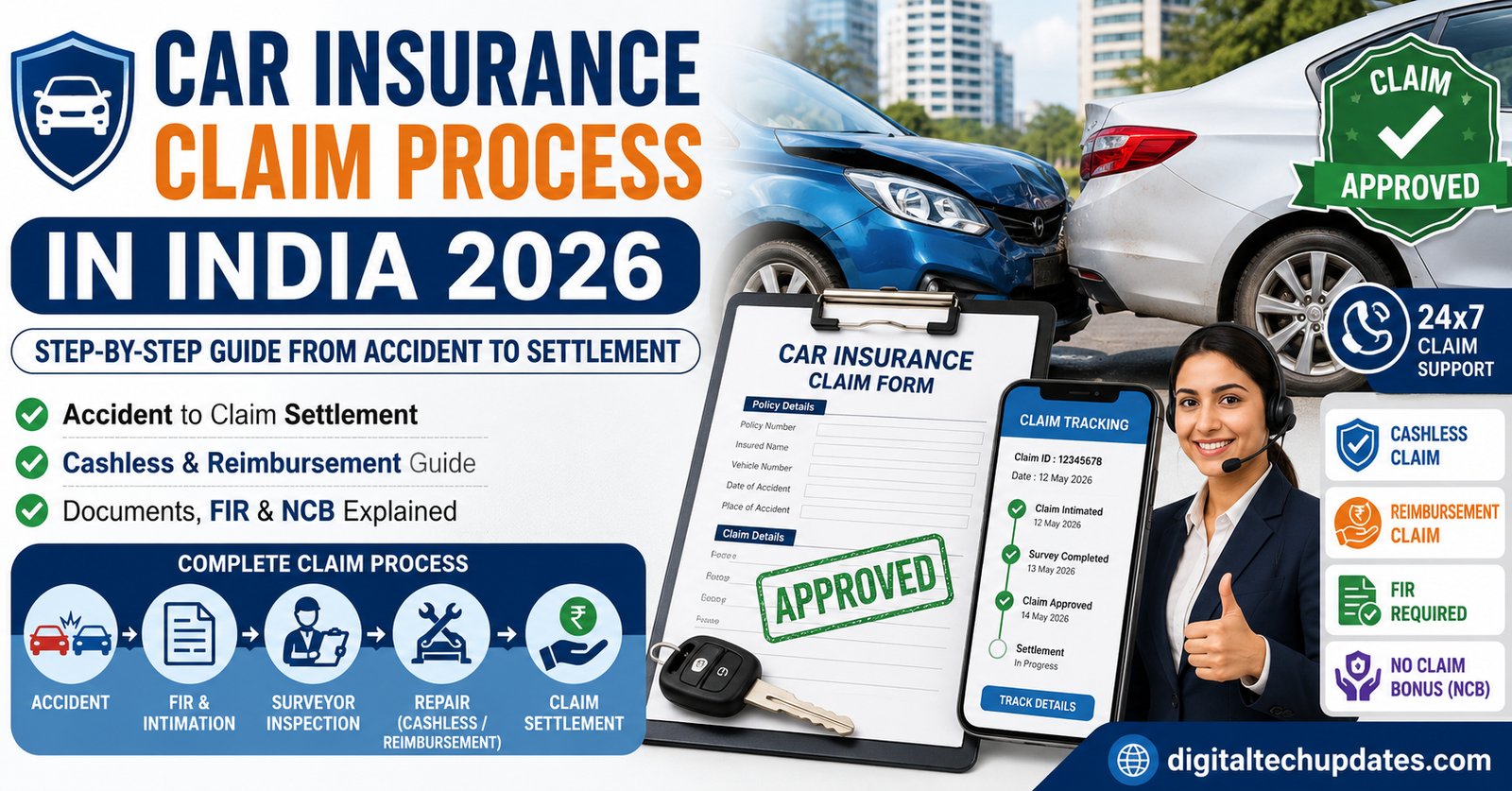
You just had an accident. Your heart is racing, there is damage to your car, and you are not sure what to do next. This is exactly when you need a clear, step-by-step guide — not legal jargon or complicated policy language.
This article will walk you through the entire car insurance claim process in India, from the moment of the accident to the final settlement. Follow these steps carefully and you will maximise your chances of getting your full claim approved quickly.
First 30 Minutes: What to Do Immediately After the Accident
Stay calm and check for injuries first. If anyone is hurt, call an ambulance immediately (108) and then call the police (100). Your priority is people, not paperwork.
Do not move the vehicles if the accident is major. The insurance surveyor will need to inspect the exact position of the vehicles for a third-party or major damage claim.
Document everything with your phone:
- Take at least 20 photos from multiple angles — your car, the other vehicle, the road, road signs, and the surrounding area
- Take a short video walking around both vehicles
- Note the exact time, date, and location
- Get the registration number of the other vehicle
- Exchange contact and insurance details with the other driver
Call your insurer immediately. Most insurance companies have a 24/7 helpline. The claim intimation (notification) should ideally happen within 24 hours. Many insurers now allow WhatsApp or app-based claim intimation.
Two Types of Car Insurance Claims in India
Understanding which type of claim applies to your situation saves a lot of confusion.
Own Damage (OD) Claim: When your own vehicle is damaged — whether in an accident, flood, fire, or theft. This is covered under comprehensive insurance policies. If you only have third-party insurance, you cannot file an OD claim.
Third-Party Claim: When you damage someone else’s vehicle, property, or injure another person. This is mandatory under Indian law for all vehicles. Your insurer compensates the third party on your behalf.
Most accidents involve both — so you may need to process both simultaneously.
Step-by-Step Car Insurance Claim Process
Step 1: Intimate Your Insurance Company Call the toll-free number printed on your insurance policy document or use the insurer’s mobile app. Provide your policy number, the date and location of the accident, and a brief description of what happened. They will give you a claim reference number — save this.
Step 2: File an FIR (if required) An FIR is mandatory for accidents involving:
- Third-party bodily injury or death
- Hit-and-run incidents
- Theft of your vehicle For minor own-damage accidents (scratches, dents with no other party involved), an FIR is not required, but a police report may still be needed by some insurers.
Step 3: Choose Cashless or Reimbursement
- Cashless Claim: Take your car to any garage within your insurer’s network. The insurer directly pays the garage. You only pay the deductible (compulsory excess) and any non-covered amounts. This is the easiest and fastest option.
- Reimbursement Claim: Take your car to any garage of your choice, pay the bill yourself, and then submit documents to the insurer for reimbursement. This takes longer but gives you freedom in choice of garage.
Step 4: Surveyor Inspection Your insurer will send a licensed surveyor to inspect the vehicle damage — either at the accident site or at the garage. Do not start any repairs before the surveyor has completed the inspection. Starting repairs early is one of the most common reasons for claim rejection.
Step 5: Submit All Required Documents Standard documents required for a car insurance claim:
- Duly filled claim form (provided by insurer)
- Copy of your driving licence
- Copy of your vehicle registration certificate (RC)
- Copy of the insurance policy
- FIR copy (if applicable)
- Photos of the accident and vehicle damage
- Original repair bills and payment receipts (for reimbursement claims)
Step 6: Repair and Claim Settlement For cashless claims, the insurer approves the repair estimate given by the network garage and settles directly. For reimbursement, submit all documents after repairs and the insurer will process payment — typically within 7 to 15 working days.
What is the Compulsory Deductible?
Every comprehensive car insurance policy has a compulsory deductible (also called compulsory excess). This is the fixed amount you must pay from your own pocket before the insurer covers the rest.
As per IRDAI regulations:
- Vehicles with engine capacity up to 1500cc: ₹1,000 deductible
- Vehicles above 1500cc: ₹2,000 deductible
Some policies also have a voluntary deductible chosen by the policyholder during purchase — this reduces your premium but increases your out-of-pocket cost at claim time.
Why Car Insurance Claims Get Rejected (And How to Avoid It)
Driving under the influence: If you were driving drunk or under the influence of drugs, your claim will be rejected outright. This is non-negotiable.
Expired policy or lapsed premium: Always ensure your policy is active before you drive. Even one day of lapse can invalidate your claim.
Unlicensed driver: If the person driving at the time of the accident did not have a valid licence, the claim will be rejected. This applies to expired licences as well.
Delayed intimation: Most policies require claim intimation within 24 to 48 hours of the accident. Waiting a week and then filing is a common reason for disputes.
Using a personal vehicle for commercial purposes: If you use your personal car for a taxi service or courier business without a commercial permit, the claim can be rejected for accidents during commercial use.
Tips for Faster Claim Settlement
- Always use your insurer’s network garage for cashless claims — non-network garages add complexity and delay
- Keep digital copies of your RC, licence, and insurance policy on your phone using DigiLocker
- Install your insurer’s mobile app — most now allow real-time claim tracking
- Keep all repair bills, photographs, and correspondence in one folder
- Follow up proactively — call the claims team every 3 to 4 days if there is no movement
How Long Does a Car Insurance Claim Take?
Under IRDAI regulations, insurers must settle claims within 30 days of receiving all required documents. In practice, straightforward cashless claims at network garages are often resolved in 3 to 7 working days. Complex cases involving disputes or legal proceedings (particularly third-party injury claims) can take several months.
If your insurer is unreasonably delaying your claim, you have the right to escalate to IRDAI’s grievance portal (Bima Bharosa) or file a complaint with the Insurance Ombudsman.
Does Filing a Claim Affect Your No-Claim Bonus (NCB)?
Yes. Filing an own-damage claim will reduce or reset your No-Claim Bonus (NCB) at renewal. NCB is a discount of up to 50% on your premium that accumulates for every claim-free year. For small claims (₹5,000 to ₹10,000), it is often more economical to pay for repairs out of pocket and preserve your NCB for the following year.
Use the NCB protection add-on if you want the best of both worlds — it lets you make one claim per year without losing your NCB status.

Thalla Lokesh
Thalla Lokesh is a Digital Marketing Strategist and SEO Specialist with over 12 years of experience in helping businesses grow their online presence. Since beginning his career in 2013, he has successfully worked across industries including healthcare, education, technology, and e-commerce. He specializes in search engine optimization (SEO), content marketing, keyword strategy, and link building, with a strong focus on delivering measurable results. Lokesh has helped brands achieve top rankings on Google through data-driven strategies, high-quality content, and ethical SEO practices aligned with search engine guidelines. As the founder of Honey Web Solutions , a Tirupati-based digital marketing company, he actively works with clients to improve organic traffic, lead generation, and online visibility. He also contributes expert insights on digital marketing trends, AI SEO, and content strategies through blogs and industry platforms.