Connected Vehicles Technology: How IoT Is Transforming Real-Time Vehicle Monitoring and Fleet Operations

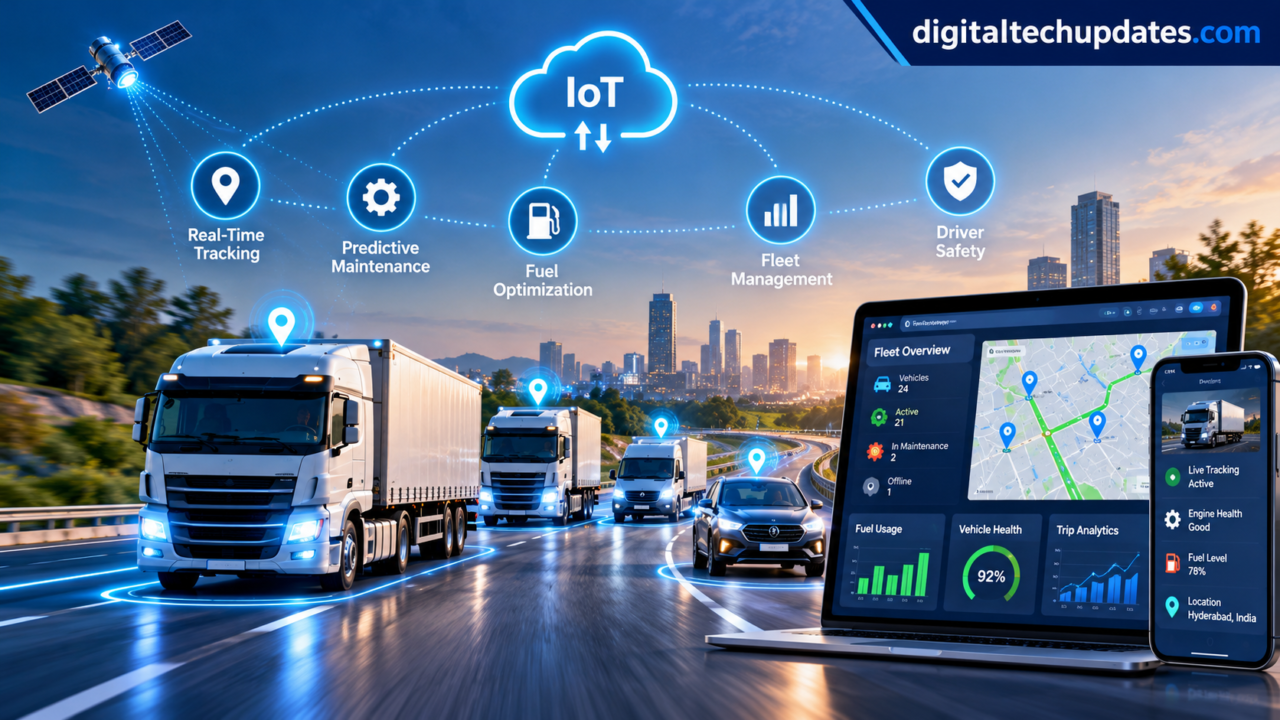
Connected vehicles technology is changing how vehicles are monitored, maintained, and managed. By combining the Internet of Things (IoT), GPS tracking, telematics, cloud computing, and artificial intelligence (AI), businesses can collect vehicle data, monitor fleet performance, identify potential maintenance issues, and make better operational decisions.
For fleet operators, logistics companies, transportation providers, and automotive manufacturers, this shift represents a move from manual vehicle management to data-driven operations.
Instead of relying only on driver updates or periodic maintenance checks, connected vehicle systems can provide near-real-time information about vehicle location, engine performance, fuel consumption, driving behavior, and operational status.
But how does this technology work, and what makes it valuable for modern fleet operations? Let’s explore the key technologies, applications, benefits, challenges, and future opportunities.
What Is Connected Vehicles Technology?
Connected vehicles technology refers to systems that allow vehicles to exchange information with external networks, cloud platforms, other vehicles, infrastructure, and digital applications.
These systems use onboard sensors, communication modules, GPS receivers, and vehicle computers to collect and transmit information. Fleet managers and authorized users can then access relevant data through web dashboards or mobile applications.
For example, a logistics company operating dozens of delivery trucks can use connected vehicle technology to view vehicle locations, monitor journeys, receive maintenance alerts, and identify inefficient driving patterns from a centralized platform.
Connected vehicle technology supports several related capabilities:
- Vehicle telematics: Collects and communicates vehicle location, diagnostic, and operational information.
- IoT sensors: Measure conditions such as temperature, pressure, movement, and equipment status.
- GPS tracking: Provides location and journey information.
- Cloud computing: Stores and processes vehicle data at scale.
- Artificial intelligence: Helps identify patterns, predict potential problems, and support operational decisions.
- Vehicle-to-everything (V2X) communication: Enables vehicles to exchange information with other vehicles, infrastructure, and other road users or systems.
These technologies work together to improve visibility, coordination, and decision-making across the vehicle lifecycle.
How IoT Enables Real-Time Vehicle Monitoring
The Internet of Things connects physical devices to digital systems so they can exchange data and support automated monitoring.
In connected vehicles, IoT technology links onboard sensors and electronic systems with telematics devices, communication networks, and software platforms.
A typical monitoring process follows five stages.
1. Data Collection Through Vehicle Sensors
Sensors and electronic control units collect information about vehicle performance and operating conditions.
Depending on the vehicle and installed equipment, this information may include:
- Engine temperature and diagnostic trouble codes.
- Fuel level and fuel consumption estimates.
- Vehicle speed and odometer readings.
- Battery voltage and charging status.
- Tire pressure, where compatible sensors are installed.
- Cargo temperature and humidity.
- Driving events, such as harsh braking or rapid acceleration.
The availability and accuracy of these measurements depend on the vehicle model, sensor configuration, and telematics hardware.
2. Data Transmission Through Connected Networks
A telematics control unit or compatible tracking device sends selected information to a remote platform through cellular networks, Wi-Fi, satellite communication, or other supported connections.
The communication method depends on the application. A delivery fleet operating in urban areas may rely primarily on cellular connectivity, while vehicles operating in remote locations may require additional communication options.
Not every data point is transmitted continuously. Reporting frequency can depend on device settings, network availability, battery consumption, and operational requirements.
3. Cloud-Based Data Processing
The transmitted information is received by a backend platform, where software processes and organizes the incoming data.
The platform can associate measurements with specific vehicles, compare readings against configured thresholds, identify unusual patterns, and generate alerts.
For example, if a refrigerated delivery vehicle reports a cargo temperature outside its permitted range, the system can notify an authorized operator so that the issue can be investigated.
4. Live Dashboards and Automated Alerts
Fleet managers can access processed information through a centralized dashboard.
Depending on the platform, they may view vehicle positions, trip histories, diagnostic warnings, fuel reports, maintenance schedules, and driver performance indicators.
Automated alerts help managers respond to important events without constantly checking every vehicle manually.
5. Data-Driven Operational Decisions
The final stage involves turning vehicle data into practical decisions.
Fleet managers can use reports to adjust routes, schedule maintenance, investigate unusual fuel consumption, improve vehicle utilization, and plan replacements.
This creates a continuous cycle: collect data, analyze performance, take action, and evaluate the results.
Key Technologies Powering Connected Vehicles
Connected vehicle systems rely on several technologies that perform different but complementary functions.
| Technology | Primary function | Example application |
|---|---|---|
| IoT sensors | Measure operating conditions | Cargo temperature monitoring |
| GPS and GNSS | Determine vehicle position | Fleet location tracking |
| Vehicle telematics | Collect and transmit vehicle data | Engine diagnostics |
| Cellular connectivity | Transfer information remotely | Live fleet updates |
| Cloud computing | Process and store data | Centralized fleet dashboards |
| AI and machine learning | Analyze patterns and support predictions | Maintenance risk detection |
| Edge computing | Process selected data near its source | Faster local alerts |
| V2X communication | Exchange information with vehicles and infrastructure | Collision warnings |
The combination of these technologies allows connected vehicles to support both routine fleet administration and more advanced safety and automation applications.
How Connected Vehicles Are Transforming Fleet Operations
Fleet management involves more than knowing where vehicles are located. Businesses must also control operating costs, maintain vehicle availability, coordinate drivers, protect cargo, and meet delivery commitments.
Connected vehicle technology supports these responsibilities in several ways.
1. Real-Time GPS Fleet Tracking
GPS-enabled tracking allows fleet managers to view vehicle locations and monitor journey progress.
Instead of waiting for drivers to provide updates, authorized staff can check the latest available location information through a digital dashboard.
This can help businesses:
- Monitor delivery progress.
- Identify unexpected stops and route deviations.
- Coordinate vehicles across multiple locations.
- Provide customers with more accurate delivery updates.
- Improve dispatch planning.
- Investigate delays and operational exceptions.
However, GPS tracking alone does not guarantee accurate arrival times. Traffic conditions, weather, road closures, and delivery requirements must also be considered.
2. Predictive Maintenance and Vehicle Health Monitoring
Traditional maintenance often follows fixed schedules or begins after a driver reports a problem.
Connected vehicle platforms can supplement this approach by collecting diagnostic information and identifying patterns that may indicate developing faults.
For example, repeated engine-temperature warnings or abnormal diagnostic readings could prompt a technician to inspect a vehicle before the issue causes an unexpected breakdown.
Predictive maintenance may help fleet operators:
- Identify potential mechanical problems earlier.
- Reduce avoidable vehicle downtime.
- Schedule repairs more effectively.
- Improve maintenance planning.
- Track recurring faults across the fleet.
The accuracy of predictive maintenance depends on data quality, suitable analytical models, and vehicle-specific information. A connected system cannot reliably predict every failure.
3. Fuel Consumption and Cost Optimization
Fuel is a major operating expense for many commercial fleets. Connected vehicle systems can help managers understand how vehicles consume fuel across different routes and operating conditions.
When reliable fuel and vehicle data are available, reports may reveal:
- Vehicles with unusually high fuel consumption.
- Excessive idling.
- Inefficient route choices.
- Repeated harsh acceleration.
- Differences in performance between similar vehicles.
Managers can use these insights to investigate the causes and introduce targeted improvements.
Fuel savings are not automatic. Results depend on driving conditions, vehicle condition, fuel prices, management practices, and whether identified problems are corrected.
4. Driver Behavior Monitoring
Telematics systems can record driving events such as harsh braking, speeding indicators, sharp acceleration, and excessive idling when supported by the vehicle and device.
Fleet managers can review these events to identify training needs and improve safety procedures.
For example, repeated harsh-braking alerts on a particular route may indicate a need to review driver behavior, traffic conditions, route design, or vehicle maintenance.
Responsible driver monitoring should focus on clear safety objectives, transparent policies, and fair interpretation of the data rather than automatically treating every alert as evidence of misconduct.
5. Route Optimization and Dispatch Management
Connected fleet platforms can combine vehicle locations with delivery schedules, route information, traffic data, and job requirements.
This can help dispatch teams assign vehicles more efficiently and respond to unexpected delays.
Potential applications include:
- Selecting suitable vehicles for delivery assignments.
- Reallocating jobs when a vehicle becomes unavailable.
- Reducing unnecessary travel.
- Coordinating service technicians.
- Monitoring estimated arrival times.
- Improving vehicle utilization.
More advanced route optimization may use AI algorithms, although the quality of its recommendations depends on the accuracy and timeliness of the underlying data.
6. Cargo and Cold-Chain Monitoring
For businesses transporting pharmaceuticals, food, agricultural products, or other temperature-sensitive goods, monitoring cargo conditions is essential.
IoT-enabled sensors can track temperature and humidity inside compatible storage compartments or trailers.
When readings cross configured limits, the system can send an alert to the relevant team.
This allows operators to investigate cooling failures, door-opening events, or other conditions that could affect cargo quality.
Connected monitoring supports better visibility, but it does not by itself guarantee regulatory compliance or prevent product spoilage. Appropriate sensors, calibration, response procedures, and recordkeeping are also necessary.
Connected Vehicles vs. Traditional Fleet Management
The main difference is how operational information is collected, shared, and used.
| Feature | Traditional fleet management | IoT-enabled fleet management |
|---|---|---|
| Vehicle location | Manual updates or periodic checks | GPS-based tracking |
| Vehicle health | Scheduled inspections and driver reports | Remote diagnostics where supported |
| Maintenance planning | Primarily calendar- or mileage-based | Can incorporate condition and diagnostic data |
| Fuel analysis | Manual records and periodic reports | More frequent data-driven monitoring |
| Driver performance | Limited observations and reports | Telematics-based driving event analysis |
| Cargo monitoring | Manual temperature checks | Automated sensor alerts where installed |
| Reporting | Often delayed or fragmented | Centralized dashboards and reports |
| Decision-making | More dependent on manual information | Better supported by timely operational data |
Traditional methods remain useful, especially for small fleets. Connected systems add value when the information they provide improves decisions enough to justify their cost and complexity.
Benefits of Connected Vehicles Technology for Businesses
The benefits depend on fleet size, vehicle type, operating environment, and implementation quality. Common advantages include the following.
Improved operational visibility: Managers can access current vehicle and trip information from a centralized system.
Reduced avoidable downtime: Diagnostic alerts and condition-based maintenance can help identify issues earlier.
Better resource utilization: Fleet operators can understand how vehicles are being used and identify underutilized assets.
More informed safety management: Driving-event reports and compatible camera systems can help identify training needs and investigate incidents.
Improved customer communication: Better journey visibility can support more reliable delivery updates and exception handling.
Stronger cargo oversight: Environmental sensors can help monitor sensitive goods during transportation.
Better long-term planning: Historical data can support decisions about vehicle replacement, maintenance budgets, routes, and fleet expansion.
Businesses should establish measurable baseline indicators before deployment so that they can determine whether these potential benefits translate into real improvements.
Challenges and Risks of Connected Vehicle Systems
Although connected vehicle technology offers substantial operational opportunities, implementation also creates technical and organizational challenges.
Data Security and Cybersecurity
Connected vehicles rely on software, communication networks, onboard electronics, and external platforms. Poorly secured devices or integrations can introduce risks.
Organizations should consider:
- Strong device authentication.
- Encrypted communications.
- Role-based access controls.
- Secure software updates.
- Regular security testing and patching.
- Network segmentation where appropriate.
- Incident detection and response procedures.
Cybersecurity is especially important when third-party telematics devices connect to vehicle electronic systems. Security controls should be proportionate to the potential safety and operational consequences of unauthorized access.
Data Privacy and Employee Monitoring
Vehicle location and driving records may reveal sensitive information about drivers, employees, customers, or business activities.
Organizations should explain what data is collected, why it is necessary, who can access it, and how long it will be retained.
They should also apply appropriate privacy safeguards and follow applicable data protection and employment requirements.
Network Coverage and Data Delays
Connected systems depend on communication infrastructure. Vehicles traveling through tunnels, remote regions, or areas with weak cellular coverage may experience delayed updates or temporary disconnections.
Platforms should handle connectivity gaps gracefully and distinguish between a vehicle’s last reported position and its confirmed current location.
Integration With Existing Systems
Some businesses already use transport management systems, enterprise resource planning software, warehouse systems, fuel cards, or maintenance applications.
Integrating these tools with vehicle telematics may require compatible interfaces, data mapping, testing, and ongoing maintenance.
Without reliable integration, businesses may end up with disconnected dashboards and duplicated records.
Implementation Costs
Total costs can include hardware, connectivity, software subscriptions, installation, training, integration, data storage, and support.
Businesses should evaluate the complete cost of ownership rather than comparing software subscription prices alone.
A pilot deployment can help establish whether a proposed system solves a meaningful operational problem before the company expands it across the fleet.
How to Implement an IoT-Based Fleet Monitoring System
Businesses planning to adopt connected vehicle technology should follow a structured implementation process.
Step 1: Define business objectives. Identify the main problem, such as excessive fuel consumption, poor vehicle visibility, recurring breakdowns, or cargo-temperature excursions.
Step 2: Audit the existing fleet. Review vehicle models, installed equipment, maintenance practices, connectivity requirements, and available data sources.
Step 3: Select compatible telematics hardware. Confirm that tracking devices and sensors support the required vehicles and measurements. Check installation requirements and manufacturer guidance.
Step 4: Choose the monitoring platform. Evaluate dashboard functionality, reporting, alerts, integrations, data export, security controls, and vendor support.
Step 5: Establish security and privacy policies. Define permissions, retention periods, driver communication, access controls, and incident response procedures.
Step 6: Run a pilot program. Test the system with a representative group of vehicles. Check data accuracy, alert quality, connectivity, user experience, and operating costs.
Step 7: Measure performance. Compare results against baseline metrics, such as fuel used per kilometre, unplanned downtime, on-time delivery rate, and maintenance costs.
Step 8: Expand and improve. Roll out the system where it demonstrates value, train staff, and periodically review performance and security.
This phased approach helps organizations avoid investing in features that do not address their actual operational needs.
The Future of Connected Vehicles Technology
Connected vehicle technology is developing alongside AI, faster communication networks, advanced driver-assistance systems, and intelligent transportation infrastructure.
Several trends are likely to influence future vehicle monitoring and fleet operations.
AI-Powered Fleet Analytics
AI systems can help analyze large volumes of vehicle and operational data to identify patterns, flag anomalies, and recommend actions.
Potential applications include maintenance prioritization, fuel-efficiency analysis, route planning, and automated operational reporting.
Human oversight remains important, particularly when recommendations affect vehicle safety, employment decisions, or costly operational actions.
Vehicle-to-Everything Communication
Vehicle-to-everything, or V2X, technology allows vehicles to exchange information with other vehicles, road infrastructure, and other compatible systems.
Potential applications include collision warnings, emergency vehicle alerts, and information about traffic hazards.
In India, the Ministry of Road Transport and Highways announced a draft notification on August 3, 2026, proposing phased implementation of vehicle-to-vehicle communication systems through amendments to the Central Motor Vehicles Rules. The proposal describes potential safety applications, including emergency-braking alerts and forward-collision warnings. This is a proposed framework, not evidence that the requirements have already been implemented nationwide.
Edge Computing for Faster Responses
Edge computing processes selected data near the device or vehicle instead of sending every measurement to a distant cloud platform.
This approach can support faster local responses and reduce the amount of data that must be transmitted. It is useful for applications that need prompt processing or must continue operating during temporary network interruptions.
Over-the-Air Software Updates
Compatible connected vehicles can receive software updates remotely, potentially reducing the need for workshop visits for certain updates.
However, updates require secure delivery, authentication, compatibility checks, and appropriate recovery procedures. Not every vehicle or software component supports remote updating.
Electric Vehicle Fleet Monitoring
As businesses adopt electric vehicles, fleet monitoring systems can incorporate battery state of charge, energy consumption, charging status, and charging schedules where supported.
Combining this information with route and duty-cycle data can help fleet managers plan charging and vehicle assignments more effectively.
The precise capabilities depend on vehicle interfaces, charging infrastructure, and the telematics platform.
Conclusion
Connected vehicles technology is making fleet operations more data-driven by combining IoT sensors, GPS tracking, telematics, cloud platforms, and AI-powered analytics.
These systems can help businesses monitor vehicles, improve maintenance planning, analyze fuel consumption, support driver safety, and coordinate deliveries more effectively.
However, the value of connected vehicle technology depends on more than installing tracking devices. Reliable data, secure integrations, clear privacy policies, suitable training, and measurable business objectives are essential.
For fleet operators considering this technology, the best starting point is to identify one or two operational challenges, test a suitable solution, and measure the results before expanding deployment.
As connectivity and vehicle intelligence continue to develop, connected monitoring is likely to become an increasingly important part of efficient, secure, and well-managed transportation operations.
Frequently Asked Questions
1. What is connected vehicle technology?
Connected vehicle technology enables vehicles to exchange information with digital platforms, other vehicles, infrastructure, and external systems using technologies such as IoT, telematics, GPS, and wireless communication.
2. How does IoT help with real-time vehicle monitoring?
IoT-enabled sensors and telematics devices collect vehicle information and transmit it to a monitoring platform. Depending on the installed equipment, managers can review location, diagnostic alerts, operating conditions, and other vehicle data.
3. What is the difference between GPS tracking and vehicle telematics?
GPS tracking primarily provides vehicle location and journey information. Telematics can combine location data with vehicle diagnostics, driving events, fuel information, sensor readings, and other operational data.
4. Can IoT reduce fleet maintenance costs?
IoT-based monitoring can help identify developing faults and improve maintenance planning. Actual savings depend on the quality of the data, the accuracy of alerts, maintenance practices, and the cost of implementation.
5. Is connected vehicle technology suitable for small businesses?
Yes. Small delivery businesses, service companies, and local transportation operators can start with basic GPS tracking or selected telematics features. The solution should match the size of the fleet and the business’s operational requirements.
6. What are the main risks of connected vehicle technology?
Important risks include cybersecurity vulnerabilities, unauthorized access, privacy concerns, unreliable connectivity, inaccurate sensor data, integration difficulties, and implementation costs.
7. What is the role of AI in connected vehicle systems?
AI can analyze vehicle and fleet data to detect unusual patterns, support predictive maintenance, improve route planning, and identify operational inefficiencies. Its results depend on data quality and appropriate validation.
8. What is the future of connected vehicles?
Future developments include more advanced fleet analytics, vehicle-to-everything communication, remote software updates, electric vehicle monitoring, and greater integration with intelligent transportation systems.

Thalla Lokesh
Thalla Lokesh is a Digital Marketing Strategist and SEO Specialist with over 12 years of experience in helping businesses grow their online presence. Since beginning his career in 2013, he has successfully worked across industries including healthcare, education, technology, and e-commerce. He specializes in search engine optimization (SEO), content marketing, keyword strategy, and link building, with a strong focus on delivering measurable results. Lokesh has helped brands achieve top rankings on Google through data-driven strategies, high-quality content, and ethical SEO practices aligned with search engine guidelines. As the founder of Honey Web Solutions , a Tirupati-based digital marketing company, he actively works with clients to improve organic traffic, lead generation, and online visibility. He also contributes expert insights on digital marketing trends, AI SEO, and content strategies through blogs and industry platforms.