Generative AI Trends in Business 2026: What Is Actually Changing (And What It Means for You)

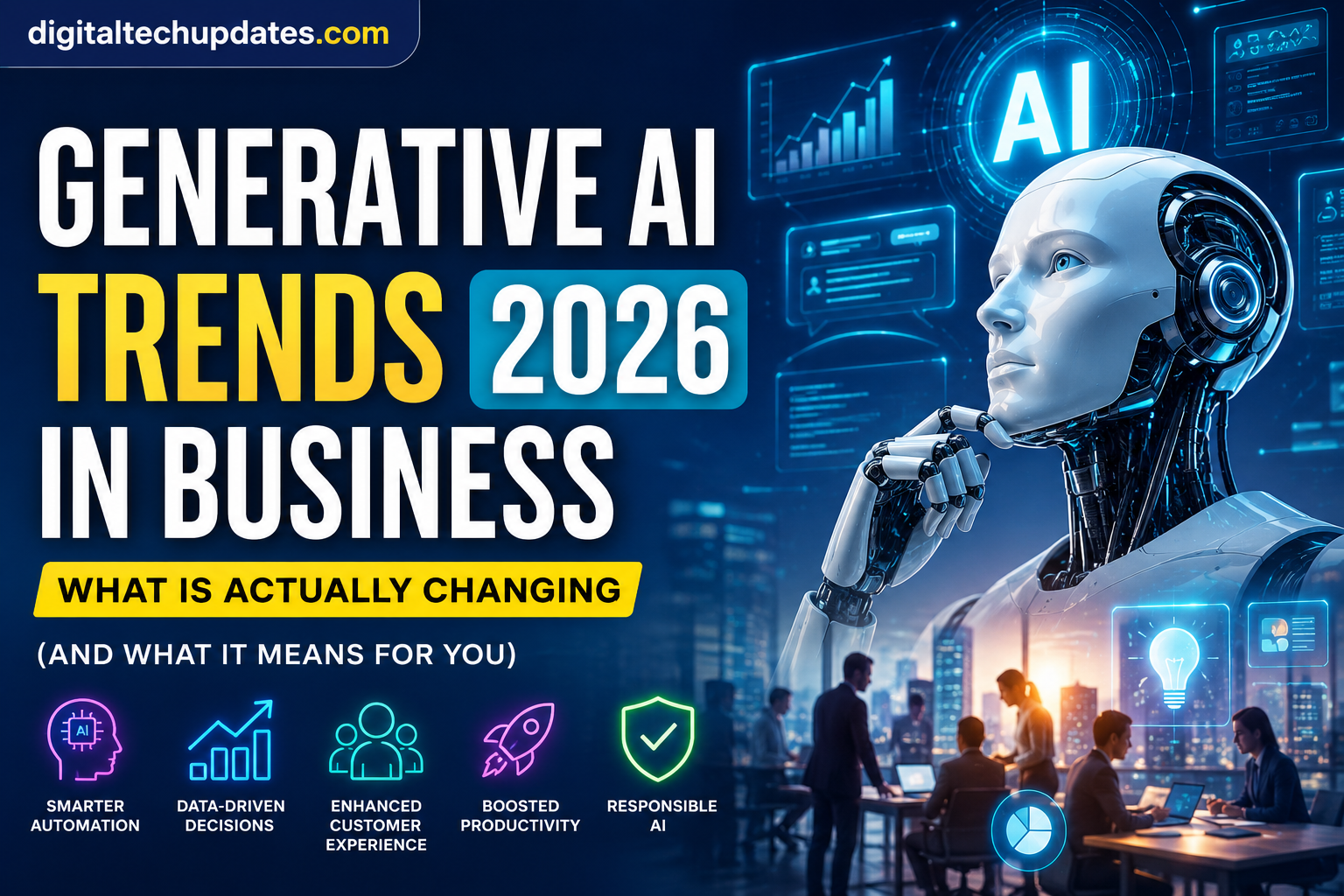
Generative AI has moved past the hype cycle. The breathless “AI will change everything” headlines of 2023 have given way to something more interesting and more concrete in 2026: actual, measurable business results from AI adoption.
According to McKinsey research, the percentage of organisations using AI in at least one business function jumped from 78% to 88% in just one year between 2024 and 2025, with approximately one-third reporting they have begun to scale their AI programmes beyond pilots.
This is not a future trend anymore. It is the present competitive landscape. And if you run a business in 2026 — regardless of size or sector — understanding the key generative AI trends is not optional. It is a matter of competitive survival.
Trend 1: Agentic AI — AI That Takes Actions, Not Just Answers
The most significant shift in generative AI in 2026 is the emergence of agentic AI — AI systems that do not just answer questions but take sequences of autonomous actions to complete tasks.
An early ChatGPT could answer: “What is the best way to follow up on a sales lead?” An agentic AI system in 2026 can: look up the lead’s LinkedIn profile, read the previous email thread, draft a personalised follow-up email, schedule it for optimal send time, and notify you when they reply — all without a human in the loop for each step.
Tools like OpenAI Operator, Anthropic’s Claude computer-use feature, and Google’s Project Astra are making agentic workflows increasingly accessible to businesses of all sizes. Expect to see agentic AI handling customer service escalation, procurement workflows, and content publishing pipelines at scale.
Business impact: Significant reduction in manual administrative work. Companies piloting agentic AI workflows are reporting 30–60% reduction in process time for targeted workflows.
Trend 2: AI-Powered Search is Reshaping Digital Marketing
This is arguably the most disruptive generative AI trend for businesses with digital marketing strategies. Google’s AI Overviews now appear for the majority of informational search queries, providing direct AI-generated answers before any organic result links.
The data is stark: 58% of Google searches now end without a click, according to Semrush’s 2026 research. For informational queries, that number is significantly higher.
What this means in practice:
- Content that used to drive traffic by ranking on page 1 now competes with AI summaries that answer the question without requiring a click
- Brands need to optimise not just for ranking but for being cited within AI Overviews — a practice called Generative Engine Optimisation (GEO) or Answer Engine Optimisation (AEO)
- Question-based, highly structured, well-cited content is more likely to be selected by AI systems for inclusion in Overviews
Business impact: Traffic from informational queries is declining for many sites, but commercial and transactional query traffic remains strong. Businesses need to rebalance content towards bottom-of-funnel, high-intent topics.
Trend 3: Personalisation at Scale
Personalised marketing used to require large data teams and complex software. In 2026, generative AI makes deep personalisation accessible to businesses of any size.
Email marketing platforms now use AI to:
- Generate individualised subject lines and email body copy based on each recipient’s behaviour history
- Dynamically adjust product recommendations in real time
- Predict the optimal send time for each individual subscriber
E-commerce platforms use AI to generate personalised product descriptions based on browsing history. Social media advertising platforms use AI to create hundreds of ad variants automatically and test them in real time.
Business impact: Personalised AI-driven campaigns show an average 38% higher conversion rate than generic campaigns in 2026, according to industry data.
Trend 4: Multimodal AI Becomes Standard
Early generative AI tools were text-only. In 2026, the leading AI systems handle text, images, audio, video, and data simultaneously within the same workflow.
Practical business applications:
- A customer sends a photo of a damaged product → AI analyses the image, identifies the issue, generates a return label, and drafts a resolution email automatically
- A marketing team describes a campaign concept in text → AI generates image options, video scripts, and ad copy simultaneously
- A sales team records a client call → AI transcribes, identifies key objections, generates follow-up tasks, and updates the CRM automatically
Tools like GPT-4o, Gemini 1.5 Pro, and Claude are all multimodal in 2026, and the gap between text-only and multimodal workflows is becoming increasingly significant.
Trend 5: AI Literacy Becomes a Core Business Skill
One of the underreported generative AI trends in business is cultural rather than technological: AI literacy is rapidly becoming a baseline expectation for professional competence.
In 2026, organisations that are winning with AI are not necessarily using the most sophisticated tools — they are the ones where employees at every level understand how to prompt effectively, evaluate AI outputs critically, and integrate AI into their specific workflows.
Companies are investing heavily in AI upskilling. Businesses without structured AI literacy programmes are increasingly losing talent to organisations that offer them.
Business impact: The competitive advantage is shifting from tool access (which is broadly democratised) to skill and workflow integration.
Trend 6: AI in Indian Business — The Accelerating Adoption Curve
India deserves special mention because AI adoption among Indian businesses has accelerated significantly faster than most global analysts predicted.
Several factors are driving this:
- India’s large English-speaking technical workforce adapts quickly to AI tools
- Cost pressures incentivise automation
- India’s startup ecosystem has been among the earliest adopters of AI-first business models
- Government digital initiatives (Digital India, AI Mission) have accelerated infrastructure
Particularly in digital marketing, content creation, customer service, and software development, Indian SMEs and startups are implementing AI at remarkable speed. Tools like Zoho’s AI suite, Freshworks’ AI customer service, and India-specific AI writing tools are gaining significant traction.
What Businesses Should Do Right Now
Based on these trends, here are five concrete actions for any business in 2026:
1. Audit your current AI usage honestly. What tools are you using? Where is the value being delivered? Where are you paying for tools you barely use?
2. Identify your highest-ROI AI opportunity. For most small businesses, this is either content creation (blog posts, social media, email) or customer service (AI chatbots). Start with one clear use case.
3. Invest in GEO alongside traditional SEO. Structure your content to be citeable by AI systems — clear headings, direct answers, cited statistics, and comprehensive topical coverage.
4. Start experimenting with one agentic AI workflow. Use Zapier AI, Make.com, or a similar tool to automate one repetitive business process this quarter.
5. Build your team’s AI literacy. Regular workshops, shared learnings, and internal prompt libraries build the organisational knowledge that turns AI tools into competitive advantages.
Thalla Lokesh
Thalla Lokesh is a Digital Marketing Strategist and SEO Specialist with over 12 years of experience in helping businesses grow their online presence. Since beginning his career in 2013, he has successfully worked across industries including healthcare, education, technology, and e-commerce. He specializes in search engine optimization (SEO), content marketing, keyword strategy, and link building, with a strong focus on delivering measurable results. Lokesh has helped brands achieve top rankings on Google through data-driven strategies, high-quality content, and ethical SEO practices aligned with search engine guidelines. As the founder of Honey Web Solutions , a Tirupati-based digital marketing company, he actively works with clients to improve organic traffic, lead generation, and online visibility. He also contributes expert insights on digital marketing trends, AI SEO, and content strategies through blogs and industry platforms.